
Calories in small avocado servings typically range from 120 to 160, depending on the amount of edible flesh. Based on the USDA reference of 160 calories per 100 grams, a small avocado weighing 75–100 grams provides approximately 120–160 calories, while half contains around 60–80 calories.
Key Takeaways
- A small avocado with 75–100 grams of edible flesh contains approximately 120–160 calories.
- Half a small avocado provides approximately 60–80 calories.
- Raw avocado contains 160 calories, 2 grams of protein, and 6.7 grams of fiber per 100 grams.
- Most avocado fat comes from monounsaturated fatty acids.
- Avocados provide potassium, folate, vitamins C, E, and K, and dietary fiber.
- Portion size matters when tracking calories because avocado is more energy-dense than many other fruits.
- Weighing the edible flesh without the skin and pit provides the most accurate calorie estimate.
Avocados are popular because of their creamy texture, mild flavor, and nutritional value. They work well in breakfast meals, salads, sandwiches, and smoothies.
However, their calorie content often creates questions for people tracking their food intake. A calorie in small avocado may look like a single serving, but its actual nutritional value depends on how much flesh it contains.
Understanding its calories, protein, fats, and carbohydrates makes it easier to include avocado in everyday meals without guessing portion sizes.
How Many Calories Are in a Small Avocado?
A small avocado generally contains 120–160 calories when its edible flesh weighs approximately 75–100 grams. However, this is an estimate rather than a fixed nutritional value.
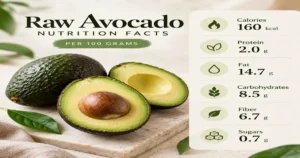
According to USDA FoodData Central, raw avocado contains approximately 160 calories per 100 grams. This reference allows you to calculate the calories in different portions accurately.
Calories in a Whole Small Avocado
The following table shows estimated calories based on different edible portion weights.
| Edible avocado weight | Calories |
|---|---|
| 40g | 64 kcal |
| 50g | 80 kcal |
| 60g | 96 kcal |
| 75g | 120 kcal |
| 80g | 128 kcal |
| 90g | 144 kcal |
| 100g | 160 kcal |
| 110g | 176 kcal |
For example, if your calories in small avocado contain 90 grams of edible flesh, it provides approximately 144 calories.
These calculations exclude the skin and pit because neither is normally consumed.
Why Do Calories in Small Avocados Differ?
Not every calories in small avocado contains the same amount of edible flesh. Several factors influence its total calorie content.
- Variety: Different avocado varieties have different physical characteristics and nutritional compositions.
- Pit size: A larger pit leaves less edible flesh.
- Skin thickness: Some varieties have thicker skins, which increase the fruit’s total weight without increasing the edible portion.
- Fruit size: Even fruits categorized as small can have noticeably different weights.
- Serving size: Eating the whole fruit provides more calories than eating half.
Measure the edible portion instead of relying on the fruit’s appearance.
1/2 Small Avocado Calories and Nutrition Facts
Half a small avocado generally contains 60–80 calories, assuming the whole fruit provides 75–100 grams of edible flesh.
It is a convenient portion for adding avocado to toast, salads, sandwiches, or breakfast meals.
Half Small Avocado Calories by Weight
| Whole avocado flesh | Half portion | Calories |
|---|---|---|
| 75g | 37.5g | 60 kcal |
| 80g | 40g | 64 kcal |
| 90g | 45g | 72 kcal |
| 100g | 50g | 80 kcal |
| 110g | 55g | 88 kcal |
1/2 Small Avocado Nutrition Facts
For a 45-gram serving, the estimated nutritional breakdown is:
| Nutrient | Amount |
|---|---|
| Calories | 72 kcal |
| Protein | 0.9g |
| Total fat | 6.6g |
| Saturated fat | 1g |
| Carbohydrates | 3.8g |
| Dietary fiber | 3g |
| Potassium | 218 mg |
| Vitamin C | 4.5 mg |
| Folate | 36 mcg |
These values are calculated using the USDA reference for raw avocado.
How Much Protein Is in Half a Small Avocado?
Half a small avocado weighing 45–50 grams provides approximately 0.9–1 gram of protein.
Although avocado contains protein, it is not considered a high-protein food. Most of its calories come from fat.
If you want to increase the protein content of your meal, combine avocado with eggs, Greek yogurt, chicken, cottage cheese, or beans.
For example, avocado toast with two eggs provides more protein than avocado toast alone.
Small Avocado Nutrition Facts: 100 g
Understanding the nutritional composition per 100 grams makes it easier to compare avocado portions and track your daily food intake.
According to USDA FoodData Central, raw avocado provides approximately 160 calories per 100 grams.
Complete Nutritional Breakdown
| Nutrient | Amount per 100 g |
|---|---|
| Calories | 160 kcal |
| Protein | 2g |
| Total fat | 14.7g |
| Saturated fat | 2.1g |
| Monounsaturated fat | 9.8g |
| Polyunsaturated fat | 1.8g |
| Carbohydrates | 8.5g |
| Dietary fiber | 6.7g |
| Total sugars | 0.7g |
| Potassium | 485 mg |
| Magnesium | 29mg |
| Calcium | 12mg |
| Iron | 0.55 mg |
| Vitamin C | 10mg |
| Vitamin E | 2.07 mg |
| Vitamin K | 21 mcg |
| Folate | 81 mcg |
Source: USDA FoodData Central, raw avocado, all commercial varieties. Values are rounded.
Why Is Avocado Relatively High in Calories?
Avocado contains more fat than most commonly eaten fruits.
Fat provides approximately 9 calories per gram, compared with 4 calories per gram from protein and carbohydrates.
Since 100 grams of avocado contains approximately 14.7 grams of fat, it provides more energy than fruits such as watermelon, strawberries, and bananas when compared by equal weight.
However, most of this fat is monounsaturated rather than saturated.
Does Avocado Contain Carbohydrates?
Yes. A 100-gram portion contains approximately 8.5 grams of total carbohydrates, including around 6.7 grams of dietary fiber.
This means a substantial proportion of its carbohydrates comes from fiber.
Avocado is therefore commonly included in lower-carbohydrate eating patterns. However, its fat content should still be considered when calculating total calories.
Health Benefits of Eating Small Avocados
Avocados provide several nutrients that contribute to normal body functions. Their nutritional value goes beyond their calorie content.
1. Provides Heart-Friendly Unsaturated Fats
Most of the fat in avocado comes from monounsaturated fatty acids, particularly oleic acid.
Replacing some foods high in saturated fats with sources of unsaturated fats can support a healthier dietary fat profile.
These fats are also found in olive oil, olives, and certain nuts.
2. Supports Digestive Health
Avocado provides approximately 6.7 grams of dietary fiber per 100 grams.
Fiber supports normal bowel function and contributes to digestive health.
Including fiber-rich foods such as vegetables, fruits, whole grains, legumes, and avocado can help increase overall dietary fiber intake.
3. Provides Potassium
A 100-gram serving contains approximately 485 milligrams of potassium.
Potassium is an essential mineral that supports normal muscle contraction, nerve signaling, and fluid balance.
It also contributes to maintaining healthy blood pressure as part of an appropriate dietary pattern.
4. Contains Folate and Vitamin K
Avocados provide folate, which is necessary for DNA synthesis and normal cell division.
They also contain vitamin K, which contributes to normal blood clotting and bone health.
These nutrients make avocado a useful addition to a varied diet.
5. Provides Vitamin E and Vitamin C
Vitamin E acts as an antioxidant that helps protect cells from oxidative damage.
Vitamin C supports normal immune function and collagen formation.
Avocados contain both vitamins, although their amounts are not as high as those found in certain fruits and vegetables.
Nutrition Note: Avocados are nutrient-dense foods, but they are not a replacement for a balanced diet. Their benefits are best considered alongside other vegetables, fruits, whole grains, and protein sources.
How Many Calories Are in a Medium Avocado?
A medium avocado is commonly estimated to contain approximately 240 calories, although the exact amount depends on its edible weight.
Harvard’s Nutrition Source also uses approximately 240 calories for a whole medium avocado.
Here is how different edible weights compare:
| Edible weight | Estimated calories |
|---|---|
| 75g | 120 kcal |
| 100g | 160 kcal |
| 125g | 200 kcal |
| 150g | 240 kcal |
| 175g | 280 kcal |
| 200g | 320 kcal |
Small vs. Medium Avocado Calories
Consider these illustrative serving sizes:
| Nutrient | Small avocado (90 g) | Medium avocado (150g) |
|---|---|---|
| Calories | 144 kcal | 240 kcal |
| Protein | 1.8g | 3g |
| Fat | 13.2g | 22.1g |
| Carbohydrates | 7.7g | 12.8g |
| Fiber | 6g | 10.1 g |
The difference comes primarily from the amount of edible flesh. These are calculated examples, not official size classifications.
Small Avocado vs. Banana vs. Egg: Calorie Comparison
Avocados, bananas, and eggs offer different nutritional benefits. Comparing their calories and protein can help you understand how they fit into everyday meals.
| Food | Serving size | Calories | Protein |
|---|---|---|---|
| Small avocado | 75g | 120 kcal | 1.5g |
| Half small avocado | 37.5g | 60 kcal | 0.75 g |
| Medium banana | 118g | 105 kcal | 1.3g |
| Large egg | 50g | 72 kcal | 6.3g |
| Avocado | 100g | 160 kcal | 2g |
Calories in Banana
A medium banana contains approximately 105 calories and 1.3 grams of protein.
Bananas provide carbohydrates, natural sugars, potassium, and dietary fiber. They are convenient snacks and can provide energy before physical activity.
Compared with avocado, bananas contain considerably less fat and more carbohydrates.
Calories in Egg
One large egg contains approximately 72 calories and 6.3 grams of protein.
Eggs are particularly useful for people looking to increase their protein intake. They also provide nutrients such as choline, selenium, and vitamin B12.
Which Food Is Better?
There is no single best choice because each food serves a different nutritional purpose.
Avocados provide unsaturated fats and fiber, bananas provide carbohydrates, and eggs offer more protein per serving.
Combining these foods can create balanced meals. For example, avocado toast with eggs provides a mixture of protein, fat, carbohydrates, and fiber.
Is Eating Avocado Good for Weight Management?
Avocado can fit into a weight-management eating pattern, but its calorie content should be considered.
It provides fiber and unsaturated fats, which contribute to meal composition and can help make meals more satisfying. However, it is relatively energy-dense compared with many other fruits.
Weight management depends on overall energy balance, food choices, physical activity, and consistency rather than one particular ingredient.
How Much Avocado Should You Eat?
There is no universal serving size for everyone. Your portion depends on your daily calorie requirements and the other ingredients in your meals.
Here are some practical examples:
- 25 grams: approximately 40 calories.
- 40 grams: approximately 64 calories.
- 50 grams: approximately 80 calories.
- 75 grams: approximately 120 calories.
- 100 grams: approximately 160 calories.
These portions make it easier to adjust avocado consumption without removing it completely from your diet.
Can You Eat Avocado Every Day?
For most people, avocado can be included regularly as part of a varied eating pattern.
The important consideration is portion size. Adding half an avocado to breakfast may be reasonable, while combining a whole avocado with several other calorie-dense ingredients can substantially increase the meal’s total energy content.
There is no nutritional requirement to eat avocado every day.
Does Eating Avocado at Night Cause Weight Gain?
Eating avocado in the evening does not automatically cause weight gain.
The body does not treat avocado calories differently simply because the fruit is consumed at night.
Overall energy intake over time is more important than the time of day you eat a particular ingredient.
How to Calculate Avocado Calories Accurately
A kitchen scale is one of the easiest ways to calculate calories accurately.
Follow these steps:
- Cut the avocado in half.
- Remove the pit and skin.
- Place the edible flesh on a kitchen scale.
- Record its weight in grams.
- Multiply the weight by 1.6.
Example:
If your avocado contains 85 grams of edible flesh:
85 × 1.6 = 136 calories.
The same formula works for smaller portions:
- 30g = 48 calories.
- 40g = 64 calories.
- 50g = 80 calories.
- 60g = 96 calories.
Remember to include additional ingredients when calculating the calories in avocado toast, salads, smoothies, or guacamole.
Olive oil, mayonnaise, cheese, bread, and dressings can increase the total calorie content.
Healthy Ways to Include Small Avocados in Your Diet
Avocados have a mild taste and creamy texture, making them suitable for different meals.
Avocado and egg toast: Spread 40–50 grams of mashed avocado over whole-grain toast and add one or two eggs. This combination provides protein, carbohydrates, fiber, and fats.
Chicken avocado salad: Combine grilled chicken, cucumber, tomatoes, lettuce, and sliced avocado. Chicken provides protein, while avocado adds fiber and unsaturated fats.
Avocado vegetable sandwich: Use mashed avocado as a spread with whole-grain bread, lettuce, cucumber, and tomatoes. Add chicken or eggs for additional protein.
Avocado and bean bowl: Combine black beans, corn, tomatoes, leafy greens, and avocado. Beans provide plant-based protein and fiber, creating a filling meal.
Avocado smoothie: Blend a measured amount of avocado with milk or yogurt and your preferred fruit. Remember that all added ingredients contribute to the total calories.
Calories in Small Avocado: What Do People Commonly Ask on Reddit?
People discussing food tracking on Reddit often have questions about avocado calorie estimates that differ between food diaries and online nutrition calculators.
One common issue is portion size. A person might assume that half an avocado always contains 80 calories, while another person may be eating a much larger half portion.
For example, 40 grams of avocado provides approximately 64 calories, while 60 grams provides 96 calories.
Another issue is whether the skin and pit are included in the weight. Since these parts are generally discarded, only the edible flesh should be counted.
Reddit discussions can offer practical experiences, but individual estimates are not standardized nutritional measurements. USDA FoodData Central is a more dependable reference for calculating the calories in a measured portion.
Plan Your Daily Nutrition With Fit4rEver
Understanding the calories in individual foods is useful, but knowing how they fit into your daily nutritional requirements is equally important.
For example, a small avocado may provide 120–160 calories, but that number alone does not tell you how much energy you need throughout the day.
Your calorie requirements depend on factors such as age, body weight, height, activity level, and personal goals.
Fit4rEver provides health, fitness, and nutrition resources that can help you understand these requirements.
Its calculators include:
- Calorie Calculator: Estimate your daily calorie requirements based on your personal information and goals.
- TDEE Calculator: Understand your estimated total daily energy expenditure.
- Macro Calculator: Calculate suitable protein, carbohydrate, and fat targets.
- Protein Calculator: Estimate your daily protein requirements based on your body weight and activity goals.
These tools can help you plan balanced meals and understand how foods such as avocado, eggs, bananas, and other ingredients contribute to your overall nutrition.
Explore Fit4rEver to access its health and fitness resources and make more informed decisions about your everyday eating habits.
Final Thoughts
A Calories in small avocado containing approximately 75–100 grams of edible flesh provides 120–160. Half of this amount generally contains 60–80 calories.
Beyond calories, avocado provides dietary fiber, potassium, folate, vitamins, and mostly monounsaturated fats.
Although it is more calorie-dense than many fruits, it can still be part of a balanced eating pattern. The most important factor is understanding portion size and considering the nutritional value of your complete meal.
For accurate calorie tracking, weigh the edible flesh after removing the skin and pit. Using approximately 160 calories per 100 grams provides a consistent starting point for calculating different portions.
Calories in Small Avocado: Frequently Asked Questions
1. How many calories are in one small avocado?
A calories in small avocado containing 75–100 grams of edible flesh provides approximately 120–160. The exact amount depends on its variety, pit size, and edible weight. Weighing the flesh provides a more accurate estimate than judging fruit size.
2. How many calories are in half a small avocado?
Half a small avocado generally contains 60–80 calories, depending on its weight. For example, a 45-gram portion provides approximately 72 calories, 0.9 grams of protein, and 3 grams of dietary fiber.
3. How much protein does half a small avocado contain?
Half a small avocado weighing approximately 45–50 grams provides around 0.9–1 gram of protein. Avocado is not a high-protein food, so pairing it with eggs, chicken, Greek yogurt, or beans can increase the protein content of your meal.
4. What are the nutrition facts for 100g of avocado?
Raw avocado provides approximately 160 calories, 2 grams of protein, 14.7 grams of fat, 8.5 grams of carbohydrates, and 6.7 grams of dietary fiber per 100 grams, according to USDA reference data.
5. How many calories are in a medium avocado?
A medium avocado is commonly estimated to contain approximately 240 calories. However, the actual amount depends on its edible flesh weight. Using 160 calories per 100 grams provides a more consistent calculation.
6. Are avocado calories higher than banana and egg calories?
Yes. Avocado contains approximately 160 calories per 100 grams, compared with around 89 calories in 100 grams of banana and 143 calories in 100 grams of raw whole egg. The foods also provide different amounts of protein, carbohydrates, and fat.
7. Is a small avocado good for weight loss?
A small avocado can fit into a weight-management eating pattern because it provides fiber and unsaturated fats. However, it is relatively calorie-dense. Portion control and overall energy balance remain important when managing body weight.
8. Are Reddit calorie estimates for small avocados reliable?
Reddit discussions can provide personal experiences with portion sizes and food tracking, but estimates vary between users. For more consistent nutritional information, use USDA FoodData Central values and calculate calories using the actual weight of edible avocado flesh.
Important Editorial Distinction: The calories in small avocado (120–160 calories) are a calculated range based on 75–100g of edible flesh, not an official USDA classification of small fruit.
