
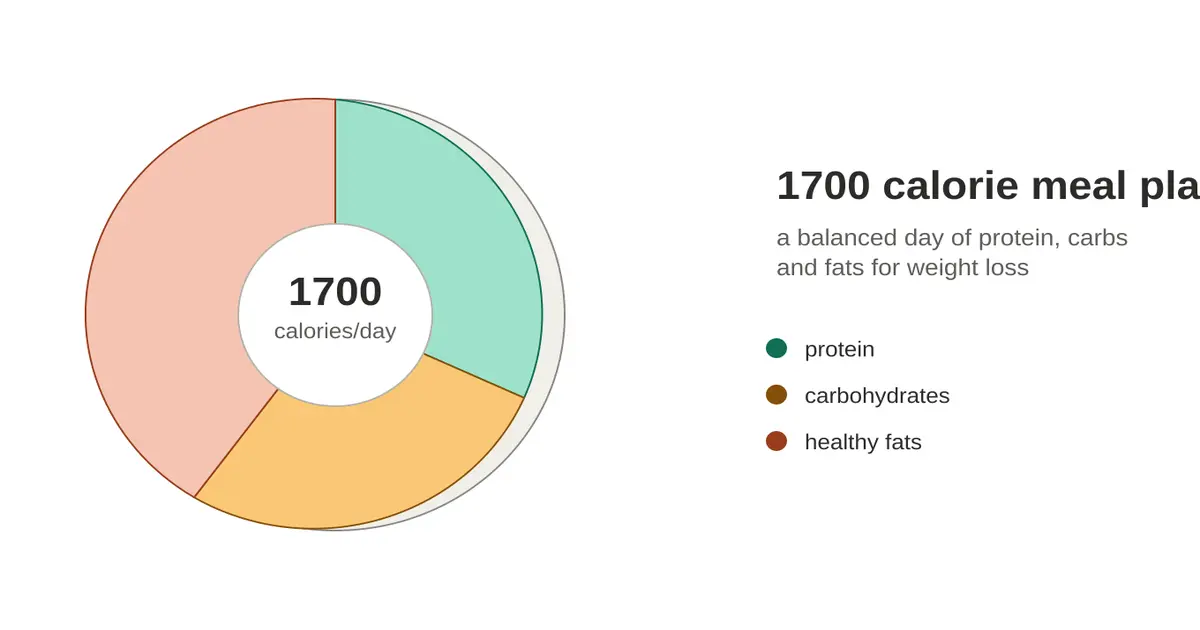
Most people don’t set out to count calories — they just want a plan that stops them from guessing what to eat every day. That’s usually the moment someone types “1700 calorie meal plan” into a search bar: not because the number itself is magic, but because they need somewhere concrete to start.
Here’s the part that rarely gets said outright:
“The number of calories your body needs isn’t something you copy from a stranger’s plan — it’s something your own height, weight, movement, and goals decide together.”
So the real question underneath “how many calories should I eat” is closer to: what does 1700 calories actually look like on a plate, and does it fit me specifically?
That answer shifts depending on your age, height, current weight, how much you move during the day, and whether you’re trying to shed weight, hold steady, or add muscle.
A 1700 calorie meal plan happens to be one of the more frequently searched targets online, largely because it sits in a workable middle ground for a lot of body types — though “popular” and “right for you” aren’t the same thing.
Unlike blanket advice such as “just eat less” or “cut out carbs,” a 1700 calorie meal plan gives you an actual number to build real meals around, which is far easier to follow than a vague instruction.
Here’s what this guide walks through:
How a 1700 calorie meal plan is actually built Whether 1700 is realistically enough for your body The difference between using it for fat loss versus simply maintaining A full sample day, plus a 3-day rotation so you’re not eating the same thing on repeat Which foods and hydration habits make it easier to stick with The warning signs that tell you it’s time to recalculate
Worth remembering: any calorie figure — including this one — is a starting estimate, not a verdict. Your metabolism, sleep, stress levels, and daily activity all push that number around, which is why we spend more time on the reasoning here than on the number itself.
[Featured image: illustrated plate divided into protein, carbohydrate, and fat portions with the text “1700 calorie meal plan” — alt text: “1700 calorie meal plan featured graphic showing balanced macros”]
Medical Disclaimer: This article is written for general education and isn’t a stand-in for individualized medical or nutrition advice. Talk to a doctor or registered dietitian before making a significant change to your diet, particularly if you’re managing an existing health condition.
What Is a 1700 Calorie Meal Plan?
Strip away the marketing language, and a 1700 calorie meal plan is just a day of eating that adds up to roughly 1,700 kilocalories. Nobody owns this number, and there’s no proprietary method hiding behind it.
What separates it from a generic diet is the layer of detail underneath. A 1700 calorie meal plan typically factors in:
Your baseline energy requirement How physically active your day actually is Whether the goal is losing fat, staying level, or gaining How protein, carbs, and fat are split across your meals
Someone who spends most of the day sitting and wants to lose weight might find 1700 calories works right out of the gate. Someone with a much more active routine might need to nudge that number up before it feels workable long-term.
A quick comparison:
Case 1 Age: 29 Weight: 65 kg Height: 165 cm Daily activity: Light movement, occasional walks Goal: Gradual fat loss
Case 2 Age: 34 Weight: 80 kg Height: 175 cm Daily activity: Structured workouts several times a week Goal: Hold current weight steady
Both of these people could technically land on “1700 calorie meal plan” as a search term, but their bodies burn energy at very different rates — which is exactly why the next section matters more than the meal plan itself.
Is 1700 Calories Enough for You?
Calorie needs aren’t one-size-fits-all, and a handful of variables decide what your personal number should really be.
1. Body size and composition
More body mass generally means more calories burned at rest, simply because there’s more tissue for the body to maintain and repair.
2. How active your days are
A person glued to a desk for eight hours a day has a completely different energy requirement than someone doing manual labor or training regularly.
3. What you’re actually trying to do
Losing weight, holding steady, and building muscle each demand a different calorie ceiling — even for the exact same person.
4. Age-related shifts in metabolism
Metabolic rate tends to slow gradually with age, which changes how many calories the body needs just to tick over.
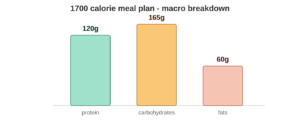
[Image: bar chart showing protein 120g, carbohydrates 165g, and fats 60g — alt text: “1700 calorie meal plan macronutrient breakdown chart”]
Two figures drive this calculation behind the scenes: Basal Metabolic Rate (BMR) — the energy your body burns doing absolutely nothing — and Total Daily Energy Expenditure (TDEE), which layers your movement and activity on top of that baseline. The CDC’s guidance on healthy weight loss points to a moderate, gradual deficit as the approach most likely to stick, compared with drastic cuts that tend to backfire. If you’ve never run either number, our BMR calculator and TDEE calculator will get you a far more accurate starting point than guesswork.
If you’re taller than average, highly active, pregnant, nursing, or working a physically demanding job, 1700 calories might simply run too low for your body. Needing more fuel isn’t a sign anything’s wrong — it’s just how your particular biology works.
How Does a 1700 Calorie Meal Plan Work?
Putting together a 1700 calorie meal plan properly comes down to three moving parts:
Work out your resting energy needs Layer in how much you move Land on a target that matches your goal
Step 1: Find your Basal Metabolic Rate (BMR)
BMR is the fuel your body spends just keeping the lights on — heartbeat, breathing, brain function, temperature regulation — all of it running even while you’re asleep.
This number is shaped by your age, height, weight, and sex. Rather than estimating it by hand, our BMR calculator will do the math for you.
Step 2: Factor in activity
Once BMR is set, the next layer is how much you actually move during a typical day.
| Activity Level | Description |
|---|---|
| Sedentary | Barely any structured exercise |
| Lightly Active | Everyday walking and normal chores |
| Moderately Active | Consistent, planned workouts |
| Very Active | Demanding physical work or heavy training |
This mirrors exactly what our TDEE calculator does — it takes BMR and layers your activity multiplier on top to estimate your true daily burn.
Step 3: Set the target
Last step: compare your TDEE against 1700. If your TDEE sits well above that figure, this plan likely puts you in a deficit suited for fat loss. If your TDEE is already hovering near 1700, this number functions more like a maintenance level for you.
1700 Calorie Meal Plan for Weight Loss: Finding the Right Balance
For a large share of people — particularly those who are less active or have a smaller frame — 1700 calories lands below their maintenance level, which is exactly what creates the deficit behind gradual weight loss. That’s the real reason 1700 calorie meal plan for weight loss shows up so often in searches from people just getting started.
Nobody talks enough about how uneven the timeline actually is. Some people see the scale move within two or three weeks. Others take considerably longer, especially if they’re coming down from a much higher intake, or dealing with poor sleep, stress, or shifting hormones.
Two levers matter most at this calorie level: protein and fiber. Protein keeps hunger in check for longer and helps hold onto muscle while you’re eating less. Fiber-heavy foods — vegetables, whole grains, legumes — bulk up your plate without adding many calories, which counts for a lot when your daily budget is tight.
Curious exactly how large your deficit is compared to maintenance? Our calorie deficit calculator does that math in under a minute. Not sure how much protein your body actually needs? Our protein intake calculator removes the guesswork there too.
Can You Lose Weight on 1700 Calories?
For many people, yes — but the outcome isn’t identical across the board.
Whether the scale actually moves comes down to a mix of things:
Total intake across the day The nutritional quality of what you’re eating How much you move Sleep quality Hormonal factors Genetics
Some people see weight drop off fairly naturally. Others hold steady until something else in their routine changes — more movement, better sleep, a bigger deficit. Neither outcome means something’s broken.
1700 Calorie Meal Plan to Lose Weight: How It Helps
Before overhauling your entire diet, a 1700 calorie meal plan gives you a clearer read on where you actually stand.
Say someone has been eating around 2,100–2,200 calories a day to hold their weight steady. Dropping to 1700 creates a moderate gap — enough to matter, without swinging into extreme restriction.
Rather than cutting further the moment progress feels slow, it’s worth figuring out first:
What your body’s real calorie requirement is What a sensible deficit actually looks like given your size and activity Whether the plan just needs small tweaks rather than a steeper cut
That approach tends to prevent the kind of over-restriction that backfires later.
Safe Weight Loss Tips While Following a 1700 Calorie Plan
If steady, lasting weight loss is the goal, a few habits make a real difference:
1. Build meals around nutrient-dense foods
Reach for foods that carry real nutritional weight — eggs, vegetables, fruit, whole grains, lean protein, and healthy fats — rather than empty-calorie fillers.
2. Don’t skimp on protein
Protein helps hang onto muscle, supports recovery, and keeps you satisfied after eating. Solid options: chicken, fish, eggs, lentils, beans, Greek yogurt, tofu. Findings summarized by Harvard T.H. Chan School of Public Health suggest that higher protein intake supports both fullness and lean mass retention during a calorie deficit.
3. Steer clear of extreme cuts
Dropping far below a moderate deficit tends to leave people drained, hungry, and unable to sustain the plan. 1700 calories is already a reasonable target — pushing lower usually isn’t necessary, and can be risky without medical guidance.
4. Layer in light movement
Once cleared by a healthcare provider, walking, light resistance work, stretching, or a structured routine all help. Small, repeatable habits tend to outlast dramatic overhauls.
Macronutrient Breakdown for a 1700 Calorie Diet
Calories set the ceiling; macronutrients decide how satisfied you feel while staying under it.
Our macro calculator can generate a breakdown tailored to your numbers, but here’s a reasonable starting split:
| Macronutrient | Grams (approx.) | Calories | % of Total |
|---|---|---|---|
| Protein | 110–130g | 440–520 | ~28% |
| Carbohydrates | 150–180g | 600–720 | ~40% |
| Fats | 55–65g | 495–585 | ~32% |
If holding onto muscle is a priority for you, shifting toward a 1700 calorie meal plan high protein approach — pushing past 130g of protein daily — outperforms the standard split above. Combine that with fiber-dense vegetables and legumes, and you get a 1700 calorie meal plan high protein high fiber setup that’s noticeably better at keeping hunger at bay on fewer calories.
Best Foods to Support a 1700 Calorie Meal Plan
The calorie total only tells half the story — what fills that total matters just as much.
Protein
Eggs bring high-quality protein plus a solid nutrient profile. Fish offers protein alongside beneficial fatty acids. Dairy — milk, yogurt, cheese — rounds out protein intake easily. Plant-based options like beans, lentils, chickpeas, tofu, and paneer work just as well.
Fats
Avocado supplies healthy fat and fiber together. Nuts and seeds — almonds, walnuts, chia, flax — pack nutrients into small portions. Olive oil is an easy, low-effort way to work healthy fat into meals.
Carbohydrates
Oats, brown rice, whole wheat bread, sweet potato, quinoa, and fruit all supply steady fuel for an active day.
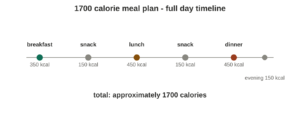
[Image: timeline graphic showing breakfast, snack, lunch, snack, dinner, evening snack with calorie counts adding to 1700 — alt text: “1700 calorie meal plan full day timeline”]
If your digestion is on the sensitive side, our low-fiber fruit guide can help you pick gentler options without sacrificing nutrition.
Hydration on a 1700 Calorie Meal Plan
A structured calorie plan often comes with noticeably higher thirst, especially once activity picks up. Staying hydrated matters for how you feel overall, though there’s no need to force fluids beyond what thirst tells you. Our water intake calculator can give you a target that’s actually personalized.
A few practical habits:
Keep water somewhere visible and within reach all day Drink in response to thirst rather than a strict schedule Lean on water-dense foods — fruit, vegetables, soups — to help along the way
Sample 1700 Calorie Meal Plan (Full Day Example)
Here’s what a realistic day looks like laid out meal by meal:
Breakfast: two eggs, one slice of whole grain toast, half an avocado (~350 calories) Mid-morning snack: Greek yogurt with a small handful of berries (~150 calories) Lunch: grilled chicken breast, brown rice, mixed vegetables, a drizzle of olive oil (~450 calories) Afternoon snack: a small apple with a tablespoon of peanut butter (~150 calories) Dinner: baked fish or lentils, sweet potato, steamed greens (~450 calories) Evening snack: a small bowl of cottage cheese or a handful of almonds (~150 calories)
Treat this as a template, not a script — everyone’s ideal version will look slightly different.
Sample 3-Day 1700 Calorie Meal Rotation
Repeating identical meals day after day gets tiresome fast, and boredom — not bad math — is usually what makes people abandon a plan. Here’s a 3-day rotation built to keep things interesting, and it works well as a 1700 calorie meal plan for weight loss because protein and fiber stay consistent across all three days.
Day 1 Breakfast: oatmeal with banana and a spoon of peanut butter Lunch: turkey or chickpea wrap with vegetables Dinner: grilled fish, quinoa, roasted vegetables Snacks: yogurt, a small handful of mixed nuts
Day 2 Breakfast: vegetable omelet with a slice of toast Lunch: lentil soup with a side salad Dinner: stir-fried tofu or chicken with brown rice Snacks: fruit, cottage cheese
Day 3 Breakfast: Greek yogurt with granola and berries Lunch: grilled chicken or paneer with mixed vegetables and rice Dinner: bean chili or fish curry with a small portion of rice Snacks: boiled eggs, a piece of fruit
This same rotation doubles as a 1700 calorie meal plan indian version, since dal, paneer, and rice slot naturally into each day without needing substitutions. Looking for a 1700 calorie meal plan indian vegetarian version specifically? Swap out animal protein for paneer, dal, chickpeas, and tofu, and pair legumes with rice or roti to round out the amino acid profile.
Signs You May Not Be Eating Enough
Your body tends to send signals before things go too far in the wrong direction. Watch for:
Ongoing tiredness that doesn’t lift A general sense of physical weakness Hunger that feels disproportionate to what you’ve eaten Trouble focusing on everyday tasks Noticeably low energy through the day
If any of this sounds familiar, it’s worth checking in with a qualified healthcare professional rather than pushing through.
1700 Calorie Meal Plan Formula Explained
Broken down simply:
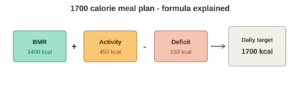
Daily Calories = BMR + Activity Adjustment + Goal Adjustment
Worked example:
BMR: 1,400 calories Activity adjustment: +450 calories Goal adjustment (deficit): −150 calories
Total: 1,400 + 450 − 150 = 1,700 calories
Treat this as an estimate, not a fixed rule — it shifts as your weight, activity, and goals shift.
1700 Calorie Meal Plan by Activity Level
How well 1700 calories fits you can change quite a bit depending on how active you are day to day.
Sedentary to lightly active: 1700 calories tends to work comfortably as an opening weight-loss target without feeling harsh.
Moderately active: many people in this bracket find 1700 calories sustainable for slow, steady fat loss — especially when protein stays on the higher end.
Very active: this figure can run low for people training hard or working physically demanding jobs, sometimes leading to fatigue or dips in performance. A higher target, mapped out with our TDEE calculator, is usually the better fit.
Frequently Asked Questions
Is 1700 calories good for weight loss? For a lot of moderately active adults — women especially — 1700 calories can create a manageable, sustainable deficit. Whether it’s right for you comes down to your current weight, height, and activity level.
Is 1700 calories enough for a man? It can work, especially for smaller-framed or less active men trying to lose weight. Taller or more active men may find it too low, leading to hunger or fatigue.
Can I build muscle while eating 1700 calories? Gaining noticeable muscle in a calorie deficit is tough for most people, though newer lifters sometimes see modest gains alongside fat loss. Keeping protein high and training with resistance helps protect the muscle you’ve already built.
How long should I stay on a 1700 calorie meal plan? There’s no set expiration date — it depends on your goal and how your body responds along the way. Check in every few weeks and adjust based on energy and progress, not an arbitrary deadline.
Do I have to track calories precisely? Not really. Plenty of people do fine tracking loosely and focusing more on portions and food quality than exact numbers. Go with whatever approach you’ll realistically maintain.
How We Calculate This 1700 Calorie Meal Plan
At Fit4Rever, our approach to building a plan like this factors in:
Your personal body measurements Your activity level Your specific nutrition goals How balanced the food choices are across each meal
This guide is meant for general education and isn’t a substitute for professional medical advice. For further reading, you can check the CDC’s healthy weight loss guidance or Harvard T.H. Chan School of Public Health’s protein research.
Before adjusting your daily intake, our TDEE calculator can help you pin down your real calorie range and shape a plan around your actual goals.
Final Thoughts: Making a 1700 Calorie Meal Plan Work for You
A 1700 calorie meal plan is a solid place to begin — but it’s a starting point, not a permanent fixture. Your body doesn’t operate on a fixed formula, and neither should your calorie target.
The approach most likely to stick combines a sensible calorie number with food you actually want to eat, shaped around your lifestyle and budget. Prioritize staying nourished, staying hydrated, and choosing foods that genuinely support what you’re working toward.
