
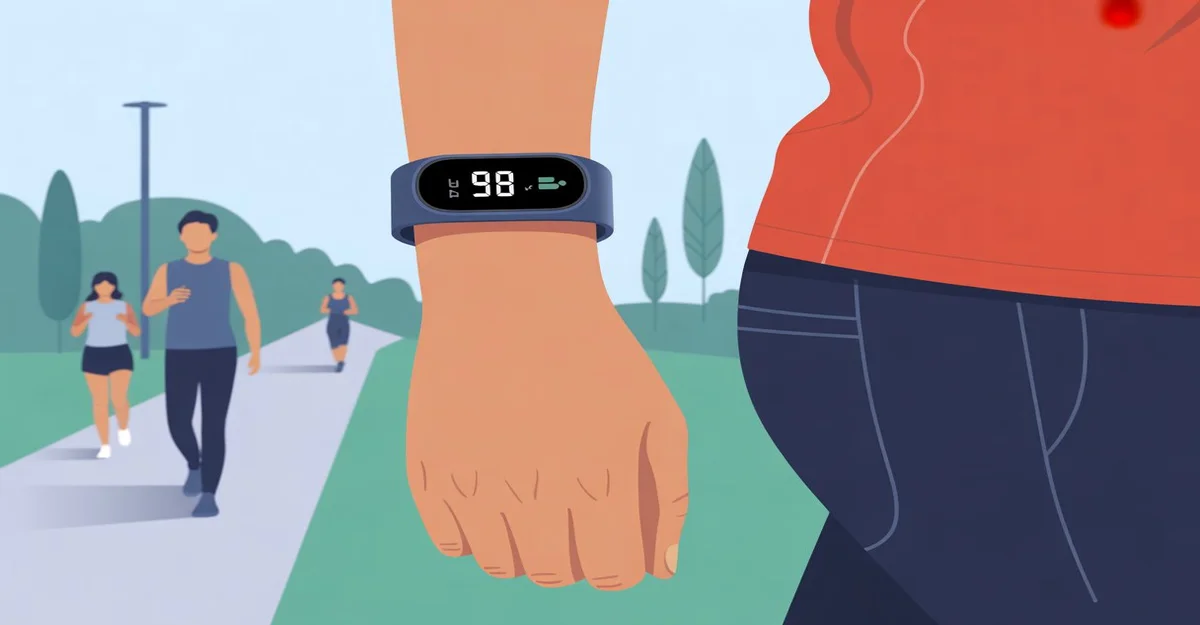
You’ve probably already read three other articles telling you to hit 10,000 steps. Maybe you tried it. Maybe you actually hit 10,000 for two straight weeks, stepped on the scale, and… nothing.
Not a pound. So now you’re here, wondering if the whole “just walk more” advice is a scam.
It’s not. But the number everyone throws around isn’t quite right either.
There’s no single step count that works for every body. There is, however, a number that works for yours – and finding it is way less complicated than the internet makes it sound.
That’s what this guide is actually for: not another generic “walk 10,000 steps” post, but a real answer to how many steps a day to lose weight naturally, based on where you’re starting from, your age, and what you’re actually trying to achieve.
One thing worth saying upfront – this is about the drug-free path. No GLP-1 medications, no fat burners, no 500-calorie soup cleanses.
Just walking and food, done consistently. If you’re on a medication like Ozempic or Wegovy and working with a doctor, most of what’s below still applies to you too – you’ll just want your calorie targets to come from your provider, not this article.
A quick personal note: I’ve tracked my own daily steps for over a year, through a desk job, a move to a walkable city, and everything in between – the ranges and advice in this guide come as much from that lived, day-to-day trial and error as they do from the research cited throughout.
Key Takeaways
- The short answer to how many steps a day to lose weight naturally is 7,000-10,000, paired with a modest calorie deficit – not from steps alone.
- The “10,000 steps” goal everyone quotes? It came from a 1965 ad campaign for a Japanese pedometer called manpo-kei, which literally means “10,000-step meter.” Not a study. A marketing slogan that stuck for 60 years.
- Steps work by burning extra calories – that’s really all they do. If you eat back what you burn, you’ve cancelled out the walk.
- One frequently cited analysis followed over 3,700 adults and found that people averaging 8,500 steps a day during a structured program lost close to 9 pounds in 8 months, and kept most of it off a year later while walking a slightly lower 8,200 steps daily.
- Terrain and pace can matter almost as much as the number itself. A brisk walk uphill can burn nearly double what a slow, flat stroll does – at the exact same step count.
How Many Steps a Day Do You Actually Need to Lose Weight Naturally?
Let’s kill the 10,000 myth first, because it’s honestly the reason so many people give up on walking altogether.
That number never came from a lab. It came from a Japanese company selling pedometers right before the 1964 Tokyo Olympics, and manpo-kei was just a catchy name.
Somehow it outlived the product, outlived the decade, and ended up baked into every fitness tracker default since.
What does actual research say? Here’s where it’s worth being precise: neither the World Health Organization nor the American Heart Association actually issue an official “steps per day” number – both frame their guidance in minutes.
The WHO recommends adults aged 18-64 get at least 150–300 minutes of moderate-intensity activity a week, and the AHA’s figure is the same 150 minutes weekly (about 30 minutes, five days a week).
Depending on your pace, that roughly translates to somewhere in the 7,000–8,000 step range daily – which is where a lot of “official step count” claims you’ll see online actually come from, even though it’s a translation, not a direct recommendation.
For weight loss specifically – which is really what you’re asking when you search how many steps a day to lose weight naturally – most of the useful studies land people somewhere in that 7,000–10,000 window, assuming their eating habits are also in check.
So if you’re stuck at 6,000 steps right now and feeling bad about it – don’t. That’s a completely reasonable place to start, not a failure.
Here’s the part that trips people up: steps don’t do anything magical to your metabolism. They burn calories. That’s the whole mechanism.
More movement means more calories out, which makes it easier to stay under your daily intake. Walk 10,000 steps and then treat yourself to a muffin you wouldn’t otherwise have eaten, and you’ve basically undone the walk.
Steps vs. Approximate Calories Burned (Average Adult, Moderate Pace)
| Daily Steps | Approx. Distance | Approx. Calories Burned | What This Typically Supports |
|---|---|---|---|
| 4,000–6,000 | 2–3 miles (3–5 km) | 100–200 kcal | A starting point — small but real |
| 6,000–8,000 | 3–4 miles (5–6.5 km) | 200–300 kcal | Meaningful support for a deficit |
| 8,000–10,000 | 4–5 miles (6.5–8 km) | 300–450 kcal | The sweet spot most research points to |
| 10,000–12,500 | 5–6 miles (8–10 km) | 450–550 kcal | Faster results, best built up gradually |
Keep in mind these numbers swing by roughly 30% depending on your body weight and pace.
A 200-lb person torches noticeably more calories per step than a 130-lb person walking the same route at the same speed – which is exactly why a flat “just walk 10,000 steps” recommendation fails so many people.
That’s the real, evidence-based answer to how many steps a day to lose weight naturally – not a flat, one-size-fits-all 10,000.
What “Naturally” Actually Means Here
If you added “naturally” to your search, you probably already know what you don’t want – a prescription, a subscription supplement, or another crash diet you’ll abandon in three weeks. Fair enough.
Walking for weight loss the natural way just means: no medication, no shortcuts, movement plus reasonable eating, and a bit of patience.
Worth knowing though – even people who are on weight-loss medication get told by their doctors to keep walking daily, because appetite suppression on its own doesn’t protect muscle mass or prevent regain once the prescription stops.
Movement earns its place either way. Doing it the natural route just means you’re covering both jobs — creating the deficit and protecting your muscle – through activity and food, with no chemical assist. Slower, probably. But nothing to wean off of, either.
One thing “natural” doesn’t mean, though: passive. You still need a real calorie deficit to actually do something.
Walking makes that deficit easier to hit and easier to stick to. It doesn’t replace it. That trade-off – patience over shortcuts – is really the core of how many steps a day to lose weight naturally, done right.
How Many Steps a Day to Lose Weight Naturally – Use This Calculator to Find Your Number
Forget picking a number out of thin air. If you’ve been searching for a how many steps a day to lose weight naturally calculator, this is that section – your current activity level should be the starting point, and this is honestly the step most other guides skip entirely – which is exactly why so many people jump straight from 3,000 steps to a 10,000 goal, burn out by Thursday, and decide walking “just doesn’t work for them.”
If you’d rather skip the mental math altogether, our free Walking Calories Calculator by Weight, Pace & Incline will spit out a target based on your weight, pace, and current activity level in about ten seconds.
If you also want to see how your food side of the equation lines up, our Calorie Calculator to Lose Weight guide walks through finding your real number there too.
Suggested Starting Targets by Current Activity Level
| Your Current Daily Steps | Recommended New Target | How Fast to Build |
|---|---|---|
| Under 3,000 (mostly sedentary) | 5,000 | Add 500–1,000 steps/week |
| 3,000–5,000 | 7,000 | Add 500–1,000 steps/week |
| 5,000–7,500 | 9,000 | Add 500 steps/week |
| 7,500+ | 10,000–12,000 | Add 500 steps/week, or add intensity instead |
Say you’re 34, work a desk job, and average around 4,200 steps a day – pretty normal for someone with a short commute and a lot of sitting. Jumping straight to 10,000 is a 138% increase overnight.
No wonder it feels impossible by day three. Aim for 7,000 first instead. Still a real stretch, but a doable one – and you can add more once it starts feeling easy instead of exhausting.
Want your exact number?
Try the free Walking Calories Calculator → it factors in your weight, pace, and incline in seconds.
The goal was never to nail some arbitrary number once. It’s hitting a sustainable one, most days, for months.
Steps to Lose Weight vs. Steps to Keep It Off
Here’s something almost nobody separates out clearly, and it genuinely changes how you should think about your target. This split is honestly one of the most overlooked parts of how many steps a day to lose weight naturally actually looks like in practice.
In that same research mentioned earlier, participants raised their walking from a baseline of roughly 7,200 steps a day up to about 8,500 during an 8-month active weight-loss phase – and lost close to 9 pounds doing it.
Once that structured phase ended, their average dipped slightly to around 8,200 steps a day over the next 10 months, and they still held onto about 7 pounds of the loss.
So your “losing” number and your “maintaining” number don’t have to match exactly. Push a bit harder now to create the deficit, and you can often ease off slightly later and still hold most of the result – as long as “easing off” means a small dip, not a full slide back to your old couch-and-commute baseline.
A Few Signs You’ve Quietly Shifted From Losing Mode Into Maintenance:
- Your weight’s been steady within a pound or two for three-plus weeks
- You’re eating roughly at maintenance calories, not a deficit
- Your energy feels stable instead of “pushing through” every walk
If that sounds like you and you’re happy with the number on the scale – good. That’s not a plateau. That’s the system doing exactly what it’s supposed to.
Does Walking Speed or Incline Matter More Than the Step Count Itself?
Yes – and it’s probably the single most underused lever in walking for weight loss.
A slow amble around the block and a brisk, purposeful walk can burn wildly different calorie totals for the exact same number of steps. Add a hill into the mix, and the gap gets even bigger.
One family physician put it well in an interview about step-count research: 8,500 steps for one person isn’t the same as 8,500 steps for another, because pace and terrain change how hard your body’s actually working the whole time.
Three Ways to Burn More Without Adding a Single Extra Step:
- Add incline.
Uphill walking, treadmill incline, hilly routes — any of these can nearly double your calorie burn compared to flat ground at the same pace.
- Pick up the pace.
A good benchmark: you should be able to talk, but not comfortably sing.
- Add a bit of resistance.
A weighted vest or a loaded backpack raises the effort per step. Skip this one if you’ve got joint issues — check with a doctor first.
Picture two people, both logging 8,000 steps today. One strolls flat and easy around the neighborhood. The other takes a hilly loop at a brisk clip.
The second person can easily burn 40–60% more calories on the identical walk – without the tracker ever knowing the difference.
This trick matters most if you’re short on time, or dealing with joints or mobility that make racking up extra steps genuinely hard. Intensity becomes your lever instead of volume.
It’s a reminder that intensity is the hidden variable in how many steps a day to lose weight naturally really requires — two people hitting the same number can get very different results.
Already Walking 10,000 Steps and Still Not Losing Weight?
This one’s common, and it’s rarely because “walking doesn’t work.” Usually it’s one of these:
Calorie creep.
It’s easy to eat an extra 200–300 calories on days you feel like you “earned it” — which can wipe out the entire deficit the walk just created.
Your body quietly compensates.
This is called NEAT (non-exercise activity thermogenesis) — you might unconsciously fidget less or move less throughout the rest of the day without noticing.
Water retention, not fat gain.
If you’ve recently ramped up your walking, some early weight stability is just water held during muscle repair. It usually settles within a week or two.
The deficit was never really there.
Nearly everyone who studies this agrees — exercise supports weight loss, but food intake is still doing most of the heavy lifting. If your eating hasn’t changed, steps alone might only move the needle a little, slowly.
Before Piling on More Steps, Check:
- Am I actually tracking food, or just estimating?
- Have I been consistent for at least 3–4 weeks — not just a good few days here and there?
- Am I sleeping enough? Poor sleep quietly raises hunger and can undercut a deficit fast.
- Is this week’s number just noise (water, hormones, digestion), not a real trend?
- Am I tracking anything besides the scale?
Still stuck after checking all five? The fix is almost always a small diet tweak, not another 2,000 steps. If you’re already active and still stuck, it’s worth revisiting how many steps a day to lose weight naturally actually requires versus what your plate is doing – our piece on why calculators alone don’t work covers exactly this kind of stall.
Working through a weight loss plateau can take some patience, but it’s usually a food-side fix, not a walking-side one – for the food-side details, see our Calorie Deficit Calculator.
How Long Before You Actually See Results?
Most people walking consistently, while paying some attention to food, start noticing small shifts – a bit more energy, clothes fitting slightly looser, maybe a pound or two – somewhere around 3 to 6 weeks. More visible changes tend to show up closer to the 8-12 week mark.
That timeline assumes consistency, not perfection. Hitting 9,000 steps five days a week and taking it easier the other two still counts as consistent.
Crushing 12,000 steps for four days and then doing almost nothing the rest of the week doesn’t — averages matter more than your best days.
Worth Tracking Besides the Scale:
- Waist measurement – often a better short-term fat-loss signal than the scale
- Resting heart rate – tends to improve within a few weeks of regular walking
- How your regular clothes fit
- Afternoon energy levels
Age-Specific Guidance (18-60)
Since this is written for a fairly wide range of readers, here’s roughly how the answer to how many steps a day to lose weight naturally shifts by decade:
18–29:
Usually the highest capacity for both volume and intensity. 10,000–12,500 steps, with some incline or pace thrown in, is realistic for most people here without much added risk.
30–45:
Often the busiest, most desk-bound stretch of adult life – the least walking naturally built into the day. A realistic, sticky target is 8,000–10,000 steps, with the emphasis on showing up daily rather than chasing a peak number.
46–60:
Joint-friendly pacing tends to beat pure speed here. 7,000–9,000 steps, using incline instead of a faster pace to add intensity, balances effectiveness against recovery. Got joint pain or arthritis? Check with a doctor before ramping up intensity.
Across every age bracket: if you’re managing a health condition, pregnant, or coming back from an injury, get individualized guidance before making a big activity jump.
If you’re unsure what a healthy target weight even looks like for your age and frame, our Ideal Weight Calculator is a useful starting reference alongside your step goal.
How Many Steps a Day to Lose Weight Naturally at Home (No Gym Needed)
Not everyone has time carved out for a dedicated walk, and depending on where you live, safe outdoor walking space isn’t always a given either.
The good news: you really don’t need a treadmill or a gym membership to hit these numbers. Small additions throughout your day at home add up faster than most people expect.
- Walk while you’re on phone calls instead of sitting through them
- Take the stairs instead of the elevator for anything three flights or fewer
- Pace around the kitchen while something’s cooking
- Walk laps of your living room or hallway during TV ad breaks
- Walk for 10 minutes after each meal — this also happens to help with blood sugar regulation
Three 10-minute walks after breakfast, lunch, and dinner add up to roughly 3,000–3,500 extra steps a day – enough to take most people from a sedentary 4,000 steps to a solid 7,000+, without ever “going for a walk” in the traditional sense, or leaving the house at all.
That’s really how many steps a day to lose weight naturally at home adds up — in small chunks, not one long walk.
Building This Into a Home Routine?
Sign up for our weekly guides → for practical, no-equipment ways to build these habits into your week.
FAQ
How many steps a day to lose weight naturally – is walking alone enough?
For most people, walking on its own produces a slow, small result. Paired with a modest calorie deficit, it turns into a genuinely sustainable tool — but food is still doing most of the heavy lifting.
How many steps a day to lose 1kg (2 lbs) a week?
That’s an ambitious weekly target for walking alone. It usually takes 10,000-12,500 steps a day plus a consistent calorie deficit through diet – steps by themselves rarely get you there. Our Calorie Deficit Calculator can show you what that deficit actually looks like day to day.
Can you lose belly fat by walking 10,000 steps a day?
Walking burns calories broadly, which can reduce fat across the whole body, midsection included, over time. There’s no way to spot-target belly fat through steps alone, unfortunately.
Curious how long a bigger goal like this realistically takes? Our piece on how long it takes to lose 100 pounds breaks down realistic timelines for larger weight-loss goals.
Is 5,000 steps a day enough to lose weight?
It’s a solid launch point, especially coming from a sedentary baseline. Probably not fast on its own, but paired with some attention to what you’re eating, it can absolutely contribute.
How many steps is 30 minutes of walking?
Roughly 3,000–4,000 steps for most people, depending on pace. Brisk walking often lands close to 100 steps a minute.
Do I need to walk fast to lose weight, or is distance enough?
Distance and duration drive most of the total calorie burn, but pace and incline squeeze more out of each individual step – handy if your time or step count is genuinely limited.
The Bottom Line
There’s no universal step count that guarantees weight loss, which is exactly why how many steps a day to lose weight naturally has to be personalized rather than borrowed from a slogan.
Anyone insisting it’s exactly 10,000 is quoting a 60-year-old ad campaign, not a study.
What actually works: pick a target a bit above your current baseline, build up gradually, pair it with a real (not extreme) calorie deficit, and give it more than a couple of weeks before deciding it isn’t working.
That’s really the whole answer to how many steps a day to lose weight naturally – start where you actually are, not where you think you should be, and let the number climb from there.
Sources
- World Health Organization -Global guidelines on physical activity for adults (18–64), framed in weekly minutes rather than steps
- American Heart Association — National Walking Day resources – Recommendations on weekly moderate activity and heart health
- American Heart Association (Go Red for Women) — the real origin of “10,000 steps” – covers the manpo-kei marketing origin and current step-count research
Medical Disclaimer:
This article is for educational purposes only and isn’t a substitute for personalized medical advice. Talk to a doctor before making significant changes to your activity level, especially if you have an existing health condition, are pregnant, or are recovering from an injury. See our full Health Disclaimer for more.
Ready to find your number for how many steps a day to lose weight naturally?
Use our free Walking Calories Calculator → — get a target based on your weight, pace, and activity level in under a minute.
Want help staying consistent?
Sign up for our weekly guides → and get practical routines delivered straight to your inbox.
Still stuck despite walking consistently? Read our piece on why calculators alone don’t work for the food-side fixes that usually solve it.
