
Is an 1800 calorie meal plan enough to lose weight without feeling hungry all day?
It depends, and that isn’t a dodge. Two people can eat the same 1,800 calories and get opposite results. One loses a steady pound a week. The other is exhausted by Wednesday or sees no change at all. The number isn’t the problem. The mismatch between the number and the person is.
This guide gives you a complete 1800 calorie meal plan with calories and macros for every day, plus swaps, a grocery list, and a plan for when the scale stalls. First, though, it helps you check whether 1,800 fits your body at all.
Quick answer: An 1800 calorie meal plan is an eating plan that adds up to about 1,800 calories a day, usually across three meals and one or two snacks. It causes weight loss only when 1,800 sits below your own maintenance calories, so check that first.
In this guide, you will learn:
- Whether 1,800 calories is right for you
- How to build a balanced 1800 calorie meal plan
- How to make it a high-protein 1,800-calorie meal plan
- A 7-day plan with calories and macros for every day
- Easy swaps for vegetarian, budget, and busy weeks
- An 1800 calorie meal plan with grocery list and meal prep routine
- How much weight you can realistically lose, and what to do when progress stalls
Important: Every number here is an estimate. Your real needs depend on your body, metabolism, and lifestyle. As we explain in why calculators alone don’t work, a number is a starting point, not the full picture.
What Is an 1800 Calorie Meal Plan?
An 1800 calorie meal plan is simply a way of eating that adds up to about 1,800 calories a day. No special foods, no powders required.
People choose it for three reasons. They want to lose weight, they’re tired of guessing portions, or they want a weekly structure, so they stop deciding what to eat at 6 p.m. when they’re starving.
What it isn’t is a universal “diet number.” Calories are a budget, and the right budget depends on who’s spending it.
1,800 calories of chicken, rice, and vegetables feels very different from 1,800 calories of pastries and soda, even though the maths matches. Protein, fiber, and food quality decide whether you feel full and energetic or shaky and irritable.
Is an 1800 Calorie Meal Plan Right for You?
Your body burns a certain number of calories every day. That’s your TDEE (total daily energy expenditure). Eat below it, and you lose weight. Eat around it, and you maintain. Eat above it, and you gain.
So the real question isn’t whether an 1800 calorie meal plan is “good.” It’s how far 1,800 sits from your TDEE. Here are four example profiles, calculated with the Mifflin-St Jeor equation and standard activity multipliers. They are illustrations, not real clients.
| Profile | Estimated TDEE | 1,800 vs TDEE | What it means |
|---|---|---|---|
| Man, 40, 80 kg (176 lb), 175 cm (5’9″), lightly active | ~2,335 | −535 | A moderate deficit. Around 0.5 kg (1 lb) a week is realistic. |
| Woman, 32, 70 kg (154 lb), 165 cm (5’5″), lightly active | ~1,940 | −140 | A tiny deficit. Progress will be slow. |
| Woman, 28, 58 kg (128 lb), 160 cm (5’3″), sedentary | ~1,535 | +265 | A surplus. She would likely hold or gain weight. |
| Man, 30, 95 kg (209 lb), 185 cm (6’1″), very active | ~3,380 | −1,580 | Far too low. Expect fatigue and rebound overeating. |
Same 1800 calorie meal plan, four completely different outcomes.
The Dietary Guidelines for Americans list typical adult needs by age, sex, and activity level (roughly 1,600 to 2,400 for women and 2,000 to 3,000 for men in the 2020 to 2025 edition), so your own number can sit almost anywhere.
An 1800 calorie meal plan is probably a good fit if:
- Your estimated TDEE is roughly 2,200 to 2,600
- You want gradual weight loss rather than a crash diet
- You’re generally healthy and not pregnant or breastfeeding
It may be off if:
- Your TDEE is under about 1,900 (you’d barely lose anything)
- Your TDEE is above about 3,000 (the gap is hard to sustain)
- You train hard most days
Not sure where you land? Start with our BMR calculator, move on to the TDEE calculator, and use the calorie deficit calculator to see how far 1,800 sits from your maintenance.
How to Build a Balanced 1800 Calorie Meal Plan
A simple calorie split keeps your 1800 calorie meal plan on track and stops you from eating 900 calories at dinner because you skimped all day:
- Breakfast: about 400 to 450
- Lunch: about 500 to 550
- Dinner: about 500 to 550
- Snacks: about 300 to 400
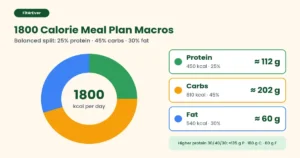
Two Macro Setups, With The Maths Shown:
| Approach | Protein | Carbs | Fat |
|---|---|---|---|
| Balanced (25% / 45% / 30%) | ~112 g | ~202 g | ~60 g |
| Higher protein (30% / 40% / 30%) | ~135 g | ~180 g | ~60 g |
Here’s how the first row works. 1,800 × 25% = 450 calories from protein, and protein has 4 calories per gram, so 450 ÷ 4 ≈ 112 g. Carbs also have 4 calories per gram, and fat has 9. Our macro calculator will tailor the split to you, and our guide on turning calories into grams shows how it looks on a plate.
Fiber: Aim for roughly 14 g per 1,000 calories, so about 25 g or more at this level. It’s one of the biggest reasons a plan feels filling or not.
Water: Drink regularly throughout the day. Our water intake calculator gives a personal target.
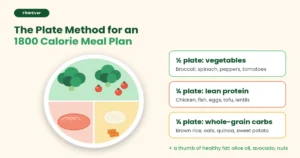
The plate method: Fill half your plate with vegetables, a quarter with protein, and a quarter with whole-grain carbs, then add a thumb of healthy fat such as olive oil or avocado. Do that, and you’re most of the way there without weighing anything.
1800-calorie-meal-plan-plate-method
High Protein 1800 Calorie Meal Plan: How to Hit 110 to 140 g
Protein is the most filling macro, and it protects muscle while you eat less. That’s why a high-protein 1800 calorie meal plan is the version most people find easiest to stick to.
A common target is 1.2 to 1.6 g per kg of body weight. For a 70 kg person, that’s about 84-112 g. The 7-day plan below lands between roughly 110 and 147 g a day, so it already works as a high-protein 1800 calorie meal plan.
If you searched for an 1800 calorie meal plan high in protein enough to keep you full, this is the version to follow. To push it higher:
- Swap the almond snack for 1 cup of shelled edamame (about 18 g protein, 190 calories).
- Add cottage cheese or two extra egg whites at breakfast.
- Replace one snack with a milk-based protein shake.
- Use Greek yogurt in place of sour cream, mayo, or creamy dressings.
Not sure what your own number should be? Our protein intake calculator gives a personal range.
7-Day 1800 Calorie Meal Plan
Here is your full 1800 calorie meal plan for the week. A few notes before you start:
- Weights are for cooked food unless stated. Measure a batch once, and you’ll know what “1 cup” of your rice looks like.
- Values are rounded estimates. Brands, cooking methods, and portion accuracy can shift them by 5 to 10%.
- Daily totals land between about 1,770 and 1,810 calories, an average of roughly 1,793.
- Prep-time tags show how easy each day is on a busy week.
Day 1 (Monday, 10-minute breakfast, batch-cook lunch)
- Breakfast (~375): Overnight oats yogurt bowl: 170 g (¾ cup) nonfat plain Greek yogurt, 40 g (½ cup) rolled oats stirred in the night before, 75 g (½ cup) blueberries, 14 g (about 12) chopped almonds
- Lunch (~560): Chicken rice bowl: 150 g (5 oz) chicken breast, 195 g (1 cup) brown rice, 1 cup steamed broccoli, 1 tsp olive oil
- Snack (~190): 1 medium apple and 1 tbsp peanut butter
- Dinner (~555): 150 g (5 oz) baked salmon, 200 g (7 oz) baked sweet potato, big green salad with 1 tsp olive oil and lemon
- Treat (~115): 20 g (¾ oz) dark chocolate
Total: ≈1,790 kcal | 125 g protein | 187 g carbs | 62 g fat
Day 2 (Tuesday, 15 minutes)
- Breakfast (~450): Veggie scramble: 2 eggs cooked in 1 tsp olive oil with spinach and tomato, 2 slices whole-wheat toast, ¼ avocado
- Lunch (~420): Tuna wrap: 1 can (about 115 g / 4 oz drained) tuna in water, 1 whole-wheat tortilla, 1 tbsp light mayo, lettuce, tomato, cucumber; 1 apple on the side
- Snack (~185): 170 g (¾ cup) low-fat cottage cheese with 150 g (1 cup) strawberries
- Dinner (~555): Turkey and lentil chili (batch-cook): 113 g (4 oz) lean ground turkey, ¾ cup cooked lentils, ½ cup tomato sauce, onion and peppers, 1 tsp olive oil, over ½ cup (100 g) brown rice
- Snack (~165): 28 g (1 oz, about 23) almonds
Total: ≈1,775 kcal | 125 g protein | 185 g carbs | 65 g fat
Day 3 (Wednesday, meat-free, 20 minutes)
- Breakfast (~420): Smoothie: 1 cup (240 ml) low-fat milk, 1 banana, 1 scoop (about 30 g) protein powder, 1 tbsp peanut butter
- Lunch (~485): Lentil soup: 1 cup (about 200 g) cooked lentils simmered with carrot, celery, onion, tomatoes, and 1 tsp olive oil; 1 slice whole-wheat bread; 28 g (1 oz) feta on top
- Snack (~200): 170 g (¾ cup) Greek yogurt and 1 pear
- Dinner (~585): Tofu stir-fry: 200 g (7 oz) extra-firm tofu, 2 cups mixed vegetables, 2 tsp oil, 1 tbsp soy sauce, 195 g (1 cup) cooked brown rice
- Snack (~80): 14 g (about 12) almonds
Total: ≈1,770 kcal | 117 g protein | 219 g carbs | 54 g fat
Day 4 (Thursday, 20 minutes)
- Breakfast (~445): Avocado egg toast: 2 slices whole-wheat bread, ¼ avocado mashed, 2 eggs; 1 orange
- Lunch (~560): Chicken burrito bowl: 120 g (4 oz) chicken, ½ cup black beans, 100 g (½ cup) brown rice, salsa, lettuce, peppers, 2 tbsp plain Greek yogurt instead of sour cream, ¼ avocado
- Snack (~215): 1 carrot cut into sticks with 3 tbsp hummus, plus 1 string cheese
- Dinner (~485): Shrimp pasta: 150 g (5 oz) cooked shrimp, 140 g (1 cup) whole-wheat pasta, 2 cups zucchini, tomato, and spinach, 2 tsp olive oil, garlic, 1 tbsp parmesan
- Snack (~80): 14 g (about 12) almonds
Total: ≈1,785 kcal | 139 g protein | 172 g carbs | 65 g fat
Day 5 (Friday, 15 minutes)
- Breakfast (~425): Peanut butter banana oatmeal: 40 g (½ cup) oats cooked in ¾ cup low-fat milk, 1 sliced banana, 1 tbsp peanut butter
- Lunch (~560): Chicken quinoa salad: 120 g (4 oz) chicken, 140 g (¾ cup) cooked quinoa, cucumber, tomato, red onion, greens, 28 g (1 oz) feta, 2 tsp olive oil and lemon
- Snack (~210): 1 apple and 28 g (1 oz) cheddar
- Dinner (~515): Turkey burger: 113 g (4 oz) lean turkey patty on a whole-wheat bun with lettuce, tomato, and mustard; 150 g (5 oz) sweet potato wedges roasted with 1 tsp olive oil; side salad
- Evening (~100): 1 cup (240 ml) low-fat milk
Total: ≈1,810 kcal | 111 g protein | 203 g carbs | 62 g fat
Day 6 (Saturday, 25 minutes)
- Breakfast (~470): Veggie omelette: 2 eggs plus 2 egg whites, mushrooms, peppers, onion, 20 g (¾ oz) cheddar, cooked in 1 tsp olive oil; 1 slice whole-wheat toast; 1 orange
- Lunch (~525): Chicken and chickpea pita: 1 whole-wheat pita, 100 g (3.5 oz) grilled chicken, ½ cup chickpeas, cucumber, tomato, lettuce, 3 tbsp yogurt-cucumber sauce
- Snack (~175): 3 cups air-popped popcorn and 1 string cheese
- Dinner (~480): Baked cod: 170 g (6 oz) cooked cod, 200 g (7 oz) potatoes roasted in 2 tsp olive oil, 1 cup green beans, lemon
- Dessert (~160): 100 g Greek yogurt, 75 g (½ cup) raspberries, 10 g dark chocolate shaved on top
Total: ≈1,810 kcal | 147 g protein | 189 g carbs | 51 g fat
Day 7 (Sunday, 30 minutes, meal-prep day)
- Breakfast (~475): Pancake brunch: 2 small whole-wheat pancakes, 150 g (⅔ cup) Greek yogurt on top, 100 g (⅔ cup) mixed berries, 1 tsp maple syrup; 2 hard-boiled eggs on the side
- Lunch (~515): Roast chicken plate: 150 g (5 oz) skinless roast chicken, 200 g (7 oz) roasted carrots and potatoes with 2 tsp olive oil, 1 cup steamed broccoli
- Snack (~195): 1 apple and 1 tbsp almond butter
- Dinner (~560): Turkey meatball pasta: 140 g (1 cup) whole-wheat pasta, 3 small turkey meatballs (about 100 g cooked), ½ cup marinara, roasted zucchini and eggplant, side salad with 2 tsp olive oil dressing
- Snack (~70): 2 clementines
Total: ≈1,810 kcal | 127 g protein | 199 g carbs | 58 g fat
That’s one full week of the 1800 calorie meal plan. Repeat it, or rotate days that suit you best.
1800 Calorie Meal Plan for Women vs Men
The 1800 calorie meal plan doesn’t know your gender. Your TDEE does. A smaller, less active person and a taller, more active person can follow the same structure but will need different portions.
- Need less than 1,800? Drop the treat and one snack (about 250 to 300 calories) and trim oil and grains slightly.
- Need more than 1,800? Add a banana with 1 tbsp peanut butter (about 200 calories) or an extra ½ cup of rice at lunch and dinner.
Remember the four profiles earlier. Men aren’t automatically the ones who need more, and women aren’t automatically the ones who need less. Check your own numbers first, then adjust.
Easy 1800 Calorie Meal Plan: Swaps for Busy Weeks, Vegetarian and Budget Needs
You shouldn’t need a culinary degree to follow this. Here’s how to keep it easy.
Busy weeks
- Ten-minute meals: eggs with toast and fruit, yogurt bowls, tuna wraps.
- Skinless rotisserie chicken, microwave rice, and a bagged salad make a fast dinner.
- Canned lentil soup plus a slice of bread is a real lunch.
Vegetarian and vegan
- Swap 150 g of chicken for 200 g extra-firm tofu (about 20 g protein) or ¾ cup lentils, and add a serving of Greek or soy yogurt to make up the protein.
- Use fortified soy milk instead of dairy milk.
- Tempeh, chickpeas and edamame all work as main proteins.
Budget-friendly
- Eggs, canned tuna, dried lentils and beans, oats, frozen vegetables and bananas cover most of your protein and fiber for very little money.
- Frozen fish fillets cost less than fresh and are just as nutritious.
Keep the flavors you love
The structure matters more than the cuisine. Keep portions, change the seasoning: lemon and oregano for Mediterranean, ginger and garlic for Asian-inspired, salsa and lime for Latin-inspired, or dal and curry spices for South Asian-inspired meals. If you’d rather have a roti than bread, one medium whole-wheat roti is roughly 100 calories.
1800 Calorie Meal Plan With Grocery List
This shopping list covers one person for one week of the 1800 calorie meal plan above.
- Proteins: chicken breast (about 900 g / 2 lb), salmon fillet (1), cod fillet (1), shrimp (about 200 g), lean ground turkey (about 360 g / ¾ lb), canned tuna (1), extra-firm tofu (200 g), eggs (10), cottage cheese (small tub), plain nonfat Greek yogurt (large tub, about 1 kg / 2 lb), string cheese (2), protein powder (optional)
- Dairy: low-fat milk (1 liter / 1 quart), cheddar, feta, parmesan
- Grains and starches: rolled oats, brown rice, quinoa, whole-wheat bread (1 loaf), tortilla, pita, bun, whole-wheat pasta (about 100 g dry), pancake mix, sweet potatoes (2), potatoes (3)
- Fruit: bananas (2), apples (3), oranges (2), pear (1), clementines (2), blueberries, strawberries, raspberries, mixed berries, avocado (1)
- Vegetables: spinach, lettuce, tomatoes, cucumber, bell peppers, onions, broccoli, zucchini, eggplant, mushrooms, green beans, carrots, celery, garlic, lemons, mixed stir-fry vegetables
- Legumes and cans: dried lentils (about 150 g), black beans, chickpeas, canned tomatoes or tomato sauce, marinara, hummus, salsa
- Fats and extras: olive oil, almonds (about 70 g), peanut butter, almond butter, dark chocolate, light mayo, soy sauce, popcorn kernels, maple syrup
Meal Prep Tips for the Week
An 1800 calorie meal plan is much easier when you prep ahead. You don’t need to cook every meal on Sunday, because ninety minutes covers most of it:
- Cook a big batch of brown rice and quinoa.
- Roast a sheet pan of vegetables.
- Bake the week’s chicken at once.
- Boil 6 eggs.
- Double the turkey and lentil chili and freeze half.
- Portion almonds into small containers so a “snack” doesn’t become a handful and a half.
Cool cooked food quickly, refrigerate within two hours, and eat it within three to four days, following USDA leftovers guidance. Freeze anything you won’t get to.
1800 Calorie Meal Plan for Weight Loss: How Much Can You Lose?
How much you lose on an 1800 calorie meal plan depends entirely on your deficit, so use your own numbers.
Take the earlier examples. The 40-year-old man has a 535-calorie daily deficit. Over a week that’s about 3,745 calories, and with the common rule of thumb of roughly 7,700 calories per kilogram (3,500 per pound), that’s about 0.5 kg (1 lb) a week. The 32-year-old woman has a 140-calorie deficit. That’s 980 calories a week, or roughly a quarter pound. She won’t see a change for a month, and that isn’t failure. It’s arithmetic.
The CDC notes that people who lose weight at a gradual, steady pace of about 1 to 2 pounds a week are more likely to keep it off. Treat the 7,700-calorie rule as an approximation, because as you lose weight, your body needs fewer calories and progress usually slows.
Expect the scale to lie, too. Water, sleep, salt, and hormones can swing your weight by a kilogram or more overnight. Judge progress by the two-to-three-week trend, and consider a tape measure or our body fat calculator for a fuller picture. For timelines, see how long it takes to lose significant weight.
How to Stay Full on an 1800 Calorie Meal Plan
Hunger is the number-one reason people quit any 1800 calorie meal plan. What actually helps:
- Protein at every meal. It’s the most filling macro.
- Eat your calories instead of drinking them. A medium orange has about 62 calories and fiber. A cup of orange juice has about 112 calories and almost no fiber.
- Add volume. Soup, salad, and roasted vegetables fill you up for very few calories.
- Don’t skip meals to “save” calories. It usually ends in a huge dinner.
- Sleep. Short sleep raises hunger and makes cravings louder.
What to Do If You Stop Losing Weight
If your 1800 calorie meal plan stops working, don’t cut calories again straight away. Check the usual suspects first:
- Oil and spreads. A tablespoon of olive oil is about 120 calories, and free-pouring can double it.
- Peanut butter. A heaped spoon can be a tablespoon and a half, about 140 calories.
- Weekends. An extra 300 calories on Saturday and Sunday erases 600 calories of your week. For someone with a 140-calorie daily deficit (980 a week), that’s more than half.
- Cooked vs. dry. Measuring rice or pasta dry but logging it cooked (or the reverse) throws the count off.
- Less movement. Steps often drop without you noticing when you eat less.
If your intake really is accurate:
- Recalculate. You’ve lost weight, so your TDEE has dropped. Recheck it after every 4 to 5 kg (about 10 lb).
- Add movement. Our walking calories calculator shows what a daily walk is worth.
- Take a maintenance break. One to two weeks at your TDEE can help with energy and adherence before you resume.
Going too low is the other trap, as our guide on whether 1,300 calories is enough explains.
Who Should Be Careful With an 1800 Calorie Meal Plan?
This plan isn’t right for everyone. Talk to a doctor or registered dietitian first if you:
- Are pregnant or breastfeeding. Your needs are higher, as our breastfeeding calorie calculator guide explains.
- Are under 18.
- Have diabetes, especially if you take insulin or medication that can cause low blood sugar. Eating less can mean your dose needs adjusting.
- Have a history of disordered eating.
- Are an athlete or very active, where 1,800 is often far too low.
- Have a medical condition or take medication that affects appetite or metabolism.
Frequently Asked Questions
Is an 1800 calorie meal plan enough?
For many adults, it’s comfortable, but it depends on size, age, and activity. Compare it to your TDEE. If it’s well below, you may feel tired. If it’s above, you won’t lose weight.
How much weight can I lose on an 1800 calorie meal plan for weight loss?
It depends on your deficit. A 500-calorie daily gap is roughly 0.5 kg (1 lb) a week, while a smaller gap is much slower.
Is an 1800 calorie meal plan good for women?
It can be, if it fits her maintenance needs. For some women it’s a solid deficit. For a smaller or sedentary woman, it might be at or above maintenance.
Can I build muscle on an 1800 calorie meal plan?
Sometimes. Beginners, people returning to training, and people with more body fat can often gain muscle in a moderate deficit with enough protein and resistance training. It gets much harder for lean, experienced lifters.
How much protein should I eat on a high-protein 1800 calorie meal plan?
A common target is 1.2 to 1.6 g per kg of body weight, which is roughly 25 to 30% of your calories, or 112 to 135 g a day.
Can I follow this 1800 calorie meal plan if I’m vegetarian?
Yes. Use the swaps above and watch your protein. Day 3 is already meat-free.
Should I count calories on an 1800 calorie meal plan?
Either works. Counting is more precise, while the plate method is easier to sustain. Try counting for two weeks to learn what portions look like, then decide.
How accurate is an easy 1800 calorie meal plan like this one?
Treat it as a strong estimate. Labels, cooking methods, and portion sizes all shift your real intake. Give it two to three weeks, look at the trend, then adjust.
How We Built This Plan (Our Method and Sources)
At Fit4rEver, every plan starts from energy needs rather than a round number. We estimate maintenance calories with the Mifflin-St Jeor equation, subtract a moderate deficit, split macros using standard ranges, and build meals from whole, widely available foods.
Nutrition values are rounded estimates, and each day lands within about 2% of 1,800 calories.
[EDIT: Confirm before publishing. Run each day through a nutrition tracker using USDA FoodData Central entries, fix any differences, and then keep this sentence. If you can add one line of real experience, such as how you tested or prepped this plan, add it here.]
This article is for education and does not replace medical advice. For official guidance, see:
- CDC: Steps for Losing Weight
- Dietary Guidelines for Americans
- NHS: Healthy weight
- USDA: Leftovers and food safety
Learn more about our standards on our About page.
Final Thoughts: Make Your 1800 Calorie Meal Plan Work
The best 1800 calorie meal plan is the one that fits your body and that you can actually stick to. Check your numbers first. Build balanced meals around protein, fiber, and real food. Be patient with the scale, and adjust based on results rather than guilt.
Every body is different, and a number is just a starting point.
Ready to make it yours? Start with our TDEE calculator to find your exact daily calories, then come back and adjust the portions in this 1800 calorie meal plan to match. You can also explore all our free fitness calculators.
