
Nobody types “reverse BMI formula” into Google for fun. You’re here because a number’s stuck in your head – a doctor mentioned a BMI cutoff before surgery, a coach handed you a weight class, or you decided on your own that 22 sounds like a solid target.
Whatever brought you here, you want one thing: the actual weight or height that number translates to, not another page explaining what BMI is for the hundredth time. So let’s skip the fluff and get into it.
What Is a “Reverse BMI” Formula?
There’s no separate reverse BMI equation hiding in a medical textbook somewhere – that would be convenient, but it doesn’t exist. It’s the same BMI formula everyone learns in school, just solved for a different variable.
The version you already know:
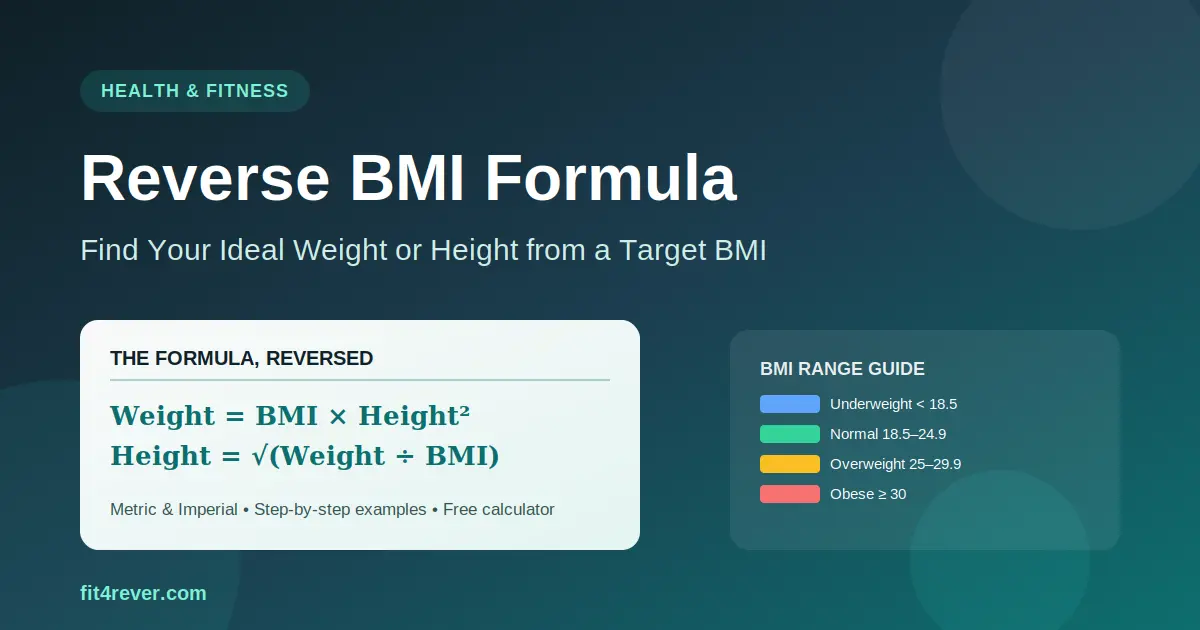
BMI = weight (kg) ÷ height (m)²
That equation tells you your BMI once you already have your weight and height. Handy, but backwards from what most people typing this phrase actually need. You know the BMI you’re aiming for. What you don’t know is the weight – or height – that gets you there. Flip the algebra around, and you get:
- Solving for weight: weight = BMI × height²
- Solving for height: height = √(weight ÷ BMI)
Two lines. That’s the entire reverse BMI formula – no proprietary trick, no hidden variable, just the same equation rearranged.
People rarely search for this out of curiosity. It’s usually tied to something concrete: a surgeon’s pre-op weight requirement, a wrestling weigh-in next month, a weight-loss goal with a real number attached, or a parent trying to make sense of a pediatrician’s growth chart.
We’ll walk through all of these later, because knowing why people reach for a reverse BMI calculation matters just as much as knowing the math.
If you want to check where you currently stand before working backward, run your numbers through our free reverse BMI calculator first.
The Reverse BMI Formula, Step by Step (Metric & Imperial)
Let’s actually do the math. Seeing it work builds much more trust than being handed a number with no explanation.
Metric: Solving for Weight
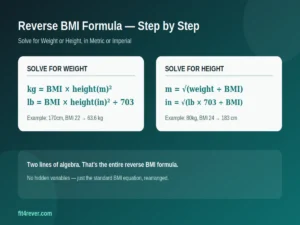
Formula: weight (kg) = BMI × height (m)²
Example: You’re 170 cm tall (1.70 m) and want a BMI of 22.
- Square your height: 1.70 × 1.70 = 2.89
- Multiply by your target BMI: 22 × 2.89 = 63.6 kg
At 170 cm, a BMI of 22 puts you at roughly 63.6 kg. That’s your number.
Metric: Solving for Height
Formula: height (m) = √(weight ÷ BMI)
Example: You weigh 80 kg and want to know what height would give you a BMI of 24.
- Divide weight by target BMI: 80 ÷ 24 = 3.33
- Take the square root: √3.33 = 1.83 m (about 183 cm)
This direction of the reverse BMI formula comes up less often, but it’s genuinely useful for tracking teen growth or just satisfying curiosity about the math.
Imperial: Solving for Weight
Since a lot of people searching for this reverse BMI formula are working in pounds and inches, here’s that version:
Formula: weight (lb) = (BMI × height (in)²) ÷ 703
Example: You’re 5’6″ (66 inches) and want a BMI of 25.
- Square your height: 66 × 66 = 4,356
- Multiply by BMI: 25 × 4,356 = 108,900
- Divide by 703: 108,900 ÷ 703 = ~154.9 lbs
At 5’6″, a BMI of 25 lands you right around 155 pounds.
Imperial: Solving for Height
Formula: height (in) = √((weight (lb) × 703) ÷ BMI)
Example: You weigh 180 lbs and want to know what height gives you a BMI of 23.
- Multiply weight by 703: 180 × 703 = 126,540
- Divide by BMI: 126,540 ÷ 23 = 5,501.7
- Take the square root: √5,501.7 = ~74.2 inches (about 6’2″)
A Real Example: Planning a Weight Cut the Right Way
Numbers on a page are one thing. Here’s how a reverse BMI calculation actually plays out for someone.
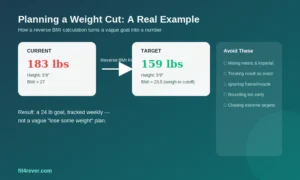
Say a friend of yours – let’s call him Bilal – is 5’9″ and just found out his upcoming amateur boxing bout has a weight-class cutoff that corresponds to a BMI of roughly 23.5. He’s currently sitting at a BMI of about 27. Instead of just “trying to lose weight” and hoping for the best, he runs the reverse BMI formula first.
At 5’9″ (69 inches), here’s what BMI 23.5 works out to:
weight = (23.5 × 69²) ÷ 703 = (23.5 × 4,761) ÷ 703 = 111,883.5 ÷ 703 ≈ 159 lbs
Bilal currently weighs about 183 lbs, and this is precisely the kind of gap a reverse BMI formula is built to close. So instead of a vague goal, he now has a concrete target: drop roughly 24 lbs before fight night.
That’s the difference a reverse BMI calculation makes: it turns “I should probably lose some weight” into “I need to be at 159 lbs by March 14th”, a target he can build a training and nutrition plan around, with weekly check-ins instead of guesswork.
This is exactly why coaches lean on the reverse BMI formula so heavily during competition prep – it removes the ambiguity that causes people to either crash-diet too aggressively near the deadline or coast without urgency until it’s too late.
Common Mistakes People Make With Reverse BMI Calculations
A few things trip people up when they start applying the reverse BMI formula on their own:
- Mixing metric and imperial mid-calculation. Using centimeters in the pounds formula (or inches in the kg formula) throws the whole number off. Pick one system and stick with it start to finish.
- Treating the result as an exact, non-negotiable number. A reverse BMI calculation gives you a target, not a law. Daily water weight, food in your stomach, and time of day can shift your scale weight by a couple of pounds regardless of your actual progress.
- Ignoring frame size and muscle mass entirely. Two people at the same height can have genuinely different healthy weights depending on bone structure and muscle. The formula doesn’t know the difference — you have to add that judgment yourself.
- Rounding too early. Rounding your height or BMI before finishing the calculation compounds the error. Keep decimals through the whole equation and round only at the final answer.
- Chasing an unrealistic BMI target. If your current BMI is 32 and someone tells you to reverse-calculate a target of 19, that’s an extreme cut that should involve a doctor, not just a formula and a deadline.
Reverse BMI Chart by Height (Common BMI Targets)
If you’d rather skip the math entirely, here’s a quick-reference reverse BMI formula chart showing target weight at common BMI values across a range of heights.
| Height | BMI 18.5 (lower normal) | BMI 22 (mid normal) | BMI 25 (overweight cutoff) | BMI 30 (obese cutoff) |
|---|---|---|---|---|
| 5’0″ (152 cm) | 94.6 lbs (42.9 kg) | 112.6 lbs (51.1 kg) | 128.0 lbs (58.1 kg) | 153.6 lbs (69.7 kg) |
| 5’4″ (163 cm) | 107.8 lbs (48.9 kg) | 128.3 lbs (58.2 kg) | 145.8 lbs (66.1 kg) | 175.0 lbs (79.4 kg) |
| 5’6″ (168 cm) | 114.6 lbs (52.0 kg) | 136.3 lbs (61.8 kg) | 154.9 lbs (70.3 kg) | 185.9 lbs (84.3 kg) |
| 5’8″ (173 cm) | 121.6 lbs (55.2 kg) | 144.7 lbs (65.6 kg) | 164.4 lbs (74.6 kg) | 197.3 lbs (89.5 kg) |
| 5’10” (178 cm) | 128.9 lbs (58.5 kg) | 153.3 lbs (69.5 kg) | 174.2 lbs (79.0 kg) | 209.1 lbs (94.8 kg) |
| 6’0″ (183 cm) | 136.4 lbs (61.9 kg) | 162.2 lbs (73.6 kg) | 184.4 lbs (83.6 kg) | 221.2 lbs (100.3 kg) |
| 6’2″ (188 cm) | 144.1 lbs (65.4 kg) | 171.4 lbs (77.8 kg) | 194.8 lbs (88.4 kg) | 233.8 lbs (106.0 kg) |
Bookmark this table if you don’t want to redo the calculation every time you’re curious about a different BMI target.
Real-World Use Cases for Reverse BMI Calculations
Knowing the reverse BMI formula is one thing. Knowing when people actually reach for it is what makes it click.
Athletes making weight. Wrestlers, boxers, and rowers deal with fixed weight classes on a fixed deadline, and this is where a reverse BMI calculation earns its keep – you saw exactly how that played out in Bilal’s example above.
Pre-surgery requirements. Some procedures – joint replacements, elective surgeries, bariatric pre-clearance – come with a BMI ceiling you need to be under before a surgeon will schedule you, which is a textbook reverse BMI formula scenario.
When your doctor says “get under a BMI of 35,” the reverse BMI formula tells you the actual weight that means for your height, instead of leaving you to guess.
Setting a real weight-loss goal. “I want to lose weight” doesn’t give you anything to track against. “I want to go from a BMI of 29 to a BMI of 24” does. Our guide on pacing a realistic weight-loss timeline goes into how to pace that kind of goal safely once you’ve got the target number.
Tracking teen growth. BMI for kids and teens works differently than for adults – it’s percentile-based rather than a fixed range – but parents and pediatricians sometimes use reverse calculations to get a rough sense of what weight range fits a healthy percentile during a growth spurt.
Visa, military, and job fitness standards. Certain military enlistment standards and a handful of job categories – firefighting, some law enforcement roles – include BMI or body composition requirements. Running the numbers ahead of time tells you exactly where you stand before you apply.
Reverse BMI vs. Other Ways to Find a Target Weight
The reverse BMI formula isn’t the only method for landing on a target weight, and it’s worth knowing how it stacks up against the alternatives.
Devine, Hamwi, and Robinson formulas were originally built for medical dosing calculations, not fitness goals, but they’re sometimes used as an alternative to the reverse BMI formula for “ideal body weight” estimates. They tend to produce lower numbers than reverse BMI for taller individuals and don’t adjust for frame size any better than BMI does.
Waist-to-height ratio skips weight entirely and instead asks whether your waist circumference is under half your height – a method some researchers argue predicts cardiovascular risk better than BMI does, though it doesn’t give you a single target weight the way a reverse BMI calculation does.
Body fat percentage targets (set through calipers, DEXA scans, or bioelectrical impedance) are the most individualized option since they measure composition rather than just mass, but they require equipment or a professional, whereas reverse BMI only needs a formula and a calculator.
In practice, most people start with the reverse BMI formula because it’s fast, requires no equipment, and gives an immediately usable number – then layer in body fat percentage or waist measurements later for a fuller picture.
Why Reverse BMI Isn’t a Perfect Target
Here’s an important gut-check before you treat any reverse BMI formula result as gospel: BMI was never designed to measure you specifically.
According to the Centers for Disease Control and Prevention, BMI is a population-level screening tool that correlates with body fat but doesn’t directly measure it – which is exactly why it can misclassify muscular or very lean individuals.
The formula can’t tell muscle from fat. A 200-pound bodybuilder at 5’10” might land in the “obese” BMI range on paper while carrying a fraction of the body fat of a sedentary person at the same BMI.
Age plays a role too – an older adult and a 25-year-old with identical BMIs can have very different amounts of muscle mass and very different actual health risks. The World Health Organization also points out that BMI ignores where fat sits on the body, which matters more for cardiovascular risk than the overall number does.
So hitting your reverse BMI target is a solid milestone, but it isn’t automatically the same thing as “healthy.” Pair it with other measurements for a fuller picture:
- Waist-to-hip ratio – a better indicator of where you’re carrying fat
- Waist-to-height ratio – an increasingly popular alternative to BMI
- Body fat percentage – via calipers, DEXA scan, or bioelectrical impedance scales. See our breakdown of why calculators alone don’t tell the whole story for how the methods compare.
None of this makes the reverse BMI formula useless – it’s still a solid starting point for goal-setting. Just don’t treat the number as the finish line on its own.
FAQs
Here are fast answers to the questions people ask most about the reverse BMI formula.
How do I calculate my weight from BMI?
Multiply your target BMI by your height in meters, squared: weight (kg) = BMI × height (m)². In pounds and inches, use weight (lb) = (BMI × height (in)²) ÷ 703.
What is the formula to reverse calculate BMI?
It depends on what you’re solving for. For weight: weight = BMI × height². For height: height = √(weight ÷ BMI). Both are the standard BMI formula rearranged algebraically — that’s the reverse BMI formula in either direction.
What weight is a BMI of 25 at my height?
It varies by height – check the chart above for common heights, or plug your own numbers into the formula: weight (lb) = (25 × height in inches²) ÷ 703.
Is reverse BMI accurate for muscular people?
Not really. BMI can’t distinguish muscle from fat in either direction, so muscular or very athletic people often land in “overweight” or “obese” BMI ranges despite low body fat. If that’s you, body fat percentage is a far more useful number than any reverse BMI calculation.
Does reverse BMI work the same for men and women?
The reverse BMI formula itself is identical for everyone – it’s purely height and weight. What differs is interpretation: women naturally carry a higher healthy body fat percentage than men at the same BMI, so two people with the same reverse BMI target can look and be built quite differently.
How often should I recalculate my target weight?
You don’t need to recalculate the reverse BMI formula itself – it stays the same as long as your height and target BMI haven’t changed. What’s worth revisiting is whether your target BMI still makes sense every few months, especially if your training or goals have shifted.
Can I use reverse BMI for kids or teenagers?
Not in the same way. Pediatric BMI is judged against age- and sex-specific percentile charts rather than the fixed adult ranges, so applying the reverse BMI formula directly can be misleading for anyone under 20. A pediatrician’s growth chart is the right tool there.
What’s a healthy BMI range?
For most adults, 18.5–24.9 is generally classified as the normal range by the CDC and WHO, and this is the range most people plug into the reverse BMI formula in the first place. That range doesn’t apply the same way to everyone, though – always factor in muscle mass, age, and overall health context rather than treating it as a strict rule.
This article is for informational purposes and isn’t a substitute for advice from a doctor or qualified health professional. If you have a specific medical BMI requirement, always confirm your target with your care team.
