
![How To Calculate Weight From BMI in 30 Seconds [Formula]](https://fit4rever.com/wp-content/uploads/2026/09/how-to-calculate-weight-from-bmi-featured.webp)
Your doctor says “aim for a BMI under 25.” Fine, but what does that actually weigh? At 5’10”, the top of healthy is about 174 lb. At 5’4″, it’s about 145 lb. Same BMI, very different weights, and here’s how to calculate weight from BMI for your own height in under a minute.
Most BMI calculators only run one way: weight and height in, BMI out. This guide flips that around.
You’ll learn how to calculate weight from BMI in kilograms and pounds, work through four real examples, and check your answer against a chart of healthy weights by height.
Want the answer right now? Use the BMI-to-weight calculator to get your number in seconds.
How to Calculate Weight From BMI: The Short Answer
Multiply your BMI by your height squared.
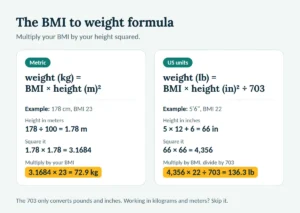
- Metric: weight (kg) = BMI × height (m) × height (m)
- US units: weight (lb) = BMI × height (in) × height (in) ÷ 703
Say you’re 5’10” (70 inches) and you’re aiming for a BMI of 22. That’s 22 × 70 × 70 ÷ 703, or about 153 lb (69.6 kg).
One catch when you’re learning how to calculate weight from BMI: you can’t skip your height. The same BMI can correspond to very different weights depending on how tall you are. BMI 22 is roughly 113 lb at 5’0″ but about 162 lb at 6’0″.
Why the Formula Works
BMI is weight divided by height squared. Flip that around, and you get weight = BMI × height squared. Once you see that, how to calculate weight from BMI stops being something you have to memorize.
The 703 only shows up in the US version. The original formula uses kilograms and meters, so 703 (technically 703.07) converts everything for pounds and inches. Working in metric? Ignore it.
How to Calculate Weight From BMI in Kilograms
Take someone who’s 178 cm and wants a BMI of 23.
- Convert height to meters by dividing by 100: 1.78 m.
- Square it: 1.78 × 1.78 = 3.1684.
- Multiply by the BMI: 3.1684 × 23 = 72.9 kg, or about 160.7 lb.
Want to double-check? Run it forward. That’s also how to calculate BMI from cm and kg: divide your weight in kilograms by your height in meters squared. 72.9 ÷ 3.1684 = 23. You got your starting BMI back, so the math holds.
How to Calculate Weight From BMI in Pounds
Now, a 5’6″ person is aiming for a BMI of 22.
- Height in inches: (5 × 12) + 6 = 66.
- Square it: 66 × 66 = 4,356.
- Multiply by the BMI: 4,356 × 22 = 95,832.
- Divide by 703: 95,832 ÷ 703 = 136.3 lb.
That’s about 61.8 kg. If you’re in the UK and think in stone, divide the pounds by 14 and you get 9 st 10 lb.
Real Examples of How to Calculate Weight From BMI
These people are made up, but the numbers are exactly what you’d work out for yourself.
“How much do I actually need to lose?” This is where how to calculate weight from BMI earns its keep. Say someone is 5’9″ and 215 lb. Their BMI is 703 × 215 ÷ 4,761 = 31.7, which the CDC calls class 1 obesity. Working backward gives two useful targets:
- BMI 29.9 (just under 30): 29.9 × 4,761 ÷ 703 = 202.5 lb, about 12.5 lb down
- BMI 24.9 (top of the healthy range): 24.9 × 4,761 ÷ 703 = 168.6 lb, about 46 lb down
Staring at a 46 lb gap is discouraging, so break it into stages. The first stop is only about 12.5 lb, under 6% of body weight. Losses in the 5-10% range are often linked to better blood pressure and blood sugar, so that first milestone counts for more than it looks.
“Am I underweight?”
Someone who’s 5’4″ and 100 lb has a BMI of 703 × 100 ÷ 4,096 = 17.2. The bottom of the healthy range at that height is 18.5 × 4,096 ÷ 703 = 107.8 lb, so they’re roughly 8 lb short. If the weight dropped without them trying, that’s worth a doctor’s visit, whatever a calculator says.
“The chart calls me overweight, but I lift.”
A 6’0″ lifter at 200 lb has a BMI of 27.1, which lands in “overweight.” Reaching the top of the healthy range (about 183.6 lb) would mean losing 16 lb, and a good chunk of that could come out of muscle. BMI can’t tell muscle from fat, and this is the situation where that limitation bites.
“Do these cutoffs even fit me?”
Anyone learning how to calculate weight from BMI should know the standard cutoffs were built mostly around people of European descent.
A 2004 WHO expert consultation found that Asian populations often face higher health risks at lower BMIs, and it flagged 23 as a public-health action point.
Some doctors and countries use it. At 5’6″, BMI 23 works out to 23 × 4,356 ÷ 703 = 142.5 lb, versus 154.3 lb at 24.9. One choice of cutoff moves the answer by about 12 lb, so ask your doctor which one they go by.
Healthy Weight Chart by Height
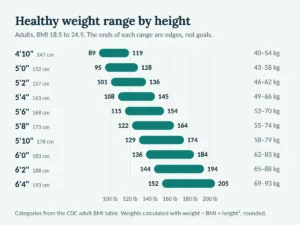
If you’d rather not work out how to calculate weight from BMI by hand, find your height below. These are the CDC’s healthy range for adults (BMI 18.5 to 24.9), rounded. The ends of each range are edges, not goals.
US Heights
| Height | Healthy range (lb) | Healthy range (kg) |
|---|---|---|
| 4’10” | 89–119 | 40–54 |
| 5’0″ | 95–128 | 43–58 |
| 5’2″ | 101–136 | 46–62 |
| 5’4″ | 108–145 | 49–66 |
| 5’6″ | 115–154 | 52–70 |
| 5’8″ | 122–164 | 55–74 |
| 5’10” | 129–174 | 58–79 |
| 6’0″ | 136–184 | 62–83 |
| 6’2″ | 144–194 | 65–88 |
| 6’4″ | 152–205 | 69–93 |
Metric Heights
| Height | Healthy range (kg) | Healthy range (lb) |
|---|---|---|
| 150 cm | 42–56 | 92–124 |
| 155 cm | 44–60 | 98–132 |
| 160 cm | 47–64 | 104–141 |
| 165 cm | 50–68 | 111–149 |
| 170 cm | 53–72 | 118–159 |
| 175 cm | 57–76 | 125–168 |
| 180 cm | 60–81 | 132–178 |
| 185 cm | 63–85 | 140–188 |
| 190 cm | 67–90 | 147–198 |
Between Heights? Use the BMI to weight calculator for an exact figure, or grab the printable height and weight chart (PDF).
Which BMI Number Should You Pick?
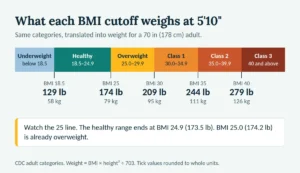
Before you run the formula, decide which BMI you’re solving for. That choice changes your answer more than any other step in how to calculate weight from BMI. Here are the CDC’s adult categories:
| BMI | Category |
|---|---|
| Below 18.5 | Underweight |
| 18.5–24.9 | Healthy weight |
| 25.0–29.9 | Overweight |
| 30.0–34.9 | Class 1 obesity |
| 35.0–39.9 | Class 2 obesity |
| 40.0 and above | Class 3 (severe) obesity |
Pick a range, not a single point. Plenty of people land on 22 or 23 because it feels safely in the middle, but there’s no rule that 22 is better than 24 for everyone.
Watch the upper boundary. Some calculators run the healthy range up to exactly 25, while the CDC and NHLBI end it at 24.9 and treat 25.0 as overweight.
At 5’10”, that’s the difference between 174.2 lb and 173.6 lb. If you want to sit clearly inside “healthy,” use 24.9 or a little lower.
Check which cutoffs apply to you (see the fourth example above), and don’t go below the range. You can plug BMI 17 into the formula and get an answer, but that doesn’t make it a healthy weight.
BMI Range vs. Ideal Body Weight Formulas
Learning how to calculate weight from BMI gives you a range. Ideal body weight formulas give you a single number, and you’ve probably met them if you’ve searched for an ideal body weight calculator. The Devine formula is one of the most common. For men, it’s 50 kg plus 2.3 kg for every inch over 5 feet, and for women it’s 45.5 kg plus 2.3 kg per inch. At 5’10”, that gives 73 kg (161 lb) for a man and 68.5 kg (151 lb) for a woman.
Both fall inside the 129-174 lb BMI range for that height, so the two methods agree pretty well here. Devine was originally developed for drug dosing, though, not for setting health goals, and it ignores frame and body composition. A BMI range is the more common reference for health.
If you want a single figure, pick a BMI inside the healthy range and run the formula. To skip the math, try our ideal body weight calculator.
Does Age Change the BMI Calculation?
Some BMI calculators in kg ask for your age. For adults 20 and over, age doesn’t change how to calculate weight from BMI, and the CDC categories stay the same at any age. What changes is what the number means, since the CDC notes that older adults tend to carry more body fat than younger adults at the same BMI.
Under 20 is a different story. Kids and teens need a different approach to how to calculate weight from BMI, because they’re judged by percentile for their age and sex.
The CDC’s categories are underweight below the 5th percentile, healthy from the 5th to below the 85th, overweight from the 85th to below the 95th, and obesity at the 95th or above.
Use the CDC’s child and teen BMI calculator or our BMI calculator for children and teens together with a pediatrician, not the adult table above.
Shortcuts: A Quick Weight Calculator for Your Phone or Spreadsheet
Once you know how to calculate weight from BMI by hand, your phone or a spreadsheet can do it in a second.
- Google or your phone: type
22 * 1.78^2and you’ll get 69.7 kg. - Spreadsheet: put your BMI in A1 and your height in meters in B1, then enter
=A1*B1^2. For US units, use height in inches and=A1*B1^2/703. - Our weight calculator: enter height and target BMI and get kg and lb straight away. Try the BMI to weight calculator.
Going the other way? Our BMI calculator turns weight and height into a BMI.
Common Mistakes When You Calculate Weight From BMI
Most errors in how to calculate weight from BMI come down to units and squaring.
- Using centimeters in the metric formula. Squaring 178 instead of 1.78 answers 10,000 times too big. Convert to meters first.
- Forgetting to square the height. Multiply BMI by height alone, and you get nonsense.
- Rounding height too early. 5’10” is 1.778 m. Round it to 1.8, and a BMI of 22 gives 71.3 kg instead of 69.6 kg, which is 1.7 kg off.
- Mixing units. Pounds with meters, or kilograms with inches, won’t work.
- Skipping the ÷703 in the US version.
How Far Can You Trust the Number?
Treat it as a rough screening tool. Even a perfectly worked example of how to calculate weight from BMI gives you an estimate, not a verdict.
As NHLBI points out, BMI is built on height and weight and doesn’t account for muscle mass, bone density, or body composition.
The CDC adds that women tend to carry more body fat than men at the same BMI, and that muscular people and athletes can have a higher BMI without excess fat.
Medicine seems to be heading in the same direction. In 2023, the American Medical Association adopted a policy describing BMI as an imperfect measure that should be used alongside other assessments.
A 2025 international commission in The Lancet Diabetes & Endocrinology also recommended pairing BMI with things like waist circumference or body fat.
A few easy add-ons:
- Waist-to-height ratio. Keep your waist under half your height. At 5’10” (70 in), that’s under 35 inches. Our waist-to-height ratio calculator does the math.
- Body fat percentage, if you can get a DEXA scan or a decent smart scale.
- Blood pressure, blood sugar, and cholesterol. These tell you more about your health than any single number.
Learning how to calculate weight from BMI is the easy part. Deciding what the number means for your body is where your doctor comes in.
If you’re pregnant, skip BMI targets. Your care team will use your pre-pregnancy BMI to guide how much weight gain makes sense. Planning a weight change? A calorie deficit calculator can help you estimate a realistic pace.
FAQ
How to calculate weight from BMI?
Weight (kg) = BMI × height (m)². In pounds and inches: weight (lb) = BMI × height (in)² ÷ 703.
How to calculate weight from BMI without knowing your height?
You can’t. The same BMI corresponds to different weights at different heights, so you need both.
How can I calculate my ideal weight using my BMI?
Pick a BMI inside the healthy range (18.5-24.9) and multiply it by your height squared. At 5’6″, a BMI of 22 gives about 136 lb. Think of the result as one point in a range, not a fixed target.
What weight is a BMI of 25 for my height?
Multiply 25 by your height squared. At 5’8″, that’s 25 × 4,624 ÷ 703 = 164.4 lb. Remember that 25.0 is the first overweight value, so the top of “healthy” sits just below it.
What’s a good BMI to aim for?
For most adults, anything from 18.5 to 24.9 counts as healthy. There’s no single best number inside that range.
Is BMI 22 a good target?
It sits comfortably mid-range for many adults, but it isn’t magic. Body composition, age, and ethnicity all affect what’s right for you.
The Bottom Line
The short version of how to calculate weight from BMI: multiply your BMI by your height squared, and divide by 703 if you’re working in pounds and inches. Aim for a range instead of one magic number, and sanity-check it against your waist measurement and what your doctor sees.
One more thing. If chasing a number starts taking over your thoughts, talk to a doctor or counselor. In the US, the NIMH eating disorders page is a decent place to start.
Still not sure how to calculate weight from BMI for your height? Enter your height and target BMI and we’ll do the math. Use the BMI to weight calculator
This article is for general information and isn’t medical advice.
