
Breastfeeding is a special stage of life where your body is doing two important jobs at the same time: recovering after pregnancy and creating nutritious milk for your baby.
Because milk production requires energy, many mothers wonder:
“Your body is doing extra work every day to produce breast milk, which means your nutrition needs change during breastfeeding.”
“How many calories do I need while breastfeeding?”
The answer depends on your individual body and lifestyle. Your calorie needs can change based on factors like your age, height, weight, activity level, breastfeeding frequency, and whether your goal is maintaining weight or losing postpartum weight.
A breastfeeding calorie calculator helps estimate your daily calorie requirements by combining your basic energy needs with the extra calories your body uses during lactation.
Unlike a regular calorie intake calculator, this tool considers the additional energy needed for breastfeeding, making it more suitable for nursing mothers.
Whether you are a new mother trying to understand your nutrition needs, returning to exercise after childbirth, or working toward healthy weight management, knowing your estimated calorie requirements can help you make better food choices.
In this guide, you will learn:
- How a breastfeeding calorie calculator works
- How many calories breastfeeding may burn
- How many calories you need while nursing
- How to support breastfeeding with proper nutrition
- How to approach postpartum weight loss safely
Important: A calculator provides an estimate. Your actual calorie needs may vary depending on your health, metabolism, milk production, and lifestyle — as we explain in why calculators alone don’t work, a number is only a starting point, not the full picture.
What Is a Breastfeeding Calorie Calculator?
A breastfeeding calorie calculator is an online tool that estimates how many calories your body may need each day while producing breast milk.
During breastfeeding, your body uses energy to create milk and support your baby’s nutritional needs. This means your calorie requirements may be higher compared with before pregnancy.
A standard calorie calculator usually looks at:
- Age
- Height
- Weight
- Activity level
However, a breastfeeding-specific calculator also considers:
- Breastfeeding status
- Milk production demands
- Feeding frequency
- Personal goals
For example, a mother who exclusively breastfeeds a newborn may need a different amount of energy compared with a mother who breastfeeds occasionally and also uses formula.
Example:
Mother A
- Age: 28 years
- Weight: 65 kg
- Height: 165 cm
- Activity: Light exercise
- Breastfeeding: Exclusive
Her calorie needs will not be the same as:
Mother B
- Age: 35 years
- Weight: 80 kg
- Height: 175 cm
- Activity: Regular workouts
- Breastfeeding: Combination feeding
Even though both mothers are breastfeeding, their bodies require different amounts of energy.
Why Does Breastfeeding Increase Calorie Needs?
Producing breast milk is a complex biological process that requires energy.
Your body uses calories for:
- Milk production
- Hormone regulation
- Recovery after childbirth
- Maintaining your own energy levels
Breastfeeding mothers often experience changes in:
- Appetite
- Thirst
- Energy levels
- Body weight
Some mothers feel hungrier than usual, while others notice gradual weight changes without making major diet changes.
The goal is not simply to eat more calories. The goal is to provide your body with enough energy and nutrients to support both you and your baby. According to the CDC’s guidance on maternal diet and breastfeeding, well-nourished breastfeeding mothers generally need an additional 330 to 400 kilocalories per day compared with their pre-pregnancy intake, though the exact amount depends on age, body mass index, activity level, and feeding pattern.
Factors That Affect Breastfeeding Calorie Needs
Every breastfeeding mother has different calorie requirements. Several factors influence your daily needs.
1. Baby’s Age
A newborn usually feeds more frequently compared with an older baby.
During the early months:
- Feeding sessions may be frequent
- Milk production is often higher
- Energy demands may be greater
As your baby grows and begins eating solid foods, breastfeeding patterns may gradually change.
2. Breastfeeding Frequency
The number of daily feeding sessions can affect your calorie requirements. For example, a mother feeding her baby multiple times throughout the day may have different needs compared with someone who breastfeeds only occasionally.
3. Exclusive vs Combination Feeding
Your breastfeeding method also matters.
Exclusive Breastfeeding — The baby receives only breast milk. The body usually produces more milk, which may require more energy.
Combination Feeding — The baby receives both breast milk and formula. The energy demand may be different because breast milk production may be lower.
4. Your Activity Level
Your lifestyle also affects calorie needs.
A mother who works from home, walks occasionally, and performs normal household tasks may have different needs from a mother who exercises regularly, has a physically active job, or trains intensely.
How Does a Breastfeeding Calorie Calculator Work?
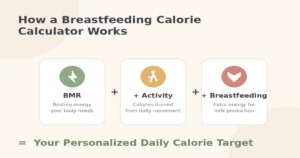
A breastfeeding calorie calculator estimates your daily calorie needs through three main steps:
- Calculate your resting calorie needs
- Adjust for daily activity
- Add breastfeeding energy requirements
Step 1: Calculate Your Basal Metabolic Rate (BMR)
Your Basal Metabolic Rate (BMR) is the number of calories your body needs to perform basic functions while resting.
Your body burns calories even when you are sleeping because it needs energy for:
- Heart function
- Breathing
- Brain activity
- Body temperature control
BMR depends on:
- Age
- Height
- Weight
- Biological sex
For example, a person with a larger body size usually requires more calories at rest compared with someone with a smaller body size.
You can also use our BMR calculator to understand your resting calorie needs.
Step 2: Add Your Activity Level
After calculating BMR, the calculator adjusts the result based on your daily movement.
Common activity categories include:
| Activity Level | Description |
|---|---|
| Sedentary | Minimal exercise |
| Lightly Active | Walking and normal activities |
| Moderately Active | Regular exercise |
| Very Active | Heavy exercise or physical work |
For example, a breastfeeding mother who spends most of the day caring for her baby at home may have different energy needs compared with someone who works out regularly.
Your activity level helps create a more realistic calorie estimate. This step follows the same logic as our TDEE calculator, which combines BMR with activity to estimate total daily energy needs.
Step 3: Add Breastfeeding Calories
The final step is adding the energy required for producing breast milk.
Breastfeeding requires extra energy because your body is creating nutrition for your baby every day.
The additional requirement depends on:
- Milk supply
- Feeding frequency
- Baby’s age
- Breastfeeding type
This is why a breastfeeding calorie calculator can be more useful than a general calorie calculator for nursing mothers.
How Many Calories Does Breastfeeding Burn?
One of the most common questions new mothers ask is: “How many calories does breastfeeding burn?”
Breastfeeding requires energy because your body is producing milk every day. Estimates from the NICHD and the CDC put the additional need at roughly 330 to 500 extra calories per day for most breastfeeding mothers, although the exact amount depends on individual factors.
The calories used during breastfeeding can vary based on:
- Amount of milk produced
- Baby’s age
- Number of feeding sessions
- Exclusive breastfeeding or combination feeding
- Your own metabolism
For example, a mother exclusively breastfeeding a 2-month-old baby may have different energy needs compared with a mother breastfeeding a 10-month-old baby who also provides solid foods.
Breastfeeding should not be viewed as a guaranteed weight-loss method. Some mothers lose weight while nursing, while others maintain weight because of increased hunger, hormonal changes, reduced sleep, or lifestyle changes after childbirth.
The most important goal is supporting your body with enough nutrients and energy.
Breastfeeding Calorie Calculator for Weight Loss: Finding the Right Balance
Many mothers search for a breastfeeding calorie calculator for weight loss because they want to understand how many calories they need while gradually losing postpartum weight.
A calorie calculator can help you estimate:
- Your maintenance calories
- Your breastfeeding calorie needs
- A realistic calorie range for your goals
However, postpartum weight loss should be approached carefully.
Your body has gone through:
- Pregnancy changes
- Childbirth recovery
- Hormonal adjustments
- Sleep disruption
Instead of making extreme calorie cuts, focus on creating healthy habits. You can also use our calorie deficit calculator to find a realistic, gradual number to work toward.
Can You Lose Weight While Breastfeeding?
Yes, some women lose weight while breastfeeding, but results are different for everyone.
Breastfeeding can increase energy expenditure, but weight changes depend on many factors, including:
- Total calorie intake
- Food quality
- Physical activity
- Sleep patterns
- Hormones
- Genetics
Some mothers notice weight loss naturally, while others may maintain weight until breastfeeding decreases. Both situations can be normal. If you’re mapping out a longer-term goal, our article on how long it takes to lose significant weight can help you set realistic expectations.
Breastfeeding Calorie Calculator to Lose Weight: How It Helps
A breastfeeding calorie calculator to lose weight can help mothers understand their estimated calorie needs before making dietary changes.
For example, before breastfeeding, a woman may maintain her weight at around 2,000 calories daily. During breastfeeding, her body may require additional energy.
Instead of immediately reducing calories, she can first understand:
- How many calories her body needs
- How much energy breastfeeding requires
- What a realistic calorie deficit looks like
This approach helps avoid unnecessary restriction.
Safe Weight Loss Tips While Breastfeeding
If your goal is postpartum weight management, consider these strategies:
1. Focus on Nutrient-Dense Foods
Choose foods that provide vitamins, minerals, and energy, such as eggs, vegetables, fruits, whole grains, lean proteins, and healthy fats.
2. Include Enough Protein
Protein supports muscle maintenance, recovery, and fullness after meals.
Good protein choices: chicken, fish, eggs, lentils, beans, Greek yogurt, tofu.
You can also use our protein intake calculator to estimate your daily protein requirement, then use our guide on turning calories into grams to translate that into actual food portions.
3. Avoid Extreme Diets
Very low-calorie diets may leave you feeling tired, hungry, or low on energy — see if 1,300 calories is enough for your body and why going too low can backfire. Breastfeeding mothers need enough fuel for daily activities and recovery.
4. Add Gentle Movement
After getting approval from your healthcare provider, many mothers begin with walking, light strength exercises, stretching, or postpartum fitness routines. If walking is your starting point, check our walking calories calculator by weight, pace, and incline and our guide on how many steps a day to lose weight naturally. Small, consistent steps are usually easier to maintain.
Breastfeeding Calorie Calculator Free: How to Use It
Many mothers look for a free breastfeeding calorie calculator tool because they want a quick estimate without paying for expensive programs. Our free breastfeeding calorie calculator can help you understand your approximate daily calorie range.
To get a more accurate result, enter:
Your Age — Age affects metabolism and calorie requirements.
Your Current Weight — Use your current weight rather than your pregnancy weight.
Your Height — Height helps estimate your resting calorie needs.
Your Activity Level — Choose the option closest to your daily routine.
Breastfeeding Type — Select: exclusive breastfeeding, combination feeding, or pumping.
Your Goal — Choose: maintain weight, lose weight, or gain weight.
Best Foods to Support Breastfeeding Nutrition
Calories are only one part of breastfeeding nutrition. The quality of your food choices also matters.
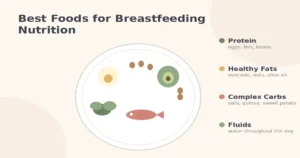
A balanced breastfeeding diet should include:
- Protein
- Healthy fats
- Complex carbohydrates
- Vitamins and minerals
- Enough fluids
Not sure how to split these up? Our macro calculator can help you find a personalized protein, fat, and carb breakdown.
Protein Foods for Breastfeeding Mothers
Protein helps your body recover and supports overall health. Good options include:
- Eggs — provide high-quality protein and important nutrients.
- Fish — can provide protein and beneficial fatty acids; choose options considered safe during breastfeeding.
- Dairy products — milk, yogurt, cheese.
- Plant-based proteins — beans, lentils, chickpeas, tofu.
Healthy Fats for Breastfeeding
Healthy fats provide energy and support overall nutrition.
- Avocado — contains healthy fats and fiber.
- Nuts and seeds — almonds, walnuts, chia seeds, flax seeds.
- Olive oil — a simple way to add healthy fats to meals.
Healthy Carbohydrates for Energy
Carbohydrates provide fuel for busy days with a newborn: oats, brown rice, whole wheat bread, sweet potatoes, quinoa, fruits. If digestion is sensitive postpartum, our list of best low-fiber fruit picks can help you choose gentler options.
Hydration During Breastfeeding
Many breastfeeding mothers notice increased thirst. According to the CDC, staying adequately hydrated supports overall well-being during lactation, though there’s no need to force extra fluids beyond thirst. Use our water intake calculator to get a personalized daily target.
Simple tips:
- Keep water near your feeding area
- Drink when thirsty
- Include water-rich foods like fruits, vegetables, and soups
Sample Breastfeeding Meal Plan
Here is an example of a balanced day:
Breakfast: Oatmeal with berries, Greek yogurt, nuts;
Lunch: Grilled chicken, brown rice, vegetables, olive oil dressing;
Snack: Fruit, peanut butter, smoothie;
Dinner: Salmon or beans, sweet potato, salad;
Evening Snack: Yogurt or whole grain toast
This is only an example. Individual nutrition needs vary.
Signs You May Not Be Eating Enough While Breastfeeding
Your body may give signals when it needs more energy. Possible signs include:
- Constant tiredness
- Feeling weak
- Extreme hunger
- Difficulty concentrating
- Low energy during daily activities
If you have concerns about nutrition, milk supply, or postpartum recovery, speak with a qualified healthcare professional.
Breastfeeding Calorie Calculator Formula Explained
A simple explanation:
Daily Calories = BMR + Activity Level Adjustment + Breastfeeding Energy Needs
Example:
A mother has:
- BMR: 1,400 calories
- Activity: 450 calories
- Breastfeeding adjustment: 350 calories
Estimated daily needs: 1,400 + 450 + 350 = 2,200 calories
This number is an estimate, not a fixed requirement. Your needs can change as your baby grows. Try the breastfeeding calorie calculator to get your own personalized number.
Breastfeeding Calorie Calculator by Baby Age
Your calorie needs may change as your breastfeeding journey continues.
0–3 Months: Feeding is often frequent, milk production may be higher, and energy demands can be significant.
3–6 Months: Many babies continue breastfeeding regularly. Mothers may notice changes in appetite, sleep patterns, and activity levels.
6–12 Months: As babies begin eating solid foods, breastfeeding patterns may change, and milk intake may gradually decrease. Your calorie needs may also adjust.
Frequently Asked Questions About Breastfeeding Calories
How many calories should I eat while breastfeeding? Your calorie needs depend on your body size, activity level, breastfeeding frequency, and goals. A breastfeeding calorie calculator can provide an estimate based on your information.
Does breastfeeding burn calories? Yes, breastfeeding requires energy because your body produces milk. The amount varies between individuals.
Can breastfeeding help with weight loss? Breastfeeding may contribute to calorie use, but weight changes depend on diet, activity, hormones, and lifestyle.
Is there a breastfeeding calorie calculator for weight loss free? Yes, many online calculators — including ours – provide free estimates to help mothers understand their calorie needs while breastfeeding.
How accurate is a breastfeeding calorie calculator? A calculator provides an estimate. Your actual needs may vary depending on your body, metabolism, milk supply, and health conditions.
Should I count calories while breastfeeding? Some mothers find calorie tracking helpful, while others prefer focusing on balanced meals and hunger signals. Choose the approach that works best for your lifestyle.
How We Calculate Breastfeeding Calories
At Fit4Rever, our calculator is designed to provide an estimated calorie range based on:
- Personal body measurements
- Activity level
- Breastfeeding status
- Nutrition goals
The calculator is intended for educational purposes and should not replace professional medical advice. For official dietary guidance, you can also refer to the CDC’s maternal diet and breastfeeding page or NICHD’s breastfeeding calorie guidance.
Before making changes to your daily food intake, you can use a breastfeeding calorie calculator to understand your estimated calorie range and create a nutrition plan that fits your breastfeeding goals.
Final Thoughts: Understand Your Nutrition With a Breastfeeding Calorie Calculator
Breastfeeding requires energy, patience, and proper nutrition.
A breastfeeding calorie calculator can help you understand your estimated daily calorie needs while nursing and make more informed decisions about your nutrition.
Whether your goal is maintaining weight, improving energy levels, or managing postpartum weight loss, understanding your calorie requirements is a helpful first step.
Remember that every mother’s journey is different. Focus on nourishing your body, staying hydrated, and choosing healthy foods that support both you and your baby. You can also explore our full collection of free fitness calculators to support the rest of your health journey.
Try our breastfeeding calorie calculator to understand your daily energy needs while supporting your breastfeeding journey.
