
Low calorie high volume foods fix the problem that ruins most diets: Hunger.
Not mild hunger. The growling, fridge-raiding kind that shows up at 10 pm and wins every time. Willpower can’t beat that for long. A bigger plate can.
Here’s the idea. Some foods take up a lot of room and cost very little. Others pack huge calories into a tiny bite. 100 calories of grapes fill a cup. 100 calories of raisins are a small handful.
This guide covers the 30 best low calorie high volume foods, easy swaps, high volume low calorie meals for weight loss, snacks, and the mistakes that trip people up.
The short list: cucumber, celery, zucchini, mushrooms, cabbage, strawberries, watermelon, boiled potatoes, egg whites, and broth-based soup. If you only remember ten low calorie high volume foods, remember those.
Calorie numbers are rounded and approximate, in line with USDA FoodData Central listings. This is general information, not medical advice. If you have a health condition, are pregnant, or take medication, talk to your doctor or a dietitian first, and read our health disclaimer.
What Are Low Calorie High Volume Foods?
Low-calorie, high-volume foods have low energy density, which means fewer calories per gram. Most of their weight is water, fiber, or air. Think cucumber, strawberries, mushrooms, and boiled potatoes. The opposite is oil, nuts, cheese, and chips.
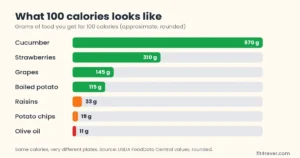
Here’s what 100 calories looks like:
| Food | Amount for 100 calories |
|---|---|
| Cucumber | About 670 g (two to three cucumbers) |
| Strawberries | About 310 g (around 2 cups) |
| Grapes | About 145 g (1 cup) |
| Boiled potato | About 115 g (a small potato) |
| Raisins | About 33 g (a small handful) |
| Potato chips | About 19 g (a dozen chips) |
| Olive oil | About 11 g (under a tablespoon) |
The goal isn’t to eat less. It’s to eat more food for the same calories.
What Is the Highest Volume, Lowest Calorie Food?
By weight, celery and iceberg lettuce sit at the top, with cucumber right behind. All three have roughly 14 to 15 calories per 100 g, so 100 calories gets you about 700 g.
The lightest food isn’t always the most filling, though. The best low calorie high volume foods mix very light ones for size with protein-rich ones like egg whites and nonfat Greek yogurt for staying power.
Why Low Calorie High Volume Foods Keep You Full
Your stomach reacts to how much is in it, not to calories. Fiber and protein slow digestion, so the full feeling lasts. Three studies show it well.
In a 1995 satiety study, people ate 240-calorie portions of 38 foods. Boiled potatoes scored 323% of white bread’s fullness. A croissant scored 47%. It measured short-term fullness over two hours.
In a Penn State soup study of 60 adults, a low-calorie soup before lunch cut total meal calories by about 20%, soup included. And in another study, a whole apple before lunch cut meal calories by about 15%, more than applesauce or juice.
Honest take: low calorie high volume foods won’t make you lose weight on their own. They make a calorie deficit easier to live with. That’s the whole job, and it’s a big one.
Low Calorie Food List for Weight Loss: 30 Best High Volume Picks
Here’s a low-calorie food list for weight loss, sorted by category. The numbers are rounded from USDA FoodData Central. “Grams per 100 calories” shows how much food you get. Bigger number, bigger portion.
Vegetables
Vegetables are the backbone of any list of low calorie high volume foods.
| Food | Grams per 100 calories | Why it’s useful |
|---|---|---|
| Celery | 710 | Pure crunch |
| Cucumber | 670 | Almost all water |
| Zucchini | 590 | Bulks up pasta and eggs |
| Tomatoes | 555 | Raw, roasted or in sauce |
| Mushrooms | 455 | Meaty texture |
| Spinach | 435 | Shrinks, so add handfuls |
| Cauliflower | 400 | Rice, mash or roasted |
| Cabbage | 400 | Cheap and long-lasting |
| Red bell pepper | 385 | Sweet and crunchy |
Our pick if you only buy three: zucchini, mushrooms, and cabbage.
Fruit
Fruit is the sweetest of the low calorie high volume foods.
| Food | Grams per 100 calories | Why it’s useful |
|---|---|---|
| Watermelon | 330 | Best fix for a sweet craving |
| Strawberries | 310 | A cup costs under 55 calories |
| Grapefruit | 310 | Tart, but interacts with some drugs |
| Orange | 205 | Peeling slows you down |
| Apple | 190 | Crunchy, skin has fiber |
| Raspberries | 190 | High in fiber |
| Blueberries | 175 | Great in yogurt or oats |
Smart starches
The right starches are low calorie high volume foods too.
| Food | Grams per 100 calories | Why it’s useful |
|---|---|---|
| Spaghetti squash | 370 | Pasta stand-in |
| Oats, cooked in water | 140 | Twice the food of pasta |
| Boiled potato | 115 | Star of the satiety study |
| Baked sweet potato | 110 | Sweet and filling |
| Air-popped popcorn | 26 (about 3 cups) | Airy, so a big bowl stays cheap |
| White rice, cooked | 77 | Fine, just less volume |
| Pasta, cooked | 63 | Mix it with vegetables |
Lean protein
Protein is the piece most lists of low calorie high volume foods forget. Without it, volume wears off fast.
| Food | Grams per 100 calories | Why it’s useful |
|---|---|---|
| Egg whites | 190 | Fluffy, almost fat-free |
| Nonfat Greek yogurt | 170 | Dessert or dressing |
| Cottage cheese (1%) | 140 | Creamy, good with fruit |
| Light tuna in water | 115 | Cheap and quick |
| Shrimp, cooked | 100 | Lean and fast |
| Cod, cooked | 95 | Mild, bakes in minutes |
| Chicken breast, roasted | 60 | Lean, less volume |
Soup deserves a mention too. A cup of clear broth has roughly 10 to 15 calories, and a big bowl of vegetable soup lands between 80 and 150. It’s one of the most underrated low calorie high volume foods. Lentils (85 g per 100 calories), chickpeas (60 g), and tofu (70 g) add plant protein and fiber.
Easy Swaps That Save Calories Without Shrinking Your Plate
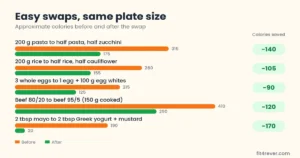
Swapping dense ingredients for low calorie high volume foods is where the real savings are. You don’t need a new diet.
| Swap | Before | After | Saved (about) |
|---|---|---|---|
| 200 g cooked pasta | 315 calories | 100 g pasta + 100 g zucchini: 175 | 140 |
| 200 g cooked rice | 260 calories | 100 g rice + 100 g cauliflower: 155 | 105 |
| 3 whole eggs | 215 calories | 1 egg + 100 g egg whites: 125 | 90 |
| 150 g beef, 80/20 | 410 calories | 150 g beef, 95/5: 290 | 120 |
| 2 tbsp mayo in tuna salad | 190 calories | 2 tbsp Greek yogurt and mustard: 20 | 170 |
One rule: swap half, not all. Half pasta and half zucchini is still a bowl of pasta, so you’ll stick with it.
High Volume Low Calorie Meals for Weight Loss: A Full Day of Eating
High volume low calorie meals for weight loss don’t need fancy recipes. Four to six ingredients is plenty.
- Breakfast: veggie scramble with spinach and mushrooms, or oats with berries and Greek yogurt.
- Lunch: chicken and cabbage soup, or a boiled potato, tuna and cucumber salad dressed with yogurt and lemon.
- Dinner: baked cod with roasted zucchini, peppers and tomatoes, or a shrimp stir-fry with a small portion of rice.
- Vegetarian: swap the meat for white beans, lentils, chickpeas or tofu.
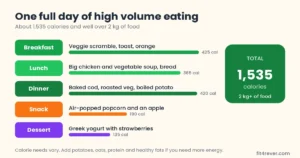
Here’s one full day, so you can see how much food these high volume low calorie meals add up to.
| Meal | What’s on the plate | Calories (about) |
|---|---|---|
| Breakfast | 2 eggs, 100 g egg whites, spinach, mushrooms, 1 slice toast, 1 orange | 425 |
| Lunch | Big chicken and vegetable soup, 1 slice of bread | 365 |
| Dinner | 150 g baked cod, roasted vegetables, 200 g boiled potato | 420 |
| Snack | 3 cups air-popped popcorn and 1 apple | 190 |
| Dessert | 150 g Greek yogurt with 150 g strawberries | 135 |
| Total | Well over 2 kg of food | About 1,535 |
Calorie needs vary a lot. Men, tall people, and anyone training hard need more, so add potatoes, oats, protein, and some olive oil. To find your number, try our calorie calculator or the TDEE calculator.
High Volume Low Calorie Snacks
The best high volume low calorie snacks are low calorie high volume foods you can eat by the bowl.
- Watermelon: 2 cups, about 90 calories.
- Greek yogurt and berries: about 145.
- Cucumber and hummus: one large cucumber with 2 tbsp hummus, about 115.
- Air-popped popcorn: 3 cups, about 95.
- Apple with 1 tsp peanut butter: about 125.
- Frozen grapes: a cup is around 100 calories and tastes like sorbet.
Pair a snack with a little protein or fat. An apple alone fades fast.
Low Calorie High Volume Foods From Around the World
Many cuisines already do this well, so you don’t need to eat salads every day.
- Japan: miso soup is usually under 70 calories a cup.
- Vietnam: pho is a broth-based bowl with herbs and lean meat, around 350 to 450 calories. Ask for extra vegetables and go easy on the noodles.
- Thailand: clear tom yum is full of mushrooms and shrimp. Pick it over the creamy version.
- Italy and Spain: minestrone and gazpacho are vegetable bowls that fill you up for around 150 to 200 calories.
- India and Pakistan: dal with lauki or tori is filling and protein-rich. Watch the oil in the tarka.
- Korea and Mexico: kimchi and cabbage dishes, or fajita vegetables with pico de gallo and black beans, add flavor for few calories.
How to Cook Low Calorie High Volume Foods Without Hidden Calories
Low-calorie, high-volume foods aren’t the problem. What you cook them in often is. One tablespoon of olive oil has about 120 calories, so three tablespoons on a tray of vegetables adds 360.
- Measure oil with a spoon. Don’t pour from the bottle.
- Roast hot. At around 220°C (425°F), vegetables brown and taste sweeter.
- Use flavor, not fat. Lemon, vinegar, garlic, chili, herbs, and salsa all work.
- Simmer in broth. Soups give you the most food per calorie.
Foods That Look Light But Aren’t
Some “healthy” foods look like low calorie high volume foods but lose the volume.
- Dried fruit: The water is gone, the calories stay.
- Granola: A cup can run 400 to 500 calories.
- Juice and smoothies: A glass of orange juice can hold the fruit of two oranges.
- Dressings: In a salad study, a light salad before lunch cut total calories by about 7 to 12%, while one loaded with dressing and cheese raised them by about 8 to 17%.
How to Stay Full for Longer
Low calorie high volume foods get you through the meal. These habits get you through the afternoon.
- Add protein to every meal. Not sure how much? Use our protein calculator.
- Start with soup or a vegetable starter.
- Slow down. Fullness signals take a while to catch up.
- Don’t cut fat to zero. A little olive oil or avocado makes food more satisfying.
Common Mistakes and Who Should Be Careful
Adding fiber too fast. It can cause bloating and gas. Build up over two or three weeks and drink water. Mayo Clinic suggests at least 25 g a day for women under 50 and 38 g for men under 50.
Going too low overall. Low calorie high volume foods are for a moderate deficit, not for eating 800 calories. Our calorie deficit calculator helps you set a safe target.
Skipping protein and fat. A day of only vegetables and fruit leaves you hungry and tired.
Some people should get personal advice first: children, teens, pregnant or breastfeeding women, older adults with a small appetite, anyone underweight, and anyone with a history of disordered eating. Athletes and people trying to gain muscle often need denser foods, not lighter ones.
Budget-Friendly Shopping List
Low calorie high volume foods don’t need fancy ingredients. Frozen vegetables and berries, cabbage, carrots, onions, potatoes, oats, canned beans and lentils, canned tomatoes, eggs, plain yogurt, and canned tuna cover most of it. Buy seasonal produce when you can. It’s cheaper and tastes better.
Watch: 100 Calories, Compared in 28 Seconds
This short original animation shows low calorie high volume foods in action: grapes beat raisins, a boiled potato beats a handful of chips, and cucumber dwarfs a spoonful of olive oil.
Video transcript: 100 calories is about 145 g of grapes or 33 g of raisins, 115 g of boiled potato or 19 g of potato chips, 670 g of cucumber or 11 g of olive oil.
FAQs
What is the 3 3 3 rule for weight loss?
There’s no single official 3 3 3 rule. The most common version is 3 balanced meals a day, about 3 bottles of water by 3 PM, and 3 hours of movement a week. Another is 3 strength, 3 cardio, and 3 recovery days. Neither is a proven medical plan. If you try the meal version, low calorie high volume foods make it easier: build each meal around protein and vegetables.
Are low calorie high volume foods good for weight loss?
They help with the hardest part, which is hunger. You still need an overall calorie deficit, and these foods make it easier to stick to.
What are some high volume low calorie snacks?
Watermelon, berries with Greek yogurt, cucumber with hummus, air-popped popcorn, apple with a little peanut butter, and frozen grapes.
What is the most filling low calorie food?
Boiled potatoes scored highest in the 1995 satiety study, at more than three times the fullness of white bread, at roughly 86 calories per 100 g. Egg whites, nonfat Greek yogurt, and white fish are strong too.
Is fruit a high volume food?
Whole fruit is. Watermelon and strawberries give you over 300 g per 100 calories. Dried fruit is not, because the water is gone.
Can you eat high volume foods and still build muscle?
Yes, if you eat enough total calories and protein. Use volume foods to round out meals, but don’t let them crowd out the protein and denser foods your training needs.
Why am I still hungry after eating vegetables?
Usually the meal is short on protein, fat or total calories, or you ate too fast. Vegetables add size, but they work best next to a real protein source.
Final Thoughts
You don’t need to starve to eat less. You need foods that fill the plate and the stomach for fewer calories. That’s what low-calorie, high-volume foods do.
Pick one meal tomorrow and make one swap. Half pasta and half zucchini. One egg plus egg whites. Yogurt instead of mayo. Want more guides like this? Join the Fit4rEver weekly newsletter or browse our latest articles.
About the Author
Fahad Baig is a research-based health and fitness writer at Fit4rEver with 5 years of experience in the field. He builds every article on scientific research and credible sources, and keeps the advice practical and free from fads.
Sources
- Holt SHA, et al. A satiety index of common foods. European Journal of Clinical Nutrition, 1995.
- Flood JE, Rolls BJ. Soup preloads in a variety of forms reduce meal energy intake. Appetite, 2007.
- Flood-Obbagy JE, Rolls BJ. The effect of fruit in different forms on energy intake and satiety at a meal. Appetite, 2009.
- Rolls BJ, et al. Salad and satiety. Journal of the American Dietetic Association, 2004.
- U.S. Department of Agriculture. FoodData Central.
- Mayo Clinic. The importance of dietary fiber.
- U.S. Food and Drug Administration. Grapefruit juice and some drugs don’t mix.
