
You’ve been eating “clean” for three weeks. The scale hasn’t budged. Meanwhile, your friend has pizza every Friday and keeps getting leaner.
It isn’t luck, and it isn’t willpower. Your friend is simply eating to a different number than you are. And chances are, you’ve never actually checked yours.
That number is exactly what a calorie calculator finds. It takes your age, size, and daily movement and turns them into one working figure: roughly how much energy you burn in a day. Eat below it, and your weight drifts down. Eat above it, and it climbs. That’s easy on paper and messy in real life, so this guide goes past the number. Using a calorie calculator well takes five easy steps: enter your real numbers, pick your activity level, set your goal, track what you eat, and test the result for 14 days.
Quick answer: adult women usually maintain on about 1,600 to 2,400 calories a day, and adult men on about 2,000 to 3,000, based on the U.S. Dietary Guidelines. Where you land in that range is personal. The free Fit4rEver calorie calculator gives you maintenance, cutting, and bulking numbers in seconds.
Your Daily Calories in 5 Easy Steps
Here’s how to use a calorie calculator from start to finish. Each step has its own section below.
- Enter your real numbers. Age, sex, height, and today’s weight, measured in the morning before eating.
- Pick your activity level. Base it on your average week, not your best one.
- Set your goal. Cut 250 to 500 calories to lose, add 250 to 500 to gain, or stay at maintenance.
- Track what you eat. Use a free food calorie calculator or app to see whether you’re hitting the target.
- Test and adjust. Follow the plan for 14 days, compare weekly averages, and tweak by 100 to 150 calories.
Step 1: Enter Your Real Numbers Into the Calorie Calculator
Think of your daily energy as a household budget. Some spending is fixed rent: the energy your body burns just to stay alive. Breathing, circulation, body temperature, brain activity. That’s your basal metabolic rate, or BMR. The rest is flexible spending: walking to the bus, lifting weights, carrying groceries, fidgeting, even digesting lunch. Add the two together, and you get your total daily energy expenditure, or TDEE.
A calorie calculator estimates both parts from your profile. Larger, younger, and more muscular people spend more. Smaller, older, and less active people spend less. The total is your maintenance level, the intake where your weight stays flat. Your goal decides the rest: eat under maintenance to lose, over it to gain.
Want to see each half on its own? The BMR calculator shows the fixed part, and the TDEE calculator adds movement on top.
What to enter: your age, sex, height, and today’s weight, measured in the morning after the bathroom and before eating. Use the number on the scale right now, not the one you’re aiming for. A calorie calculator is only as honest as the numbers you give it.
Step 2: Pick Your Activity Level (and Check the Math)
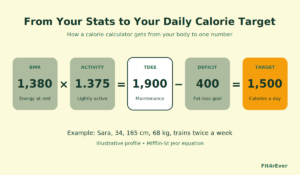
Most modern tools use the Mifflin-St Jeor equation, which a 1990 study found predicted resting needs better than older formulas. In plain words: multiply your weight in kilograms by 10, multiply your height in centimetres by 6.25, then subtract five times your age. Add 5 if you’re male or subtract 161 if you’re female. That gives your BMR.
Then the result gets multiplied by an activity factor:
| Activity level | What a typical week looks like | Multiplier |
|---|---|---|
| Sedentary | Desk job, under about 5,000 steps a day, no workouts | 1.2 |
| Lightly active | 1 to 3 short workouts, or about 7,500 steps a day | 1.375 |
| Moderately active | 3 to 5 solid workouts | 1.55 |
| Very active | Hard training 6 to 7 days | 1.725 |
| Extra active | Physical job plus daily training | 1.9 |
Any calorie calculator does this in a blink, but knowing the steps helps you catch a bad result. If a tool tells a 60 kg woman she needs 3,500 calories, something was typed wrong.
Choosing the level is where most people slip. Pick it from your average week, not your best one. If you’re torn between two levels, take the lower one. Your phone’s step counter settles most arguments: under 5,000 steps a day is sedentary, even if you train three times a week.
See It in Action: Three People, Three Targets
These are illustrative profiles, built to show how the math plays out.
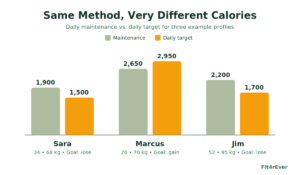
Sara, 34, 165 cm, 68 kg, trains twice a week. Her BMR comes to about 1,380. Multiply by 1.375, and her maintenance is roughly 1,900 calories. She wants to lose fat, so she trims 400 and aims for about 1,500. That’s close to 0.35 kg (0.8 lb) a week.
Marcus, 26, 180 cm, 70 kg, lifts five days a week. BMR: about 1,700. Times 1.55 puts his maintenance near 2,650. He’s lean and wants muscle, so he adds 300 and eats about 2,950.
Jim, 52, 183 cm (6 ft), 95 kg, desk job with a daily dog walk. BMR: about 1,840. Times 1.2 gives maintenance of about 2,200. He cuts 500 and lands near 1,700, which is roughly 0.45 kg (1 lb) a week.
Look at the spread. Marcus eats nearly double what Sara eats, and both are doing it right. That’s why a generic “2,000 calories a day” tells you very little. Run each profile through a calorie calculator, and you should land within a few dozen calories of these figures.
What Moves Your Number Up or Down
Two people with the same height and weight can still need different amounts. Here’s why:
- Muscle. Lean tissue burns more at rest than fat, so a lifter and a non-lifter at the same weight rarely match.
- Age. The equation takes off about 5 calories a day for every year of age. Part of that is lost muscle and part is slower movement.
- Everyday movement. Pacing, chores, standing, and fidgeting can swing your burn by several hundred calories between two people with identical gym habits.
- Sleep. Short nights tend to raise hunger and cravings, which makes any target harder to hit.
- Weight change. A lighter body needs less fuel. Your number shrinks as you do.
Step 3a: Calorie Calculator to Lose Weight: Set a Deficit You Can Live With
The classic mistake with a calorie calculator for weight loss is treating the lowest number as the best number. It isn’t. A harsh cut burns muscle, drains energy, and usually ends in a rebound.
Aim for a deficit of 10% to 25% below maintenance. For most people, that’s 250 to 500 calories a day, which works out to losing about 0.5% to 1% of body weight per week. Slower feels boring, but it’s the pace people actually keep.
A calorie deficit calculator takes this one step further. Enter your goal weight and a date, and it shows the daily intake that plan demands. If the answer is a number you can’t picture eating for three months, move the date, not the calories.
Three habits make a deficit easier:
- Protect muscle with protein. Check your target with the protein calculator.
- Move a little more. Adding 2,000 daily steps often costs less effort than giving up 100 calories of food you enjoy.
- Keep a floor. Many clinicians treat about 1,200 calories for women and 1,500 for men as the lowest sensible level without medical supervision. Don’t aim for it by choice.
One honest warning. You’ll often hear that 3,500 calories equals one pound of fat. It’s a handy estimate, but your body adapts as you shrink, so real progress slows. Plan for that instead of being surprised by it.
Step 3b: Food Calorie Calculator to Gain Weight: A Surplus That Turns Into Muscle
Gaining is harder than people expect, especially with a fast metabolism or a packed schedule. A food calorie calculator for gaining weight starts the same way: find maintenance, then add a 250-500 calorie surplus. Marcus’s extra 300 should add about half a pound a week. Faster than that, and most of the gain is fat.
The real obstacle is fullness, not willpower. These tricks help:
- Drink calories. A glass of whole milk adds about 150 without a single chew.
- Upgrade dense foods. Olive oil over rice, nut butter on toast, trail mix between meals.
- Eat by the clock. Waiting until you’re hungry usually means under-eating.
- Lift. Without resistance training, surplus calories have no reason to become muscle.
When you’re ready to split calories between protein, carbs, and fat, the macro calculator handles it.
Step 4: Track Your Food With a Free Food Calorie Calculator
People mix these up all the time. A calorie calculator sets your target. A free food calorie calculator, usually a food-logging app or database, measures what you actually ate. One is the map and the other is the GPS dot showing where you are. You need both.
Tracking tips that save your sanity:
- Use a cheap kitchen scale for the first two weeks. It trains your eye faster than any app.
- Log the small stuff: cooking oil, sauces, creamers, and drinks. A large whole-milk latte can land around 200 calories, and it’s the item people forget most.
- Round restaurant meals up. Kitchens use more oil than you’d guess.
- Don’t obsess over a 20-calorie label difference. Consistency beats precision.
A Sample Day at 2,000 Calories
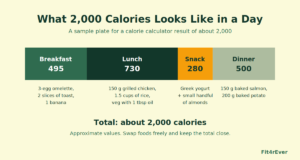
Here’s what a 2,000-calorie result from a calorie calculator looks like on a plate. Figures are approximate.
| Meal | What’s on the plate | Approx. calories |
|---|---|---|
| Breakfast | 3-egg omelette, 2 slices of toast, 1 banana | 495 |
| Lunch | 150 g grilled chicken, 1.5 cups of rice, vegetables with 1 tbsp olive oil | 730 |
| Snack | Greek yogurt with a small handful of almonds | 280 |
| Dinner | 150 g baked salmon, 200 g baked potato | 500 |
| Total | about 2,000 |
Swap the chicken for lentils or tofu, and the total barely moves. The point isn’t this exact menu. It’s seeing that 2,000 calories is a lot of real food, not a punishment.
Step 5: Test and Adjust: How Accurate Is a Calorie Calculator?
Honestly? A calorie calculator produces an estimate, and your true maintenance can sit a couple of hundred calories above or below it. Muscle mass, genetics, sleep, stress, and everyday movement all nudge it. Mayo Clinic’s own tool warns that results may be off for people who are pregnant or breastfeeding, competitive athletes, and people with metabolic conditions such as diabetes.
So test it instead of trusting it blindly:
- Eat your target for 14 days. Include weekends.
- Weigh yourself every morning under the same conditions.
- Average week one, then average week two.
- Compare both averages to your goal.
Daily swings of a kilo from water and salt are normal. Only the averages matter.
What to Change After Two Weeks
| What happened | What to do |
|---|---|
| Lost weight faster than planned | Add 100 to 150 calories |
| Lost weight at your planned pace | Change nothing |
| No movement (goal: lose) | Trim 100 to 150 calories, or add steps |
| Gained at your planned pace | Change nothing |
| No movement (goal: gain) | Add 150 to 200 calories |
Make one change at a time, then wait another two weeks before judging it.
When to Recalculate
Your number is a moving target. Run your stats through the calorie calculator again when:
- you’ve lost or gained about 5 kg (10 lb)
- your job, training, or step count changes
- progress stalls for three weeks or longer
- you enter a big life stage, such as menopause
Common Mistakes That Skew the Result
- Overrating activity. This one causes more wrong results than any other.
- Trusting a watch’s burn number. Wearables tend to overstate calories burned.
- Skipping weekends. Two loose days can cancel five careful ones.
- Starting at the floor. Begin with a modest deficit, so you have room to adjust.
- Treating the output as exact. Even the best calorie calculator can’t see your muscle, sleep, or stress.
Counting Without Burning Out
You don’t have to log food forever. A practical pattern is to track strictly for two to four weeks, learn what your usual meals weigh, then build a “default day” of meals you know land near your target. After that, spot-check one or two weekdays a week. If the scale agrees with your plan, you’re done. If it drifts, go back to full logging for a fortnight.
Who Should Be Careful
Pregnant or breastfeeding women, teenagers, older adults, people with diabetes or thyroid conditions, and anyone with a history of disordered eating should plan with a doctor or registered dietitian. A calorie calculator is a general tool and can’t replace that advice. If you take a GLP-1 medication, appetite changes in ways no formula predicts. Our Wegovy guide explains what to expect.
Kcal vs. kJ, Pounds vs. Kilograms
If you live in Australia or New Zealand, food labels show kilojoules. The conversion is simple: 1 calorie (kcal) equals 4.184 kJ, so 8,400 kJ is about 2,000 calories. UK labels often show both. And if you think in stone, one stone is 14 pounds, or about 6.35 kg. Whatever you use, a good calorie calculator lets you switch units, so pick the one you naturally think in.
FAQ
Is there a calorie calculator free to use? Yes. The Fit4rEver calorie calculator is free, needs no sign-up, and works in metric or imperial. Plenty of other free calorie calculator tools exist as well. Just check that they use the Mifflin-St Jeor formula.
How many calories should I cut to lose 1 kg (2.2 lb) a week? That’s a deficit of roughly 1,000 calories a day, which is aggressive and wrong for many people. Most do better at about half that pace.
Should I eat back the calories I burn exercising? Not if your activity level already includes your workouts. Adding them again counts the same effort twice.
What if my result comes out below 1,200 calories? Check for typing mistakes first. If it’s accurate, don’t cut further. Speak to a doctor or dietitian, because a target that low usually needs supervision.
Do I have to count calories forever? No. Many people track for a few weeks to learn portion sizes, then eyeball meals and check in occasionally.
Is a calorie calculator accurate enough for beginners? Yes, as a starting point. Treat the result as a draft and use the 14-day check to fine-tune it.
Your Next Step
Stop guessing. Run your numbers through the free calorie calculator, write down your target, and follow it honestly for two weeks. Then adjust. That one habit beats any diet trend.
Disclaimer: This article is for general information and isn’t medical advice. If you have a medical condition, are pregnant, or take medication, talk to your doctor or a registered dietitian before changing how you eat
