
Is 1300 calories enough? I’ve sat with this exact question more times than I can count – from people starting their first real diet, from people three months into a plateau, and from people who typed “is 1300 calories enough” into Google at 11pm because something felt off and they wanted an honest answer, not a sales pitch.
So here’s the honest one: 1300 calories can be plenty for one person and genuinely too little for another – and the difference usually isn’t willpower, it’s math.
Picture a 5’2″ woman in her 50s with a desk job, and a 6’1″ guy doing construction work. Hand them both 1300 calories a day. One of them might lose weight comfortably.
The other will probably be dizzy and irritable by mid-afternoon. Same number, two completely different bodies underneath it. That contrast alone shows why this question can’t be answered with a single yes or no.
This is where I want to save you some time: instead of another generic “it depends” article, let’s actually work out which side of that line you’re on, who needs to be more careful than average, and what 1300 calories looks like on an actual plate – because a number means nothing until you can picture the food behind it.
The Three Questions Hiding Inside “Is 1300 Calories Enough?”
Most people asking “is 1300 calories enough” are actually asking one of three different things, and almost every article on this topic blurs them together:
- Will 1300 calories help you lose weight? For most adults, yes – 1300 sits below maintenance for the large majority of people, so a deficit happens.
- Is it enough that I won’t feel awful? This is where it gets personal. Body size and activity level decide this one, not the number itself.
- Is it enough to meet my nutrient needs? A separate question again. You can be in a deficit, feel okay-ish, and still be short on protein or fiber if your food choices aren’t deliberate.
Keep these three apart as you read. A “yes” to one doesn’t mean “yes” to all three – that mix-up is where most of the confusion around this topic comes from.
Do the Math on Yourself (Two Minutes, No App Required)
So, is 1300 calories enough? Here’s the part most articles skip: an actual way to check your own number, not just someone else’s average.
Step 1 – Rough resting calorie burn (BMR):
Multiply your weight in pounds by 10 if you’re a woman, or 11 if you’re a man. A 160-pound woman lands around 1,600. A 180-pound man lands around 1,980.
It’s not lab-precise, but it’s close enough to be genuinely useful. For a more exact figure using the Mifflin-St Jeor equation, run your numbers through our BMR calculator.
Step 2 — Add your activity level:
| Activity level | Multiplier |
|---|---|
| Mostly sitting (desk job, little exercise) | 1.2 |
| Light activity (short walks, workouts 1–3x/week) | 1.375 |
| Moderately active (workouts 3–5x/week, on-your-feet job) | 1.55 |
| Very active (daily training, physical job) | 1.725 |
Multiply your BMR by the number that fits. That’s roughly your maintenance calories – what you’d eat to hold steady. Our TDEE calculator does this step automatically and factors in a couple of variables the quick version above skips.
Step 3 — Compare it to 1300.
Maintenance around 1,700–1,900? Eating 1300 is a normal, moderate deficit. Maintenance north of 2,400? 1300 isn’t really a diet at that point – it’s closer to a fast, and your body will let you know fast.
For context, the U.S. Dietary Guidelines put average maintenance calories for adults aged 19–60 at roughly 1,600–2,400 for women and 2,200–3,000 for men, depending on activity level – so where you land in those ranges says a lot about how 1300 will actually feel.
If you’d rather skip straight to a personalized deficit target, our calorie deficit calculator will map out the gap for you.
A real comparison worth sitting with:
Maria is 34, 5’4″, 150 lbs, works hybrid, and does two spin classes a week. Her rough maintenance lands around 2,060, so 1300 puts her in a ~760-calorie deficit – aggressive, but workable for a few weeks with attention to protein.
Dave is 41, 6’0″, 210 lbs, works construction, and lifts three times a week. His maintenance lands closer to 3,580. At 1300 calories, he’s over 2,000 calories short of that number every single day. That’s not a diet. That’s a plan for crashing workouts and quitting by Thursday.
Same 1300. Two completely different outcomes. Is 1300 calories enough? The answer depends far more on the person than on the number itself. If you want to see how your own numbers compare, our piece on why calculators alone don’t work is worth a read after this one — the number is only step one.
When 1300 Calories Genuinely Works
It tends to fit people whose maintenance calories already sit close to that number – generally smaller-framed, shorter, or largely sedentary adults, where 1300 is an unremarkable deficit rather than a shock.
It can also make sense as a short, deliberate cut before an event, ideally with some outside guidance, rather than a permanent way of eating.
Our ideal weight calculator can help you sanity-check whether your current goal weight and timeline are realistic before you commit to a number this tight. For this group, the answer to “is 1300 calories enough” is usually a fairly confident yes.
The pattern I keep seeing: if 1300 sits a few hundred calories below your natural maintenance, it behaves like a normal diet. If it’s a thousand-plus calories below, it behaves like deprivation – no matter how disciplined you are about it.
Who Should Think Twice
Is 1300 calories enough for a man?
Usually not as an everyday target. Larger average body size and higher muscle mass push most men’s maintenance calories well above 1300, so it tends to function as a steep, short-term cut rather than something sustainable.
Anyone training regularly.
Gym sessions, sports, physically demanding jobs – all of it raises your number. Lift weights three times a week while eating like you don’t, and recovery is usually the first thing to go, followed closely by motivation.
Is 1300 calories enough for a teenager?
This article is written for adults 18–60, and teens are a genuinely different case – still growing, with calorie needs that work differently. That conversation belongs with a pediatrician, not a generic calculator.
Pregnant or breastfeeding people.
Energy needs rise substantially during pregnancy and lactation. A general weight-loss calculator simply doesn’t apply here – this is a conversation for your OB or midwife, not an article.
Anyone with a history of disordered eating.
If restrictive eating has ever been a hard pattern for you, a rigid low-calorie number can carry more risk than benefit. A doctor or therapist who knows your history is the safer starting point, not a number from a formula.
Worth knowing for context: the UK’s NHS classifies diets of 800 calories a day or less as “very low calorie diets” that should only be followed under medical supervision.
1300 sits well above that clinical threshold, but it tells you something useful: the concern with aggressive calorie restriction isn’t just about hitting some arbitrary “safe” number — it’s about how far below your own needs you’re going, and for how long.

The Cases Most Articles Skip Entirely
This is the part almost nobody answers well, and it affects a lot of people asking this question right now.
If you’re on a GLP-1 medication (like semaglutide or tirzepatide), appetite suppression can make 1300 calories feel easy – sometimes too easy, to the point where food barely crosses your mind.
That’s not automatically a green light. When you’re eating less simply because you’re not hungry, protein and nutrient density matter more, not less, since there’s less total food volume to work with.
A shake with 30g of protein does more for you here than a small plate of pasta with none. Our protein intake calculator can help you figure out a target that protects muscle even at a lower calorie budget.
If you have hypothyroidism, your resting metabolic rate can run lower than the formula above assumes, so 1300 may land differently for you than it would for someone without a thyroid condition.
This is genuinely a case where a conversation with your prescribing doctor about your specific number is worth more than any calculator, including ours.
If you have PCOS or you’re in perimenopause, hormonal shifts can affect hunger, water retention, and how quickly progress shows up on the scale, which makes a tight calorie target harder to judge day to day. Slower or noisier feedback doesn’t mean the plan has failed – it means the usual signals are less reliable for you specifically, and patience matters more here than in most cases.
Across all three, the honest answer is consistent: talk to whoever manages your treatment about your specific number, rather than assuming a general formula carries over cleanly to your situation.
Signs 1300 Calories Is Too Low for You
A little hunger in week one is normal and expected. These are different – they’re your body’s own way of telling you the deficit has moved from “challenging” to “unsustainable”:
- Fatigue that doesn’t lift even after a good night’s sleep
- Irritability that feels out of proportion to what’s actually happening
- Dizziness, especially standing up quickly
- More hair shedding than usual
- A missed or irregular period
- Workouts that used to feel manageable now feeling like wading through wet sand
- Food thoughts that won’t quiet down, even when you’re not hungry
One of these on a rough day doesn’t mean much on its own. Three or four together, lasting more than a week, is your body asking for more fuel – not asking for more discipline.
What to actually do: raise your intake by 200–300 calories and hold there for two weeks before judging anything. If the symptoms don’t ease, or a missed period continues, that’s worth a call to your doctor rather than more adjusting on your own.
What 1300 Calories Actually Looks Like on a Plate
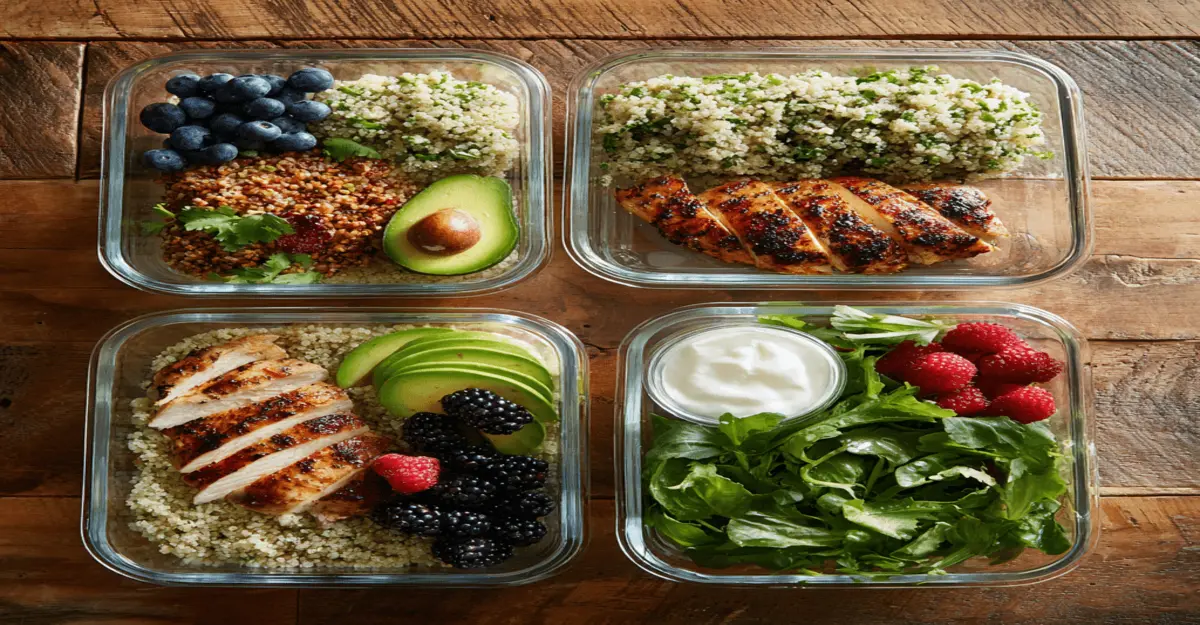
Numbers are abstract. Food isn’t. Is 1300 calories enough for your own lifestyle? Look at three genuinely different ways to spend 1300 calories in a day below – because “enough” also depends on whether the plan actually fits how you like to eat.
If you want to build your own version around specific protein, carb, and fat targets, our macro calculator will split any calorie number into grams for you.
The high-protein, high-volume day (good if you hate feeling hungry):
- Breakfast: Greek yogurt (170g) with berries and a tablespoon of chia — ~250 cal
- Lunch: Big salad with 150g grilled chicken, mixed veg, light dressing — ~400 cal
- Snack: An apple with a tablespoon of peanut butter — ~180 cal
- Dinner: Stir-fried tofu or shrimp with a full plate of vegetables over a small portion of rice — ~470 cal
The fewer, bigger meals day (good if you’re not a snacker):
- Late breakfast/brunch: Three eggs, spinach, one slice of toast — ~450 cal
- Mid-afternoon meal: Salmon, roasted potatoes, broccoli — ~550 cal
- Evening: Protein shake plus a small handful of nuts — ~300 cal
The “real life” flexible day (good if you eat out or cook for a family):
- Breakfast: Oatmeal with banana — ~300 cal
- Lunch: Turkey sandwich, side salad — ~450 cal
- Dinner: Whatever the family’s having, in a moderate portion, plus extra vegetables — ~450 cal
- Leaves ~100 cal for milk in coffee, a small treat, or a sauce you didn’t measure
That last line matters more than people expect. A tablespoon of olive oil runs about 120 calories. A “healthy” granola topping can be 200 calories in a single handful.
On a budget as tight as 1300, the calories you don’t track are usually the ones that quietly turn a manageable deficit into an accidental crash diet.
The high-volume approach in the first sample day above follows the same logic Mayo Clinic uses in its energy-density guidance – building meals around water- and fiber-rich foods so you can eat a satisfying amount without spending your whole budget on it.

If 1300 Isn’t Working, Here’s the Fix – It’s Not Failure
A stalled scale after two or three weeks doesn’t automatically mean you need to eat even less. More often, it’s one of three things: tracking has quietly drifted (an extra bite here, an uncounted sauce there), your activity has genuinely gone up since you started, or your body is holding water for reasons that have nothing to do with fat – stress, sodium, your cycle, or a rough stretch of sleep.
Before cutting calories further, look at the bigger picture over two weeks: your average weight trend rather than any single day, how you’re sleeping, whether workouts still feel okay, and whether hunger has shifted from occasional to constant.
If most of that looks fine and the scale’s just being slow, that’s a normal plateau – not a signal to restrict harder. If several of those are slipping at once, that’s your cue to add calories back, not take more away. This is exactly the trap our article on why calculators alone don’t work digs into — the number gets you started, but it was never supposed to run the whole show on its own.
Frequently Asked Questions
Is 1300 calories enough to lose weight?
For most adults, yes – it sits below maintenance for the majority of people, so a deficit happens. Whether that deficit feels sustainable is the separate question this whole article is really about.
Is 1300 calories enough for a woman?
It depends on size and activity far more than sex alone. A smaller, largely sedentary woman may do fine on it. An active woman who trains regularly may find it falls short.
Is 1300 calories enough for a man?
Usually not as an ongoing target. Most men have higher maintenance calories due to larger average body size, which makes 1300 a steep, short-term cut rather than an everyday number.
Is 1300 calories enough with exercise?
For most people training several times a week, no – this is typically where 1300 starts falling short on recovery and energy, even if the scale keeps moving in the right direction.
Is 1300 calories enough for weight loss?
Nearly always, in the narrow sense of creating a deficit. The harder question is whether it’s enough for weight loss you can actually sustain, which comes down to your own maintenance calories, covered in the math section above.
Is 1300 calories enough for a teenager?
This isn’t the right question to answer with a general calculator. Teens are still growing, and calorie needs work differently at that age – this belongs in a conversation with a pediatrician.
Can you build muscle eating 1300 calories?
Building new muscle in a calorie deficit is difficult for most people. The realistic goal here is holding onto the muscle you already have, which means prioritizing protein and continuing resistance training rather than skipping it.
Should I stay at 1300 calories long-term?
For most adults, no. It tends to work better as a short-term tool for a specific stretch than a permanent way of eating. As your weight changes, your calorie needs change with it, and the number deserves a second look rather than being left on autopilot.
Is 1500 calories enough?
Often more sustainable than 1300, especially for anyone whose maintenance calories land on the higher end. If 1300 feels too aggressive based on the math above, run your numbers through our calorie intake calculator to see what a gentler target looks like for you.
Final Thoughts
Is 1300 calories enough? On its own, it’s just a number. Do the quick math on your own maintenance calories, be honest about your activity level, and pay attention to what your body’s telling you in week two – not just what the scale says on day three.
If the number and your real life don’t line up, adjusting isn’t quitting. That’s the entire point of paying attention in the first place.
Still wondering: is 1300 calories enough for you? Run your numbers through our TDEE calculator, track how you feel for two weeks, and adjust from there – that beats guessing with any single number, including this one.

[…] a calorie calculator accurate enough for beginners? Yes, as a starting point. Treat the result as a draft and use the 14-day check to […]