
![Walking Calculator for Weight Loss: [Free & Easy]](https://fit4rever.com/wp-content/uploads/2026/09/77ab9765-b272-48cd-ac1d-baad27f7dd68.jpg)
Here’s a scenario I’d bet you’ve lived through: you start walking every day, you feel great, and after two weeks you step on the scale expecting a reward – and it hasn’t budged. So you Google “walking calculator for weight loss,” plug in your numbers, get a calorie figure, and… now what? What does that number actually mean for your weight?
That gap – between “here’s how many calories you burned” and “here’s what that means for your body” — is exactly what most walking calculators leave you to figure out on your own.
This walking calculator for weight loss closes that gap. Use the calculator to get your number, then keep reading to understand what it’s really telling you.
Walking Calculator for Weight Loss: How Many Calories You Burn
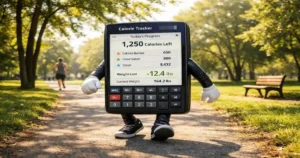
It’s a way of comparing how much energy an activity takes relative to sitting still. Walking at a leisurely 2 mph sits around 2.0–2.5 METs; picking it up to a brisk 4 mph pushes you closer to 5.0 METs.
Multiply that MET value by your body weight and the time spent, and you get an estimate of calories burned.
It’s a solid starting point. It is not gospel — more on that in a minute. And once you have your number, our Calorie Deficit Calculator can tell you exactly how it fits into your weekly weight-loss target.
“Try our free walking calculator for weight loss — see calories burned by weight, speed & steps, then turn that number into a real timeline.”
The Walking Speed & Calories Chart
Speed changes your calorie burn more than most people expect. Run your own numbers through the walking calculator for weight loss above, but here’s roughly what 30 minutes of walking looks like at different paces, for a few common body weights:
| Speed | 130 lb (59 kg) | 155 lb (70 kg) | 180 lb (82 kg) | 200 lb (91 kg) |
|---|---|---|---|---|
| 2.0 mph (leisurely) | ~65 cal | ~78 cal | ~90 cal | ~100 cal |
| 2.5 mph (easy) | ~78 cal | ~93 cal | ~108 cal | ~120 cal |
| 3.0 mph (moderate) | ~90 cal | ~107 cal | ~125 cal | ~140 cal |
| 3.5 mph (brisk) | ~103 cal | ~123 cal | ~143 cal | ~160 cal |
| 4.0 mph (fast) | ~118 cal | ~141 cal | ~164 cal | ~182 cal |
These are estimates, not lab-verified numbers for your exact body – but the pattern holds: going from a stroll to a brisk pace can nearly double your burn for the same half hour. If you only take one tactical thing from this article, let it be this: speed matters more than most people give it credit for.
One more lever worth mentioning here: incline. Walking on even a 3-5% grade — a gentle hill, or a treadmill set to incline — can boost your calorie burn by 20–50% compared to flat ground at the same pace, without needing to walk any faster.
If your knees or joints aren’t fans of running but you want a bigger calorie hit, incline walking is probably your best friend.
From Calories Burned to Pounds Lost – The Real Math
This is the part almost every other walking calculator for weight loss skips, and it’s the part that actually matters if your goal is actually losing weight, not just seeing a number.
The commonly used rule of thumb is that one pound of body fat represents roughly 3,500 calories – though this figure is a simplification with real-world limitations. So if you want to lose a pound, you need a cumulative deficit of about 3,500 calories – through eating less, moving more, or (realistically) some mix of both.
Let’s put that in a real example. Say you’re a 170 lb person who starts walking briskly (3.5 mph) for 45 minutes a day, 6 days a week.
- Roughly 210 calories burned per session
- 6 sessions/week = about 1,260 calories burned weekly from walking alone
- 1,260 ÷ 3,500 = about 0.36 lbs of fat loss per week from the walking itself
That’s nothing – over a month, that’s roughly 1.5 lbs, and over three months, close to 4–5 lbs, purely from the walking, with zero other changes. Add a modest dietary adjustment (cutting 200–300 calories a day) and that monthly number can realistically double.

Here’s a quick reference so you can ballpark your own numbers:
| Daily steps (approx.) | Weekly calorie burn (approx.) | Monthly weight loss (walking alone) |
|---|---|---|
| 5,000 | ~1,000–1,400 cal | ~0.5–0.8 lb |
| 8,000 | ~1,800–2,400 cal | ~1–1.5 lb |
| 10,000 | ~2,200–3,000 cal | ~1.5–2 lb |
| 12,000+ | ~2,800–3,800 cal | ~2–2.5 lb |
Notice the ranges – that’s on purpose. This isn’t a precise science, and I’d rather give you an honest range than a fake-precise number that sets you up to feel like you failed when reality doesn’t match a decimal point.
Why the Calculator Says One Thing But the Scale Says Another
This is the section I wish existed the first time I went looking for answers about a walking calculator for weight loss, because it explains the most common source of frustration with walking for weight loss.
The formula overestimates.
MET-based calculations were built from average lab data on a “reference” person – not you specifically. Research has found these estimates can overshoot real-world calorie burn by 20–30% for a lot of people, especially those who are more fit (a trained body becomes more efficient and burns slightly less for the same effort).
Your body adapts.
Walk the same route at the same pace every day for a month, and your body gets more efficient at it. That’s a good thing for your fitness – but it also means the calorie burn quietly drops over time, even though the calculator keeps giving you the same number.
You might be eating a bit more without noticing.
This is called compensatory eating, and it’s incredibly common and not a character flaw. Exercise can increase appetite, and it’s easy to unconsciously “reward” a walk with a slightly bigger portion or an extra snack that cancels out the deficit.
You might be moving less elsewhere.
If you added a 45-minute walk but then find yourself parking closer, taking the elevator instead of stairs, or generally being more sedentary the rest of the day (your body seeking to conserve energy), your daily total burn might not increase as much as you’d think.
The scale reflects more than fat.
Water retention, hormonal fluctuations, and even small amounts of muscle gain can mask fat loss for days or weeks at a time. This is real, and it’s why the trend over 3–4 weeks matters far more than any single morning’s number.
None of this means walking “doesn’t work.” It means the calculator is a compass, not a GPS – it points you in the right direction, but don’t expect it to predict your exact coordinates.
How Many Steps a Day Do You Need to Lose Weight?
You’ve probably heard “10,000 steps a day” so many times it barely means anything anymore. Here’s where that number actually comes from, and whether you need it.
Research has shown that even 7,000–8,000 steps a day is associated with meaningful reductions in cardiovascular risk and overall mortality – you don’t need five figures just to be healthier. One JAMA Internal Medicine study even found that as few as 4,400 steps a day meaningfully lowered mortality risk in older women compared to more sedentary peers.
For weight loss specifically, though, more steps generally do correlate with better results, and 10,000+ steps a day shows up repeatedly in research as a threshold where people start seeing more noticeable changes on the scale.
We break this down in much more depth in our dedicated guide on how many steps a day to lose weight naturally, if you want the full picture beyond this walking calculator for weight loss.
If you’re starting from a sedentary baseline (say, 3,000–4,000 steps a day), don’t jump straight to 10,000. Add 500–1,000 steps a week instead. It’s a boring recommendation, but it’s the one that actually sticks – sudden jumps in activity are a classic way to get discouraged (or injured) and quit within a month.
Walking + Diet: Why Calorie Burn Alone Won’t Guarantee Weight Loss
Here’s an uncomfortable truth: you can walk every single day and still not lose weight if your eating pattern absorbs the deficit.
Walking fits into a bigger picture called total daily energy expenditure (TDEE) – basically everything your body burns in a day, including your resting metabolism, digestion, and all movement (not just intentional exercise).
Weight loss happens when you consistently eat less than your TDEE, and walking is one tool for widening that gap – not the only one. If you haven’t worked out your own number yet, our guide on how to calculate your TDEE for weight loss walks you through it in five steps.
A practical way to think about it: if a 45-minute walk burns 200 calories, and you follow it with a coffee-shop muffin that’s also 200 calories, you’ve walked for zero net benefit toward weight loss (though you still got the cardiovascular and mental-health perks, which count for something).
Our calorie calculator to lose weight can help you see this trade-off clearly before it happens, not after.
You don’t need to obsessively track every bite. But if the scale isn’t moving despite consistent walking, the first thing worth examining honestly is whether portions or snacking have quietly crept up – not whether the walking “isn’t working.”
Does Walking Speed or Incline Matter More for Fat Loss?
Both matter, but for slightly different reasons.
Lower-intensity, longer walks (think: a comfortable pace you could hold a conversation at) tend to use a higher proportion of fat as fuel.
As intensity climbs, your body shifts toward burning more carbohydrate stores instead. This is why some people report better results from longer, easier walks than from a handful of short, intense ones – it’s not about burning the most calories in the moment; it’s about consistency and what’s sustainable.
Incline, on the other hand, is the fastest way to raise your total calorie burn without needing to run or push your pace into “brisk” territory.
If your joints don’t love higher-impact cardio, a hilly walking route or a treadmill set to 3–5% incline is one of the best trade-offs available: meaningfully higher burn, same low-impact movement.
My honest take: alternate. A few flat, easy, longer walks a week for the fat-oxidation and mental-health benefit, and one or two incline or brisk-interval sessions to push your weekly calorie total up. You get the best of both without needing either to be perfect.
Walking Calculator Accuracy vs. Fitness Trackers
If you’ve ever compared a walking calculator for weight loss output to your Fitbit, Apple Watch, or phone’s step app and gotten two completely different numbers, you’re not imagining things.
Wearables estimate calorie burn using your heart rate, stride length (sometimes calibrated, sometimes guessed), and personal profile data – a different method than the MET formula calculators use.
Neither is “more correct” in an absolute sense; they’re both estimates built on different assumptions, and both can be off by a meaningful margin for any individual.
The practical fix: pick one method and stick with it consistently. Don’t calculator-shop looking for the number you want to see, and don’t panic if your watch and a website disagree by 30%.
Use whichever one you check daily as a trend indicator – is this week’s total higher than last week’s? — rather than treating either as an exact daily target.
Special Considerations by Age, Sex, and Body Type
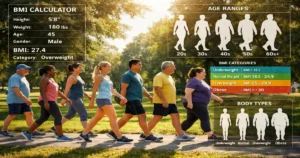
A few honest notes, because generic advice doesn’t fit everyone the same way. Before you dig into these, it’s worth knowing your starting point – our BMI calculator and body fat calculator take two minutes and give useful context for everything below.
Age. Metabolism naturally slows somewhat with age, partly due to gradual muscle loss. This doesn’t mean walking stops working – it means the same walking routine may yield slightly less calorie burn at 55 than it did at 25, and pairing walking with some strength training (to preserve muscle) tends to pay off more as you get older.
Sex. On average, men tend to have more muscle mass and burn somewhat more calories at rest and during activity than women of the same weight – this is baked into most calculators via the sex input, and it’s normal, not a flaw in either direction.
Menopause and hormonal shifts. Many women notice weight loss becomes harder around perimenopause and menopause, independent of activity level, due to hormonal changes affecting fat storage and metabolism.
Walking is still genuinely beneficial here – for bone density, mood, and cardiovascular health, alongside weight management – but expectations may need to be a bit more patient during this stage.
Underlying conditions. If you have a thyroid condition, PCOS, or another factor that affects metabolism and you’re not seeing expected results despite consistent effort, that’s worth a conversation with a doctor rather than more troubleshooting via calculator. This article can’t account for individual medical circumstances, and it shouldn’t try to.
Sample Walking Plans for Weight Loss
Run any of these through the walking calculator for weight loss above to see your own numbers, but here’s a general framework by experience level:
Beginner (new to regular exercise or coming back after a break)
- 20–30 minutes/day, comfortable flat pace, 5 days a week
- Estimated weekly burn: 500–900 calories
- Goal: build the habit before chasing intensity
Intermediate (already walking somewhat regularly)
- 45–60 minutes/day, mixing moderate pace with occasional incline, 5–6 days a week
- Estimated weekly burn: 1,200–1,800 calories
- Goal: start layering in variety to avoid plateaus
Advanced (comfortable with longer sessions, looking to maximize results)
- Interval walking (alternating 3 minutes brisk / 2 minutes easy) for 45–60 minutes, plus one longer weekend walk (75–90 min), 6 days a week
- Estimated weekly burn: 2,000–2,800+ calories
- Goal: push total weekly volume while keeping joints happy
Whatever tier you start in, the honest goal is to move up one level every few weeks – not to jump straight to “advanced” in week one.
How Long Will It Take to See Results Walking for Weight Loss?
Most people notice non-scale changes – looser clothes, easier stairs, better sleep – within 2–3 weeks, before the scale reliably reflects it. That’s normal, and it’s actually a better early signal than the number on the scale, which bounces around with water weight and hormones day to day.
A commonly recommended safe, sustainable pace of weight loss is around 1–2 lbs per week total (from all sources combined – diet and activity), and walking alone will typically account for part of that deficit rather than all of it, unless you’re walking a genuinely high volume.
Give it a full 4-6 weeks before judging whether your current routine – and the numbers your walking calculator for weight loss is showing you – is actually “working.” Shorter than that, and you’re mostly just looking at noise.
FAQs
How many calories does walking 10,000 steps burn?
For an average-weight adult (around 155–175 lb), 10,000 steps typically burns somewhere between 300–500 calories, depending on pace, stride length, and body weight. Heavier individuals and faster paces land toward the higher end.
Is walking enough to lose belly fat?
Walking contributes to overall fat loss, which does include abdominal fat over time – but you can’t spot-reduce fat from one area through walking alone.
Consistent walking combined with a modest calorie deficit is what drives visible changes, belly included.
How long should I walk each day to lose weight?
Most guidance points to 30–60 minutes most days of the week as a solid target, but total weekly volume matters more than any single day. 150–300 minutes a week is a widely cited healthy range to aim for.
Does walking on an incline burn more fat?
It burns more total calories for the same pace, which can support faster overall fat loss when paired with a consistent calorie deficit – it’s not “fat-specific,” but it does raise your burn efficiently.
Why am I walking every day and not losing weight?
The most common culprits: portion sizes or snacking creeping up to offset the deficit, your walking calculator for weight loss overestimating your actual burn, or being earlier in the process than you think (give it 4-6 weeks before troubleshooting further).
Is it better to walk fast or long for weight loss?
Both work – brisk walking burns more per minute; longer walking accumulates more total calories even at an easier pace. The best answer is whichever one you’ll actually do consistently, since consistency outperforms optimization here.
The Bottom Line
A walking calculator for weight loss gives you an estimate – a genuinely useful one, but an estimate nonetheless.
The real path to weight loss with walking comes down to three things: showing up consistently, paying honest attention to what you’re eating alongside it, and giving the process enough time (weeks, not days) to actually show up on the scale.
Use the walking calculator for weight loss above to get your number. Then use everything in this article to understand what that number actually means for you – and to stop expecting a formula to predict something as personal as your own body.
Ready to build your full plan?
Try the TDEE Calculator next to see your total daily number, or jump straight to our Calorie Deficit Calculator to map out a realistic weekly target.
