
Walk into almost any gym and count the tubs. Black label, gold lettering, a scoop sticking out the top. Odds are it’s Optimum Nutrition.
That visibility does most of the selling. A mate uses it, the shop stocks it, so you grab one too. Fair enough. The trouble starts when the tub doesn’t match the problem you actually have.
So we’ll work backwards here. Problem first, product second. Three products cover most situations: whey, creatine, and a mass gainer.
The 60-second answer
| Your situation | Best starting point | Reason |
|---|---|---|
| You miss your protein target most days | Whey | One scoop closes the gap |
| You lift weights at least a few times a week | Creatine | Cheap, studied for decades |
| You’re underweight and food feels like a chore | Mass gainer | Calories without the chewing |
| You’re not sure | One product only | Add another in a month |
Why Optimum Nutrition ends up in so many shopping carts
It’s everywhere, and it’s easy to understand. The labels are clear, the flavours are familiar, and one brand covers protein, creatine, and weight gain.
But that convenience hides a problem. A skinny student chasing 75 kg and a desk worker wanting more protein have almost nothing in common. Same logo, completely different needs.
Start with your Gap, not the Tub
Most people buy first and do the maths never. Try it the other way round.
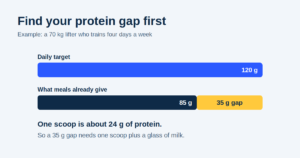
Imagine Hamza. He weighs 70 kg and trains four days a week. Active people often aim for 1.4 to 2.0 g of protein per kg. For Hamza, that’s about 100 to 140 g a day. Say he picks 120 g.
Next, he adds up what he eats. Two eggs at breakfast, chicken and rice at lunch, some yogurt, a bowl of daal at night. It comes to around 85 g. His gap is 35 g.
That number is the whole shopping decision. One scoop of whey fills most of it. If his gap were 5 g, he wouldn’t need powder. He’d do better spending the money on food.
You can do this in about a minute with the Fit4Ever protein calculator. The calorie intake calculator handles the calorie side. Do both before you pay for any Optimum Nutrition product.
Optimum Nutrition whey protein: what you get for each scoop
Optimum Nutrition whey protein, specifically Gold Standard 100% Whey, is the tub most people picture. Listings show a rounded scoop of roughly 30 g, which delivers about 24 g of protein for around 120 calories. Carbs are about 3 g, and fat sits near 1 to 1.5 g.
Check your own label, though. Listed scoop weights run from about 25 g to 32 g, depending on flavour and country. The numbers shift with them.
What the powder is made of
The protein comes from a blend of whey isolate, whey concentrate and whey peptides. Many flavours also include lactase, an enzyme that can make dairy easier on some stomachs. A few list Aminogen too.
Sweetness comes from sucralose in most flavours, and acesulfame potassium in some. If artificial sweeteners bother you, read the ingredients before committing to a 2 kg tub. Flavours differ.
How many scoops?
One is enough for most people. Two makes sense only when the gap is big, and food can’t close it.
Back to Hamza. His 35 g gap needs one scoop and a glass of milk. Three scoops a day would just be expensive protein his body doesn’t need.
Who gets real value
- People who regularly fall short of their protein number
- Anyone with a rushed morning who skips breakfast
- Vegetarians who eat dairy but struggle to reach their target
- Lifters who like a simple post-training drink
Who can skip it
If your meals already hit the target, powder adds nothing. Same if you can’t stand artificial sweeteners and find none you tolerate.
My view
Optimum Nutrition whey is a convenience product. It’s useful, and it’s not special. Muscle comes from lifting, eating enough, and sleeping properly. A scoop only makes the eating part easier.
Optimum Nutrition creatine: the dull supplement that earns its place
Nobody gets excited about creatine. It’s a white powder that dissolves in water and tastes of very little. Yet it has one of the biggest research bases in sports nutrition. That matters more than a flashy label.
What it does in your body
Muscles keep a small store of creatine. They burn it during short, heavy efforts, like a hard set of squats. The International Society of Sports Nutrition (ISSN) says your body replaces roughly 1 to 3 g a day. About half comes from food.
An ordinary diet leaves your stores around 60 to 80 percent full. Supplementing raises muscle creatine by roughly 20 to 40 percent. Think of topping up a tank that’s already three-quarters full.
Two ways to take it
The ISSN lays out two routes, and both work.
Fast route. Take about 0.3 g per kg of bodyweight for 5 to 7 days. Then drop to 3 to 5 g daily.
Slow route. Skip the loading and take 3 to 5 g every day. Your stores fill in about three to four weeks.
Bigger athletes might need 5 to 10 g a day to stay topped up.
Picture an 80 kg lifter. On the fast route, he takes about 24 g a day for a week (0.3 times 80). He splits it into four small doses. On the slow route, he takes 5 g a day and waits a month. He ends up in the same place either way. The slow route is kinder to the stomach and easier to remember.
Which type to buy
When you shop for Optimum Nutrition creatine, look for plain creatine monohydrate. The ISSN describes it as the most studied form, and fancier versions haven’t been shown to beat it.
Check the serving size too. Scoops differ from tub to tub.
Is it safe?
The ISSN reports good safety data. Studies ran up to 30 g a day for five years, and healthy participants tolerated it well. That’s reassuring, but it isn’t a guarantee for everybody.
Speak to a doctor first if you have kidney disease, take regular medication, are pregnant, or are under 18.
Four easy ways to get it wrong
- Skipping rest days. The point is to keep your stores full, so take it daily.
- Expecting a result in a week. Without loading, it takes a few weeks.
- Paying extra for fancy forms. Monohydrate does the job.
- Ignoring fluids. Drink normally, and a bit more when it’s hot.
Optimum Nutrition mass gainer: who really needs 1,250 calories?
A gainer exists for one kind of person: someone who simply can’t eat enough. For everyone else, it’s a lot of sugar in a shaker.
Serious Mass is the best-known Optimum Nutrition mass gainer. Two scoops, about 334 g, deliver roughly 1,250 calories and 50 g of protein. Add 250 g of carbs and under 5 g of fat. The protein comes from whey concentrate.
One review points out about 20 g of sugar per serving, which will put some people off. The US page also lists 19 vitamins and minerals, 8 g of glutamine and 11 g of BCAAs.
Labels change by country
A UK retailer lists 1,262 calories, 50 g of protein and 3 g of added creatine. The US page says up to 1,260 calories and 5 g of creatine.
So don’t copy numbers from a blog, including this one. Your own tub is the final word.
Why half a serving is smart
The UK listing suggests new users start with about half a serving, which is roughly 625 calories. That’s sensible advice.
Say you eat 2,300 calories a day and need about 2,800 to gain weight. You’re 500 short. Half a serving covers it without forcing an extra meal down your throat.
Who should leave it on the shelf
- Anyone cutting or holding their weight steady
- Anyone who already eats plenty
- Anyone who hates very sweet drinks
- Anyone who could simply eat more real food
A peanut-butter sandwich and a glass of milk do a similar job for far less money. A gainer buys convenience. It doesn’t buy anything magical.
Optimum Nutrition Pakistan: spotting fakes before they cost you
Wherever demand is high, and prices bounce around, fakes follow. If you’re buying Optimum Nutrition in Pakistan, authenticity matters more than flavour.
I couldn’t find a verified list of authorised sellers for the country. Start at the Optimum Nutrition website and look for approved distributors. Then compare at least three sellers if you’re hunting for Optimum Nutrition Pakistan prices.
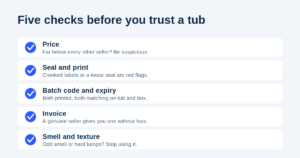
A five-point check
- Price. Far below everyone else? Be suspicious. Real tubs cost real money to make.
- Seal and printing. Crooked labels, blurry text, or a loose inner seal should worry you.
- Batch code and expiry. Both must be printed, and both must match on the tub and the box.
- Invoice. A genuine seller will give you one without fuss.
- Smell and texture. Strange odour or hard lumps? Stop using it.
Summer heat spoils real tubs too
Even a genuine tub suffers in a hot room. Keep it cool and dry with the lid tightly shut. Never leave it in a parked car, on a sunny windowsill or near the stove.
If something feels off, don’t gamble with it. A tub you can’t trust is worth nothing, so trust the seller before you trust the discount.
Optimum Nutrition UK: reading the label properly
Optimum Nutrition UK listings show nutrition per 100 g and per serving. Look at both columns. UK versions can differ from US ones, as the Serious Mass creatine figures already showed.
One UK listing names the manufacturer as Optimum Nutrition in Dublin, Ireland. Make sure the pack in your hands matches the shop you bought from.
Then check three things: serving size, calories per serving, and the allergen line.
Compare by serving, not by tub
Tub sizes vary a lot, and the biggest isn’t always the cheapest per scoop. Divide the price by the number of servings. It takes ten seconds and sometimes saves real money.
If you compete in a tested sport
Don’t assume anything. Look for batch-level certification on the pack, and ask the seller if you can’t find it.
How to add all three without wasting money
You don’t need every Optimum Nutrition product on day one. Stagger them.
Month one: whey. Close your protein gap and see how your meals change.
Month two: creatine. Take 3 to 5 g daily and give it a few weeks.
Month three: gainer, if needed. Only try it if you’re still not gaining despite eating more. Start at half a serving.
Adding one thing at a time shows you what works. Start everything together, and you’ll never know which one helped.
A sample day for a 70 kg lifter
- Breakfast: eggs, bread and a glass of milk
- Lunch: chicken, rice and vegetables
- After training: one scoop of whey and 5 g of creatine
- Dinner: daal, yogurt and roti
That lands near 120 g of protein, and most of it comes from ordinary food. The scoop tops it off.
Mistakes that waste money
- Buying Optimum Nutrition before calculating. Know your gap first.
- Chasing every new launch. Most repeat an older idea.
- Neglecting food quality. Whole food comes first.
- Cutting sleep. Recovery builds muscle; powder doesn’t.
- Trusting the lowest price. Cheap can mean fake.
- Doubling the scoops. More rarely means better.
Which Optimum Nutrition product should you buy?
| You are… | Best fit | Watch out for |
|---|---|---|
| Short on protein | Whey | Sweeteners, scoop size |
| A regular lifter | Creatine | Taking it daily |
| Underweight | Gainer, half serving | Sugar, very high calories |
| Buying in Pakistan | Any, from a trusted seller | Fakes, heat |
| Buying in the UK | Any | Label differences |
Questions people ask
Is Optimum Nutrition good for beginners?
Yes, if you pick the right product. Most beginners only need whey, and creatine can wait.
Does Optimum Nutrition whey help with weight loss?
Only indirectly. A scoop has about 120 calories and keeps you fuller, but it won’t burn fat on its own.
Should I take creatine before or after training?
Daily use matters most. The ISSN says taking it near training may help slightly.
Is a gainer the same as protein powder?
No. A gainer is mostly carbs for calories, while whey is mostly protein.
How can I tell if my tub is real?
Check the seal, printing, batch code, and expiry; buy from an authorised seller, and keep the invoice.
The short verdict
Optimum Nutrition is popular because it’s easy to find and easy to use. That’s a fine reason to consider it. It’s a poor reason to buy it.
Short on protein? Whey. Lifting hard? Add creatine. Struggling to gain weight? A gainer, starting at half a serving. Unsure? Do the maths, then buy one thing.
Your next step
Before you pay for any Optimum Nutrition product, find your numbers. The Fit4rEver macro calculator and protein calculator take a couple of minutes.
Then pick one product, not three. Want weekly tips without the hype? Join the Fit4rEver newsletter.
Disclaimer: This is general information, not medical advice. See a doctor before starting any supplement if you have a health condition or take medication. Formulas differ by country, so read your own label.
Sources: ISSN position stand on creatine (Kreider et al.) | Optimum Nutrition Serious Mass, official page
