
Think about what your legs did today. They sat bent under a desk, took the stairs, maybe squatted or sprinted for a bus, and then got zero attention before bed. Tight legs aren’t a mystery.
Leg stretches are the cheapest fix going. No gym, no gear, and a decent routine takes five to ten minutes. What trips people up is the practical stuff: which ones to do, how long to hold them, and when.
This guide sorts that out with 12 stretches, four routines, a four-week plan, and an honest look at what stretching can’t do. So what are the best leg stretches, and how do you do them properly? Let’s start.
Key takeaways
- Good leg stretches reach six areas: quads, hamstrings, calves, hip flexors, glutes, and inner thighs.
- Aim for roughly 30 seconds per stretch, two to four rounds on each side, as Mayo Clinic suggests.
- Do dynamic leg stretches before you train and keep the long holds for afterward.
- Stretching makes you more flexible. It won’t reliably stop next-day soreness.
How This Guide Was Put Together
This guide leans on Mayo Clinic’s guide to basic stretches, the Physical Activity Guidelines for Americans, the National Institute on Aging, a Cochrane review, and a 2016 systematic review by Behm and colleagues. It’s meant for healthy adults, so check with a doctor or physical therapist first if you’re injured or healing from surgery.
What Are the Best Leg Stretches? (Quick Answer)
The best leg stretches cover your six main leg areas: quads, hamstrings, calves, hip flexors, glutes, and inner thighs. Hold each one for about half a minute, keep the pull gentle, and don’t forget the other side.
Here Are All 12 At a Glance:
| Stretch | Muscle Targeted | Hold |
|---|---|---|
| Standing quad stretch | Quads | 30 sec per leg |
| Kneeling hip flexor stretch | Hip flexors | 30 sec per leg |
| Lying hamstring stretch | Hamstrings | 30 sec per leg |
| Standing hamstring stretch | Hamstrings | 30 sec per leg |
| Wall calf stretch | Upper calf | 30 sec per leg |
| Bent-knee calf stretch | Deep calf (soleus) | 30 sec per leg |
| Wide-stance inner thigh stretch | Inner thighs | 30 sec per side |
| Butterfly stretch | Inner thighs, groin | 30 sec |
| Figure-4 glute stretch | Glutes, outer hip | 30 sec per side |
| Standing IT band stretch | Outer hip and thigh | 30 sec per side |
| Shin stretch | Front of lower leg | 20 to 30 sec |
| Supine leg stretch with ankle circles | Hamstrings, calves, ankles | 20 to 30 sec per leg |
Short on time? Pick the hip flexor, hamstring, and calf stretches. If you sit a lot or run, those three are usually the ones holding you back.
Safe Rules for Leg Stretches
Even good leg stretches can go wrong when rushed.
- Warm up first. Five to ten minutes of brisk walking or easy cycling. Cold muscles resist being pushed.
- Stay smooth. No bouncing, and keep breathing the whole time.
- Back off early. A mild pull is the goal. Sharp or burning pain, numbness, or tingling means ease off.
- Be regular. Two to three days a week is the minimum Mayo Clinic suggests for your main muscle groups.
Quick Self-Check: Where Are Your Legs Tight?
Before you pick a routine, take two minutes to find your tight spots. A towel and a wall are all you need.
Towel hamstring check. Lie on your back, hook a towel around one foot and raise that leg, knee straight, until you feel a firm pull behind your thigh. Do the same on the other side. If one leg lifts much less than the other, start there.
Knee-to-wall ankle check. Stand facing a wall with your toes about four inches (10 cm) from it. Keeping your heel down, bend the knee and try to tap the wall. A lifting heel or a knee that stalls early points to your calf and ankle. These are rough checks, not diagnoses, so repeat them in two weeks.
Static vs Dynamic Leg Stretches: Which Comes First?
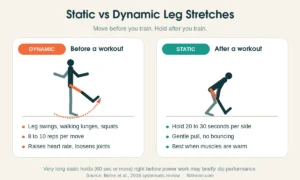
Dynamic leg stretches keep you moving, like leg swings and walking lunges. Static stretches are the hold-it-in-place kind, such as a 30-second hamstring stretch. The simple rule: move before you train, hold after.
Why the split? One 2016 review pooled the research and tied holds of a minute or longer to a slightly bigger short-term dip in performance, around 4.6%, versus about 1.1% for shorter holds. Dynamic work, done shortly before activity, showed small gains instead. Static holds feel best on warm muscles, so they make natural leg stretches after a workout.
Leg Stretches for the Front of Your Thighs and Hips
1. Standing Quad Stretch
Targets: quads. Hold: 30 seconds per leg.
- Stand beside a wall and rest one hand on it.
- Bend a knee, reach back for that ankle, and draw your heel toward your glutes.
- Keep your knees side by side and your belly gently pulled in so your lower back doesn’t arch.
Easier version: if your ankle is out of reach, loop a towel around it. Don’t let the knee wander forward.
2. Kneeling Hip Flexor Stretch
Targets: hip flexors, the muscles that lift your knee. Hold: 30 seconds per leg.
- Kneel on one knee with a folded towel underneath and plant the other foot in front, knee bent to about a right angle.
- Put your hands on your hips and stand tall through the chest.
- Squeeze the glute of the kneeling leg and glide forward until the front of that hip stretches.
Watch out: tuck your pelvis instead of arching your back. After eight hours in a chair, this is one of the most useful stretches on the list.
Hamstring and Calf Stretches for the Back of Your Legs
3. Lying Hamstring Stretch
Targets: hamstrings. Hold: 30 seconds per leg.
- Lie on your back with one leg through a doorway and the other heel propped on the wall, knee soft.
- Straighten that leg gradually until the back of the thigh feels stretched.
Easier version: no doorway? Lift the leg with a towel around your foot. Keep your hips on the floor.
4. Standing Hamstring Stretch
Targets: hamstrings. Hold: 30 seconds per leg.
- Rest one heel on a low bench or the bottom stair, toes pointing up.
- Hinge forward at the hips, back flat, until you feel the pull.
Watch out: don’t round your back to chase your toes. If it’s too intense, soften the standing knee.
5. Wall Calf Stretch
Targets: the upper calf. Hold: 30 seconds per leg.
- Face a wall with your hands on it at chest height, then step one foot back, leg straight and heel down.
- Bend the front knee and lean toward the wall.
Good to know: keep the back foot pointing forward, and shorten your step if the heel pops up.
6. Bent-Knee Calf Stretch
Targets: the deeper calf muscle (soleus). Hold: 30 seconds per leg.
- Set up like the wall calf stretch, but with your back foot closer.
- Bend the back knee a little, keep the heel planted, and lean in.
Good to know: the two calf muscles cross different joints, so stubborn calves need both versions.
Stretches for Inner Thighs, Outer Thighs and Glutes
7. Wide-Stance Inner Thigh Stretch
Targets: inner thighs. Hold: 30 seconds per side.
- Step your feet wide apart, toes angled slightly out.
- Bend your right knee and sink toward it until your left inner thigh stretches.
Easier version: shrink the stance or steady yourself on a chair.
8. Butterfly Stretch
Targets: inner thighs and groin. Hold: 30 seconds.
- Sit tall with the soles of your feet touching and your knees dropped out to the sides.
- Tip forward slowly from the hips.
Easier version: sit on a folded towel to lift your hips. Let your knees fall on their own rather than pressing them.
9. Figure-4 Glute Stretch
Targets: glutes and outer hip. Hold: 30 seconds per side.
- Lie on your back with both knees bent.
- Rest your right ankle across your left thigh, then draw the left thigh toward your chest.
Easier version: prefer a chair? Cross an ankle over the opposite knee and lean forward with a long spine.
10. Standing IT Band Stretch
Targets: outer hip and thigh. Hold: 30 seconds per side.
- Stand near a wall for balance and tuck your left foot behind your right.
- Raise your left arm overhead and lean toward the right.
Good to know: the IT band itself hardly lengthens, so you’re mostly stretching the muscles around your outer hip. That’s still worth doing.
Stretches for Shins, Ankles and Feet
11. Shin Stretch
Targets: the front of the lower leg. Hold: 20 to 30 seconds.
- Kneel on a mat with the tops of your feet flat on the floor.
- Slowly lean back toward your heels.
Easier version: slide a rolled towel under your ankles. Skip this one if your knees object.
12. Supine Leg Stretch With Ankle Circles
Targets: hamstrings, calves, and ankles. Hold: 20 to 30 seconds per leg.
- Lie on your back and hug one knee to your chest, then send that leg up toward the ceiling.
- Point and flex the foot three times, then trace three ankle circles in each direction.
Good to know: it’s a gentle wake-up you can do before you leave bed.
Ready-Made Leg Stretch Routines
Pick whichever fits your day.
| Routine | Time | What to Do |
|---|---|---|
| Desk break | 5 min | Hip flexor, standing hamstring and wall calf stretches, 30 seconds a side. Do it at lunch and again mid-afternoon. |
| Bedtime wind-down | 5 min | Lying hamstring with a towel (45 sec per leg), figure-4 (45 sec per side), then butterfly (60 sec). Keep it easy. |
Pre-Workout Routine: Dynamic Leg Stretches (8 Minutes)
These leg stretches before a workout wake your body up gradually: march in place for 2 minutes, then do 10 front-to-back and 10 side-to-side leg swings per leg, 8 walking lunges per leg, 10 bodyweight squats, and 10 ankle circles each way.
Post Leg Day Routine: Leg Stretches After a Workout (10 Minutes)
Go through two rounds of the quad, lying hamstring, figure-4, wide-stance inner thigh, and wall calf stretches, 30 seconds a side. Stretching is only part of recovery, so check your fluid target with our water intake calculator, your protein needs with our protein calculator, and browse our Recovery section.
Good Leg Stretches for Different Goals
- Runners and cyclists: calves, hip flexors, quads, and the outer hip. After a 5K, a few minutes goes a long way.
- Gym lifters: the post-leg-day routine, with long holds kept away from the minutes before a heavy set. Our Strength section covers training.
- Desk workers: hip flexors and hamstrings first, twice a day.
- Older adults: seated or supported versions, such as a seated hamstring stretch at the edge of a sturdy chair. The National Institute on Aging counts flexibility as one of four exercise types.
- Beginners: good leg stretches to start with are the lying hamstring, wall calf, and hip flexor stretches.
- Night cramps: a gentle calf stretch may ease one while it’s happening. If cramps keep showing up several times a week, talk to a doctor.
Your 4-Week Leg Flexibility Plan
Flexibility builds slowly, so raise the load a little at a time.
| Week | Days Per Week | Hold Time | Sets Per Side | Focus |
|---|---|---|---|---|
| 1 | 2 to 3 | 20 to 30 sec | 1 to 2 | Hamstring, calf, hip flexor |
| 2 | 3 | 30 sec | 2 | Add quad and figure-4 glute |
| 3 | 3 to 4 | 30 sec | 2 to 3 | Add inner thigh and butterfly |
| 4 | 4 to 5 | 30 to 45 sec (if comfortable) | 3 | Full routine |
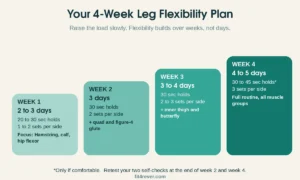
Redo the two self-checks at the end of week 2 and week 4. Expect a change after a few weeks, not a few days. Some early progress is your nervous system relaxing into the stretch rather than the muscle getting longer, which is why gains slip if you stop.
Common Leg Stretching Mistakes
- Bouncing. Ease in and stay still.
- Holding your breath. Breathe slowly and let go a little on each exhale.
- Stretching cold. Move around for 5 to 10 minutes first.
- Pushing into pain. A mild pull is enough.
- Locking your knees. Keep a soft bend.
- Wanting results by Friday. Judge progress at the end of the 4-week plan.
Do Leg Stretches Really Prevent Injury and Soreness?
Stretching reliably gives you more range of motion. Past that, the science gets messier.
Take soreness first. A Cochrane review combined 12 randomized trials to see whether stretching before or after exercise eases the aching that shows up a day or two later. It didn’t, at least not by an amount you’d notice in real life. So if you’re hoping it will spare you that stairs-hurt-on-Wednesday feeling after Monday’s squats, it probably won’t.
Injuries are a similar story. The Behm review found nothing convincing that holding static stretches, or PNF stretching, cuts your overall or overuse injury risk. What it did back was stretching inside a warm-up that finishes with dynamic movement, which seemed to help with muscle injuries and joint range of motion.
So stretch to move better and feel looser, not to dodge soreness. For injury protection, add strength gradually and warm up properly. The Physical Activity Guidelines for Americans put aerobic work and muscle-strengthening first for good reason.
When to Skip or Modify Stretching
Hold off, or check with a professional, if any of these sound like you:
- A fresh muscle strain or tear. Stretching it can set you back.
- Recent surgery on the leg, hip, knee, or back.
- Sharp pain, numbness, or tingling while stretching.
- Osteoporosis. Mayo Clinic suggests avoiding the knee-to-chest stretch.
- Very loose joints. Building stability matters more than stretching deeper.
See a doctor if you notice swelling, a joint that locks or gives way, or pain that won’t settle with rest.
Frequently Asked Questions About Leg Stretches
What are the best leg stretches?
The ones that reach all six areas above. Pressed for time, begin with the hip flexor, hamstring, and calf stretches.
How long should I hold a leg stretch?
Aim for about 30 seconds, repeated two to four times a side. Beginners can start at 20.
Should I stretch before or after a workout?
Both, in different ways. Do dynamic leg stretches before, and save longer holds for afterward.
What leg stretches should I do before a workout?
For leg stretches before a workout, stick to movement: leg swings, walking lunges, bodyweight squats, and ankle circles, around eight minutes in total.
What are the best leg stretches after a workout?
Quads, hamstrings, glutes, inner thighs, and calves. The post-leg-day routine above covers every one.
What are good leg stretches for tight hamstrings?
Begin with the lying hamstring stretch using a wall or towel, then graduate to the standing version.
Can leg stretches help with leg cramps?
A gentle calf stretch often eases a cramp while it’s happening. If cramps are frequent, mention it to your doctor.
Final Thoughts: Are Leg Stretches Worth It?
They are, if you keep expectations honest. Leg stretches won’t make you injury-proof or wipe out soreness, but they do help you move more freely and wind down after a long day or a tough session.
- Cover all six muscle areas, holding each stretch about 30 seconds with no bouncing
- Move before workouts and hold after
- Start with the 5-minute desk routine, then follow the 4-week plan
- Stop and get advice for sharp pain, numbness, or a recent injury
Pick one routine and do it three times this week. Want more practical guides in your inbox? Join the free Fit4rEver weekly newsletter or browse our latest articles.
Sources and Further Reading
- A guide to basic stretches, Mayo Clinic
- Physical Activity Guidelines for Americans, U.S. Department of Health and Human Services
- Four types of exercise can improve your health and physical ability, National Institute on Aging
- Stretching to prevent or reduce muscle soreness after exercise, Cochrane Database of Systematic Reviews
- Acute effects of muscle stretching on physical performance, range of motion, and injury incidence, Behm et al., 2016
Medical note: This article is general information, not medical advice, and it can’t replace a conversation with your own doctor or physical therapist, especially if you have pain, an injury, or a health condition. Read our full health disclaimer.
