
Two people are 175 cm tall and weigh 77 kg. Same BMI: 25.1. One has an 82 cm waist and lifts weights four days a week. The other has a 97 cm waist and hasn’t trained in years. The scale, the formula and the label are identical. Their health is not.
A good BMI calculator gives you your own number in two seconds. What it can’t do is tell you what the number means for your body. Most pages skip that part. This guide doesn’t.
Quick Answer: Your BMI in One Formula
BMI = weight in kg ÷ height in metres squared.
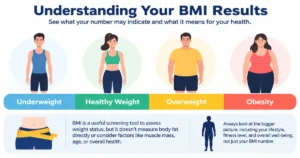
- Below 18.5: your weight sits under the healthy band
- 18.5 up to 24.9: right inside the healthy band
- 25.0 up to 29.9: above the healthy band
- 30.0 or higher: well above it, so a doctor’s opinion is worth getting
These adult bands come from the NHLBI and the WHO. They come with some big exceptions, and we’ll cover each one below.
What Is a BMI Calculator, and What Does It Measure?
BMI is short for body mass index. Put simply, it compares how much you weigh with how tall you are. A BMI calculator takes two numbers and gives you one.
Adolphe Quetelet, a Belgian mathematician, first worked out this ratio in the 19th century. He wanted to describe average body size across a population, not to grade one individual. Doctors still use it because it’s cheap, fast, and a decent first screen.
Here’s the catch. A BMI calculator can’t see muscle, bone, or where your fat sits. The NHLBI makes the same point: the score can’t separate muscle, bone, and fat. Think of it as a smoke alarm. It tells you to look closer. It doesn’t tell you what’s burning.
How Do I Calculate My BMI?
Every BMI calculator, online or in your phone’s health app, runs one of two formulas.
Metric: your weight in kilograms, divided by your height in metres, divided by your height in metres again
Imperial: multiply your weight in pounds by 703, then divide by your height in inches, twice
Let’s do it by hand with the NHS example. Someone weighs 70 kg and is 1.70 m tall.
- Square the height: 1.70 × 1.70 = 2.89
- Divide the weight: 70 ÷ 2.89 = 24.2
That’s healthy. Now the imperial version. Say you weigh 180 lb and stand 5 ft 9 in.
- Convert height to inches: (5 × 12) + 9 = 69
- Square it: 69 × 69 = 4,761
- Multiply weight by 703: 180 × 703 = 126,540
- Divide: 126,540 ÷ 4,761 = 26.6
That lands in the overweight range, but only just. Which brings up the next point: always check the cut-offs before you panic.
BMI Calculator kg: The Easy Metric Method
If you know your weight in kilograms and your height in metres, you’re ten seconds from an answer.
Take someone who weighs 60 kg and stands 1.65 m. Square the height: 1.65 × 1.65 = 2.7225. Then 60 ÷ 2.7225 = 22.0. Healthy.
A few tips so your number is actually useful:
- Step on the scale in the morning, once you’ve used the bathroom and before breakfast.
- Use the same scale every time. Different scales can disagree by a kilo or more.
- Don’t sweat daily swings. For someone 1.70 m tall, 1 kg is only worth about 0.35 BMI points.
Only have pounds? Divide by 2.205 to get kilograms.
BMI Calculator cm: What to Do With Height in Centimetres
Most online tools ask for height in cm. You have two options.
Option 1: Divide your height by 100 to get metres. 175 cm becomes 1.75 m.
Option 2: Use this shortcut: weight ÷ (height in cm × height in cm) × 10,000.
Example: 80 kg and 175 cm. 175 × 175 = 30,625. Then 80 ÷ 30,625 = 0.00261. Multiply by 10,000, and you get 26.1. That’s in the overweight range.
The classic mistake is forgetting the 10,000. If your answer comes out as 0.0026, it’s a units problem, not a health problem.
Want to skip the math? Find your height here and read off the healthy weight range (BMI 18.5 to 24.9).
| Height | Healthy weight range |
|---|---|
| 150 cm (4 ft 11 in) | 41.6 – 56.0 kg |
| 160 cm (5 ft 3 in) | 47.4 – 63.7 kg |
| 170 cm (5 ft 7 in) | 53.5 – 72.0 kg |
| 180 cm (5 ft 11 in) | 59.9 – 80.7 kg |
| 190 cm (6 ft 3 in) | 66.8 – 89.9 kg |
Notice how wide those ranges are. At 170 cm, there’s an 18 kg gap between the low and high end of “healthy.” Where you sit inside that range depends on your frame, muscle, and genetics.
BMI Quick Lookup: Height and Weight at a Glance
Don’t feel like doing math? Use this grid. Think of it as a paper BMI calculator for three common heights, built from the same formula as above. Find your height, slide across to your weight, and read the number.
| Weight | 160 cm | 170 cm | 180 cm |
|---|---|---|---|
| 50 kg | 19.5 | 17.3 | 15.4 |
| 60 kg | 23.4 | 20.8 | 18.5 |
| 70 kg | 27.3 | 24.2 | 21.6 |
| 80 kg | 31.3 | 27.7 | 24.7 |
| 90 kg | 35.2 | 31.1 | 27.8 |
| 100 kg | 39.1 | 34.6 | 30.9 |
Here’s something most BMI pages never mention. To move your BMI by one full point, your weight has to change by your height in metres squared, in kilograms. At 160 cm, that’s about 2.6 kg. At 170 cm it’s 2.9 kg. At 180 cm it’s 3.2 kg.
So shorter people feel every kilo more. It also means a 2 kg water-weight swing moves a 170 cm person by less than one point. Don’t read too much into a single weigh-in.
BMI Calculator kg and Feet: For US, UK and Canadian Users
Mixed units are everyday life if you’re in the UK, Canada, or anywhere that uses kilos for weight and feet for height. Here’s how to handle it.
Convert feet and inches to total inches, then multiply by 0.0254 to get metres. Say you’re 5 ft 9 in and weigh 70 kg:
- Total inches: 69
- Metres: 69 × 0.0254 = 1.753
- Square it: 1.753 × 1.753 = 3.073
- Divide: 70 ÷ 3.073 = 22.8
And a pure imperial example. Someone who is 5 ft 4 in and weighs 140 lb has a height of 64 inches. 140 × 703 = 98,420. 64 × 64 = 4,096. 98,420 ÷ 4,096 = 24.0. Healthy.
UK readers who think in stone: 1 stone is 14 lb, or about 6.35 kg.
A quick note on units by country. Habits differ. In the US, people mostly think in pounds and feet. In the UK and Ireland, body weight is often given in stone and pounds while height is in feet and inches. Australia and New Zealand lean fully metric, with kg and cm. Canada tends to mix both. Whatever you use, convert before you type, so the BMI calculator receives the units it expects.
5 BMI Calculator Mistakes That Give You the Wrong Number
Most “bad” results come from the input, not the tool. Before you trust any BMI calculator, check these five things.
- Mixing units. Typing pounds into a kg box is the classic slip. Enter 154 lb as if it were kg at 1.70 m, and you get a BMI of 53.3 for an average adult.
- Rounding your height. Height is squared, so small errors grow fast. Going from 1.70 m to 1.75 m drops a 70 kg person’s BMI from 24.2 to 22.9.
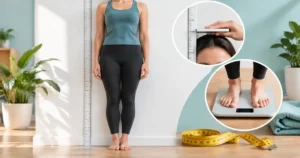
- Measuring in shoes. Shoes add 2 to 3 cm. Stand barefoot.
- Guessing your weight. Many people guess low. Step on a scale instead.
- Slouching. Stand tall with your heels against a wall and your eyes forward.
Get these five right, and every BMI calculator you try will agree with the others down to the decimal.
BMI Calculator kg With Age: Does Age or Gender Change Your Result?
Short answer: for adults, no. The formula and cut-offs are the same at 25 and at 65, for men and for women. What changes is what the number means.
Under 20. Children and teenagers get a different test. Their BMI is plotted on growth charts for their age and sex. The NHS runs a separate child tool for ages 2 to 17, and the Heart Foundation warns that the adult method is unreliable up to age 19.
Over 65. This is where it gets interesting. A meta-analysis on BMI and mortality in older adults found the lowest death risk at a BMI higher than the textbook healthy range, roughly 24 to 30 in that analysis. So a slightly “overweight” number later in life isn’t automatically bad news. Losing muscle is often the bigger worry, and BMI can’t see that.
Men vs women. Same formula, different bodies. At the same BMI, women tend to carry more body fat than men, and they store it in different places. That’s one reason a waist measurement is worth adding.
When a BMI Calculator Gets It Wrong
A BMI calculator is a blunt tool. These are the people it fails most often.
The muscular lifter. Take someone who’s 183 cm and 95 kg with a solid training history. Their BMI is 28.4, which says “overweight.” They might carry very little fat. To the formula, a kilo of muscle and a kilo of fat look the same.
People of Asian descent. Someone who’s 168 cm and 70 kg has a BMI of 24.8. That’s “healthy” on the standard chart. But a WHO expert panel suggested that risk starts climbing sooner in Asian populations, from about BMI 23. UK health guidance goes wider and also names Black African, African-Caribbean and Middle Eastern backgrounds, where problems can show up at a lower BMI. If that’s you, treat 23 as your cue to check your waist and blood sugar.
Pregnancy, under 18, and fluid conditions. Pregnancy, the teenage years, serious athletic training, and fluid-retaining conditions such as heart failure can all throw the number off.
The “skinny fat” person. Not a medical term, but you know the type. A BMI of 22, very little muscle, and a soft belly. The calculator says all clear. A waist measurement or body-fat check would say otherwise.
Anyone struggling with food. If you have, or think you might have, an eating disorder, the NHS advises against using its BMI tool. If the number on the scale controls your mood, skip the calculator and talk to your doctor. That’s not weakness. It’s the smart move.
Same BMI, Different Bodies: 3 Quick Profiles
Numbers hide stories. Picture three adults, all 175 cm and 77 kg. Each gets a BMI of 25.1. These are made-up profiles, but they show the problem clearly.
- The rugby player trains four days a week and has an 82 cm waist. Lots of muscle, low risk.
- The desk worker hasn’t trained in years and carries a 97 cm waist. Same weight, more belly fat, higher risk.
- The 70-year-old has lost muscle and gained fat. Same scale weight, weaker body.
A BMI calculator hands all three the same label: overweight. Only a waist measurement, a strength check, and a doctor’s visit can tell them apart. That’s why your BMI calculator result should start the conversation, not end it.
BMI vs Other Measures: Which One Tells You What?
No single number covers everything. This table shows what each common measure does well, and where it goes blind.
| Measure | What it tells you | What it misses | What you need |
|---|---|---|---|
| BMI | Weight relative to height | Muscle vs fat, where fat sits | A scale and a height measure |
| Waist size | How much fat sits around your middle | Total body fat | A tape measure |
| Waist-to-height ratio | Belly fat relative to your frame | Overall weight | A tape measure |
| Body fat percentage | The share of your weight that is fat | Where it is stored, with some methods | A body-fat scale, calipers, or a scan |

Use a BMI calculator as the quick first look, then pick one or two rows from this table to build the fuller picture.
Beyond BMI: 3 Numbers to Check Next
1. Your waist. Wrap a tape around your bare midsection, at the midpoint between the bottom of your ribs and the top of your hip bone, and breathe out normally. In UK guidance, risk starts to rise at 94 cm for men and 80 cm for women, and becomes high at 102 cm and 88 cm. The Heart Foundation also recommends looking at waist measurement alongside BMI.
2. Waist-to-height ratio. Keep your waist below half your height. At 175 cm tall, that’s under 87.5 cm. It works across heights, which makes it fairer than fixed cut-offs.
3. Blood pressure, cholesterol and blood sugar. BMI is only one piece of heart-attack and stroke risk. Your GP can check the rest in one visit.
Want a closer look at fat vs muscle? Try the body fat calculator next.
What to Do With Your Result
Under 18.5. Rule out medical causes first: thyroid issues, digestion problems, stress. Then eat more and lift weights so the extra calories turn into muscle, not just fat. The calorie intake calculator can give you a surplus target.
18.5 to 24.9. Don’t chase a lower number. Keep moving, keep your protein up, and re-check every few months.
25 and above. Skip the crash diets. Small, boring changes win: walk more, cut liquid calories, sleep properly. Dropping even 5 to 10 percent of your body weight tends to bring blood pressure and blood sugar down. On a 90 kg person, that’s 4.5 to 9 kg. The calorie deficit calculator shows a safe daily target, and the ideal weight calculator gives you a second opinion on your goal.
If you’re above 30, or you’re in one of the groups where BMI misleads, book a chat with your doctor or a registered dietitian. The NHLBI also has practical tips on eating and activity under its calculator.
BMI Calculator FAQs
Is a BMI calculator accurate?
The math is exact. The insight is limited. It’s a solid screen across large groups and a rough guide for one person.
What is a healthy BMI for men and women?
18.5 to 24.9 for both, using standard adult cut-offs. Remember the exceptions above.
How often should I check my BMI?
Every 8 to 12 weeks is plenty. Weight bounces around daily, and your BMI will too.
Can I use a BMI calculator for my child?
No. Children are measured against age and sex percentiles. Use a child-specific tool or ask your pediatrician.
Does a BMI calculator work for bodybuilders?
Not well. Muscle is denser than fat, so a lean, muscular person can land in the overweight range. Use body fat percentage and waist size instead.
What BMI is too low?
Under 18.5 counts as underweight. The WHO classifies anything below 16 as severe thinness, so get medical advice quickly if you’re there.
Will my BMI change if I gain muscle?
Yes, and it can go up even while your body fat drops. Any BMI calculator will show the rise, so track your waist and strength numbers too.
Final Word: Use the Number, Don’t Obey It
Your BMI is one data point. Pair it with your waist, your strength, how you feel, and your blood work, and you’ve got a real picture. Use it alone, and you’ve got a rough sketch.
Your next step: Open the free BMI calculator, write down your BMI and your waist measurement, and set a reminder to check again in 8 weeks. Then tell us what you found in the comments.
Sources
- NHS adult BMI tool
- NHLBI BMI tool and healthy-weight tips
- Heart Foundation Australia BMI page
- WHO Global Health Observatory data on BMI
- Winter et al. (2014), older-adult BMI and death risk, American Journal of Clinical Nutrition
I cross-checked every figure below with the NHS, the NHLBI, the World Health Organization and the Heart Foundation. Use it to understand your result, not to diagnose yourself.
Medical disclaimer: Nothing here replaces a consultation. If you’re unsure what your result means for you, ask your doctor before you change how you eat or train.
