
If you just typed “how to calculate my TDEE for weight loss” into Google, you’ve probably already clicked through two or three calculator pages that handed you a number and nothing else. Here’s the difference in this one: it shows you the actual math, not just the answer box.
Type your stats into any TDEE calculator and it hands you back a clean, confident number – 2,400, 1,850, whatever yours came out to. It looks precise. It isn’t, and treating it like gospel is why so many carefully-planned diets quietly stall out around week three.
Here’s the pattern I see constantly: someone eats exactly what the calculator told them to, subtracts 500 because that’s what they read somewhere, and settles in at 1,900 calories a day.
Three weeks pass. The scale hasn’t moved a gram. They start wondering if their metabolism is broken.
It usually isn’t. What’s happened is they picked the wrong activity level, and the calculator had no way of knowing.
Nobody tells you this on the calculator pages, but the equation underneath carries a margin of error of about 10–15%. And the one input you choose yourself – how active you really are – can swing the result by 300–400 calories on its own. The number you get isn’t a measurement. It’s a starting guess.
This guide is the complete answer to how to calculate my TDEE for weight loss — the actual formula, then how to check that estimate against your own body using two weeks of real data, which is the only way anyone finds their true number.
If you’d rather skip the arithmetic, our TDEE calculator runs the same formula automatically — this article is what’s happening behind that number.
Most articles on this stop at the calculator. This one goes further, because the calculator is only ever the first draft of your number, not the final answer.
Quick version – How To Calculate My TDEE for Weight Loss in Three Moves: work out your BMR with the Mifflin-St Jeor equation, multiply it by an activity factor between 1.2 and 1.9, then cut 10-20% off the result.
What TDEE Actually Measures
Your body burns calories four ways, and they’re not close to equal.
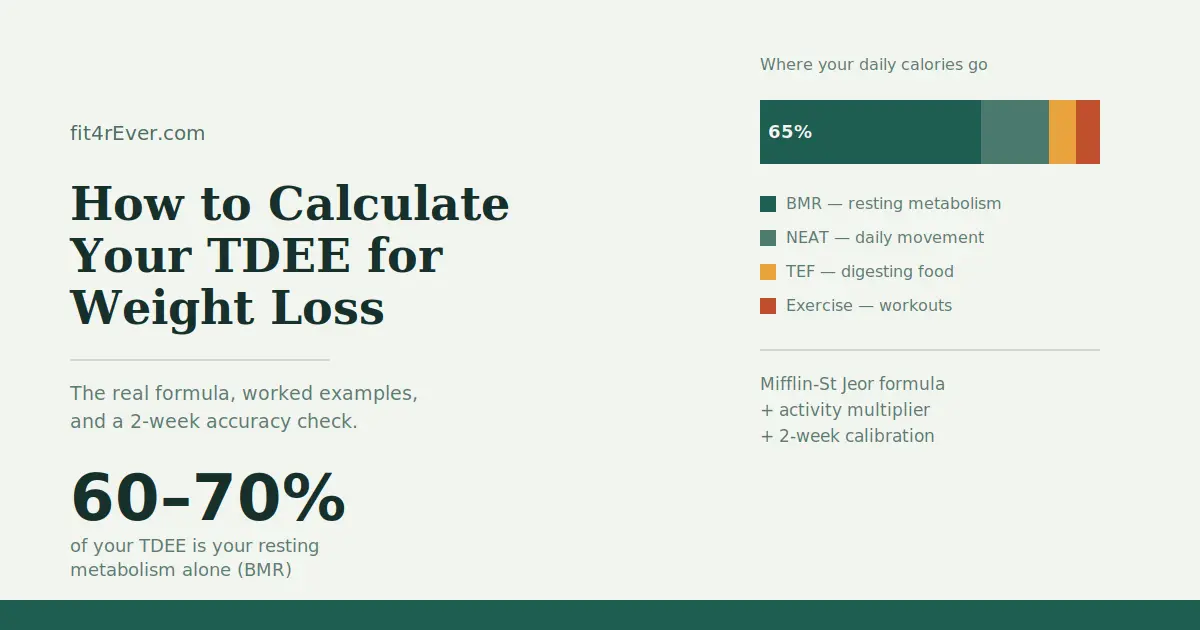
BMR (basal metabolic rate) is the biggest slice – 60–70% of your total. That’s just staying alive: heart, lungs, brain, cell repair. What you’d burn lying still all day. You can calculate it separately with our BMR calculator.
NEAT (non-exercise activity) is everything else you do – walking, standing, fidgeting, taking the stairs. Usually 15–30% of your total, and research on physical activity patterns shows it varies more between individuals than almost any other component of daily energy burn <sup>[1]</sup>.
Exercise is usually only 5–15%. Lower than most people assume.
TEF (thermic effect of food) is around 10% – the energy spent digesting what you eat, and it shifts slightly depending on meal timing and composition <sup>[2]</sup>.
For most people with a desk job and a few gym sessions a week, NEAT does more work than the gym does. Four workouts is four hours out of 168 in a week. Keep that in mind – it matters a lot when we get to picking your activity level.
BMR isn’t TDEE, and mixing them up gets expensive. BMR is your burn doing nothing; TDEE is BMR plus everything you actually do. For most people, TDEE runs 30–60% higher than BMR. Eat at your BMR thinking you’re being careful, and you’re actually 600–900 calories under maintenance – not a diet, closer to a crash.
One more thing: TDEE and “maintenance calories” are the same number, just different names. Understanding these four pieces – BMR, NEAT, exercise, and TEF – is the foundation of how to calculate my TDEE for weight loss accurately, instead of just borrowing a number off a dropdown menu.
Step 1: Calculate Your BMR (Mifflin-St Jeor)
The actual work of how to calculate my TDEE for weight loss starts here, with your BMR. This is the formula most decent calculators run behind the scenes, and the one the American Council on Exercise considers most accurate for general use.
Metric:
- Men: (10 × weight in kg) + (6.25 × height in cm) − (5 × age) + 5
- Women: (10 × weight in kg) + (6.25 × height in cm) − (5 × age) − 161
Imperial:
- Men: (4.536 × weight in lbs) + (15.88 × height in inches) − (5 × age) + 5
- Women: (4.536 × weight in lbs) + (15.88 × height in inches) − (5 × age) − 161
(1 kg = 2.205 lbs, 1 inch = 2.54 cm)
Note on the sex variable: it reflects average body composition differences, not identity. Trans and non-binary readers can use whichever category matches their current hormonal profile, and should lean more on the Step 5 calibration than the formula itself.
Sarah: 34, 165 cm, 72 kg
(10×72) + (6.25×165) − (5×34) − 161 = 720+1,031−170−161 = 1,420Marcus: 45, 180 cm, 90 kg
(10×90) + (6.25×180) − (5×45) + 5 = 900+1,125−225+5 = 1,805We’ll carry both through the rest of this. Prefer not to do the arithmetic by hand? Our BMR calculator runs this exact equation.
Step 2: Pick Your Activity Multiplier (Where Most People Go Wrong)
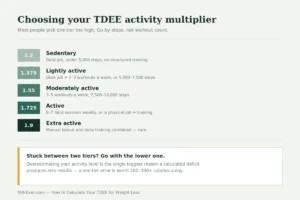
[IMAGE 2 — insert here] activity-multiplier-chart.png (1200×800) Alt text: TDEE activity multiplier chart — sedentary to extra active File name: tdee-activity-multiplier-chart.png
| Level | Multiplier | What it looks like |
|---|---|---|
| Sedentary | 1.2 | Desk job, under 5,000 steps, no training |
| Lightly active | 1.375 | Desk job + 1–3 workouts, or 5,000–7,500 steps |
| Moderately active | 1.55 | 3–5 workouts, 7,500–10,000 steps |
| Active | 1.725 | 6–7 hard sessions, or physical job + training |
| Extra active | 1.9 | Manual labour + daily training. Rare. |
Most people pick a tier too high. Someone at a desk who lifts four times a week reads “moderately active — 3 to 5 days” and picks 1.55. But four sessions is five hours out of 168 – the rest of that week they’re sitting. Realistically, that’s lightly active: 1.375.
For Sarah, that one tier is the gap between 1,953 and 2,201 calories – a 250-calorie swing based purely on which box she ticks. Pick too high and you might be eating at maintenance for a month while thinking you’re in a deficit.
Better approach: go by your step count, not your gym schedule. Steps capture NEAT, which is what actually differs between two people who train identically. Check your phone’s monthly average before choosing — our guide on how many steps a day you actually need to lose weight breaks this down further.
If you’re stuck between two tiers, go lower. Underestimating means you lose a bit faster than planned – easy to notice and adjust. Overestimating means nothing happens, and that’s what makes people quit.
Sarah — desk job, 3 sessions/week, ~6,500 steps → lightly active
1,420 × 1.375 = 1,953 caloriesMarcus — warehouse job, 2 sessions/week, ~12,000 steps → very active
1,805 × 1.725 = 3,114 caloriesMarcus trains less than Sarah and still ends up much higher – his job is doing the work his gym schedule isn’t. Get this input wrong, and the rest of how to calculate my TDEE for weight loss falls apart with it, no matter how careful you were with the formula in Step 1.
Step 3: Set Your Deficit
This is the step where how to calculate my TDEE for weight loss stops being an academic exercise and turns into an actual plan. TDEE is maintenance. To lose fat, eat under it.
“Cut 500 calories” means different things to different people – for Marcus that’s 16% of his intake, for Sarah it’s 26%. Better to think in percentages: 10–20% below TDEE. Lower end if you’re already lean, higher if you have more to lose. Beyond 20–25%, talk to a doctor. The CDC’s guidance on sustainable weight loss backs this range as well <sup>[3]</sup>.
That should produce roughly 0.5–1% of bodyweight lost per week. If you want a longer-range view of how that adds up, see our breakdown of how long it actually takes to lose significant weight.
Sarah at 15%: 1,953 − 293 = 1,660 calories Marcus at 20%: 3,114 − 623 = 2,491 calories
Or skip the manual subtraction with our calorie deficit calculator, which does Steps 1–3 in one pass.
Two Guardrails:
Don’t go below ~1,200 calories/day (women) or ~1,500 (men) without medical supervision. Below that, meeting micronutrient needs gets hard and adherence falls apart. If your maths pushes you under the floor, stretch the timeline instead of lowering the floor.
Get protein to 1.6–2.2 g per kg bodyweight (0.7–1.0 g/lb) – use our protein calculator to find your daily target, or our macro calculator for a full split.
Without enough protein and some resistance training, a real chunk of what you lose in a deficit is muscle — which lowers your BMR, which shrinks the deficit you calculated. It’s the quiet reason diets “stop working” around week six.
And if you’re tempted to just cut harder and get it over with faster — you can, but you’ll lose more muscle doing it, and your body will quietly make you move less without you noticing. The deficit you end up with on paper often isn’t the one you actually get in practice.
Step 4: Which Formula Should You Use?
Not every version of how to calculate my TDEE for weight loss uses the same equation, and that’s the source of most of the confusion between calculators. Here’s how to choose:
Don’t know your body fat % → Mifflin-St Jeor (what we used above). Most accurate general equation, uses numbers you already have.
Have a reliable body fat reading (DEXA, BodPod, or consistent calipers — not a bathroom scale) → Katch-McArdle:
Lean mass = weight × (1 − body fat %)
BMR = 370 + (21.6 × lean mass in kg)
More accurate if you’re notably muscular or lean – weight-based formulas can’t tell 90 kg of muscle from 90 kg that isn’t. Get your reading with our body fat calculator (US Navy method) if you don’t have a DEXA scan handy.
BMI over ~40 → treat any result as a rough guess and lean on Step 5; worth raising with a doctor.
A 150–250 calorie gap between two “reputable” calculators is normal – different equations and multiplier tables, not an error. It’s also exactly why doing this by hand once, rather than trusting whichever calculator you land on, is worth the ten minutes when you’re working out how to calculate my TDEE for weight loss properly.
Step 5: Verify With Two Weeks of Real Data
[IMAGE 3 — insert here] calibration-chart.png (1200×750) Alt text: 2-week TDEE calibration chart — daily weight vs weekly average File name: tdee-2-week-calibration-chart.png
Every formula above carries 10–15% error. For Sarah, that’s a range of 1,660 to 2,250. This step closes that gap, and it’s the part almost every guide on how to calculate my TDEE for weight loss skips entirely. For a deeper walkthrough of this exact method, see how to find your real calorie number.
The protocol:
- Eat at your calculated maintenance for 14 days – not the deficit, maintenance.
- Weigh food (not eyeball it) for these two weeks.
- Weigh yourself daily, same conditions – morning, post-bathroom, before eating.
- Average days 1–7, average days 8–14, compare those two numbers. Never compare single days.
The maths: roughly 0.45 kg (1 lb) of weekly change ≈ 500 calories/day of error.
Say Sarah eats 1,950/day for two weeks. Week one averages 72.4 kg, week two 72.1 kg — down 0.66 lb.
0.66 × 500 = 330 cal/day
1,950 + 330 = ~2,280 calories
Her real maintenance is closer to 2,280, not 1,953. Without checking, she’d have been eating 300 calories a day below her intended target.
Why weeks 1–2 often look flat even when it’s working: glycogen holds water (a carb change can shift 1–2 kg in days), salt holds water for a day or two, gut contents add real weight, cycle-related fluid retention masks loss for a week, and new training causes inflammation that looks like gain. A flat scale for two weeks is normal — compare weekly averages, not single days.
The bigger error most people ignore: research on self-reported food intake consistently finds people under-report by hundreds of calories — the cooking oil, the milk in four coffees, tasting while cooking, restaurant portions. Weigh your food for the two calibration weeks and log as you go, not at bedtime.
Your Smartwatch Will Disagree – Here’s Why
Your watch says 2,800 burned; your calculation says 2,200. Two things to check: are you reading “active calories” (exercise only) instead of “total calories” (everything)?
People compare the wrong number often. And wrist-based estimates are rough – accurate-ish for steady cardio, poor for lifting and intervals, since heart rate during a heavy set doesn’t map to effort the way it does on a run.
Use your watch for trends and step counts, not calorie targets — and feed those steps back into Step 2. None of this changes how to calculate my TDEE for weight loss in the first place; it just tells you whether your activity tier guess was close.
One critical rule: don’t eat back exercise calories. Your activity multiplier already includes your training. Adding the watch’s number on top double-counts it, and this single mistake kills more diets than any formula debate.
What Changes Your TDEE Over Time
Knowing how to calculate my TDEE for weight loss once isn’t enough – the number itself moves. Recalculate every 4–6 weeks, or after a 5%+ weight change.
Losing weight lowers it – a smaller body costs less to run. Expected, not a problem.
NEAT quietly drops while dieting, and you won’t notice – less fidgeting, slower walking, taking the lift. This is the real engine behind most plateaus. Fix: set a daily step floor before you start and hold it non-negotiably.
Age lowers it gradually, mostly via muscle loss rather than age itself – resistance training offsets most of it. If you’re in your 50s and have been told your metabolism is simply done, that’s usually more “use it or lose it” than an unstoppable clock.
Men average roughly 20% higher TDEE than women at similar stats, a gap largely explained by body size and lean mass differences documented in energy-expenditure research <sup>[4]</sup>.
Thyroid issues, PCOS, and menopause all shift the number meaningfully. If you’re six weeks into a clean, well-logged deficit and truly nothing is moving, that’s a doctor conversation, not a “cut harder” situation.
On GLP-1 medications (semaglutide, tirzepatide): these work on appetite, not TDEE – your burn hasn’t changed, but intake can drop sharply without you noticing, sometimes below the floors in Step 3.
Still hit your protein target and lift, and talk to your prescriber if appetite has dropped off a cliff. Knowing how to calculate my TDEE for weight loss still matters here – arguably more, since appetite is no longer a reliable guide to how much you’re actually eating.
Troubleshooting: Nothing’s Happening
You’ve worked through how to calculate my TDEE for weight loss, set your numbers, and stuck to them – so what’s actually going wrong? Go down this list in order, it’s roughly sorted by how often each one turns out to be the answer:
- Under 3 weeks? Too early — water weight masks real loss that long.
- Comparing single days? Recompute with weekly averages.
- Logging accurate? Weigh everything for 7 days as an audit — usually the real answer.
- Weekends off-plan? A 400-cal weekday deficit × 5 days = 2,000 cal. Two weekend days 500 over erases it completely.
- Activity level too high? Drop a tier, recalculate with our TDEE calculator.
- Eating back tracker calories? Stop — already counted.
- Step count dropped? Compare to your pre-diet baseline.
- Lost 5%+ since calculating? Your number’s moved — recalculate.
- Everything checks out, 6+ weeks in? See a doctor, ask about thyroid function.
When Tracking Isn’t the Right Tool
Worth saying plainly: this method helps some people and harms others. If you have a history of disordered eating, or notice tracking pulling you toward obsessiveness, anxiety, or “earning” meals through exercise, this isn’t the right approach for you right now – that’s not a discipline issue.
Plenty of people lose fat without tracking a single calorie – portion-based eating, protein-and-vegetable anchored meals, consistent timing, a step target.
If any of the signs above feel familiar, a doctor or registered dietitian is a better next step than a spreadsheet – knowing how to calculate my TDEE for weight loss doesn’t matter much if the process of tracking it is doing you harm.
In the US, the National Alliance for Eating Disorders runs a helpline; in the UK, it’s Beat. See our full health disclaimer for how we approach content like this.
FAQs
Should I eat my TDEE to lose weight?
No – that’s your maintenance number. Eat it exactly and your weight holds steady. For fat loss, come in 10–20% under it.
How accurate are TDEE calculators?
Expect 10–15% error — a 200–350 calorie window for most adults. Calibrate with Step 5.
How often should I recalculate my TDEE for weight loss?
Every 4–6 weeks, or after a 5%+ weight shift.
Can I calculate TDEE without knowing body fat %?
Yes — Mifflin-St Jeor only needs weight, height, age, and sex.
Is 1,200 calories too low?
For most women it’s a floor, not a target. If your deficit lands under it, stretch the timeline instead.
Does TDEE include workout calories?
Yes, via the activity multiplier — don’t add them again.
Will eating too little wreck my metabolism?
Somewhat, but not the dramatic “starvation mode” people describe. The bigger drivers are lower daily movement and muscle loss — both manageable with a sensible deficit, enough protein, and a step floor.
Why did my TDEE calculator give a different number than my friend’s?
Different calculators run different equations and multiplier tables. A 150–250 calorie gap between two decent tools is normal, not a sign one of them is broken.
Is there a fast way to sanity-check how to calculate my TDEE for weight loss without redoing all five steps?
Yes – plug your numbers into our TDEE calculator to confirm you landed on the same figure, then jump straight to the Step 5 calibration, since that’s the part a calculator can’t do for you.
Where to Start
Calculate the number, but hold it loosely – it’s an estimate, not a diagnosis. Be honest about your activity level, and when in doubt, go one tier down; it’s the single input most likely to throw off everything downstream.
Then give it two weeks and let your own data correct the formula, instead of trusting the formula alone.
Run your numbers with our TDEE calculator, eat at that level for fourteen days, and come back to the maths in Step 5.
That’s the difference between a guess pulled from a dropdown menu and a number you actually know to be true for your body – and it’s the complete process for how to calculate my TDEE for weight loss, start to finish.
The research behind how to calculate my TDEE for weight loss, cited at the specific claims above rather than dumped in a generic list:
Sources
- Melanson EL. The effect of exercise on non-exercise physical activity and sedentary behavior in adults. Obes Rev. 2017.
- Circadian Rhythms in Resting Metabolic Rate Account for Apparent Daily Rhythms in the Thermic Effect of Food. The Journal of Clinical Endocrinology & Metabolism.
- Steps for Losing Weight. Centers for Disease Control and Prevention.
- Energy requirements in nonobese men and women: results from CALERIE. The American Journal of Clinical Nutrition.
This article is for educational purposes and isn’t a substitute for individual medical advice. See our health disclaimer. If you have a history of disordered eating, a chronic condition, or are pregnant or breastfeeding, talk to a doctor or registered dietitian before changing your calorie intake.
