
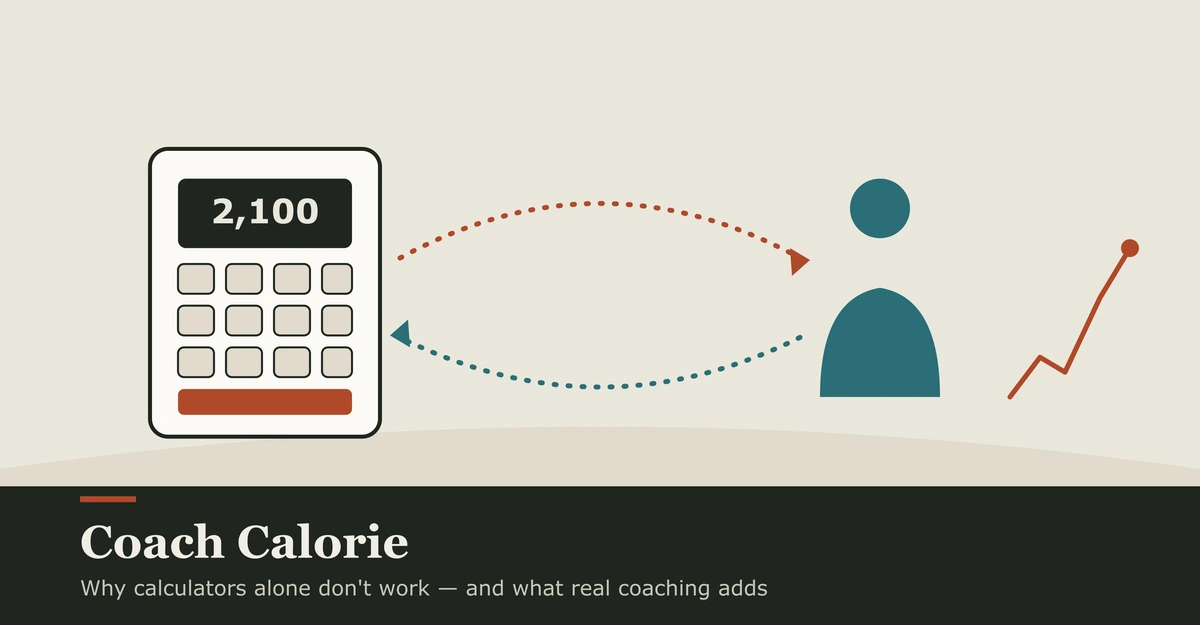
Your calculator isn’t lying to you – it’s just not listening anymore.
I’ve lost count of how many times someone has shown me their calorie calculator results, completely deflated, saying some version of “I’ve done everything right and the scale still isn’t moving.”
Almost every time, the calculator wasn’t wrong exactly – it just never got a second look after day one. That’s really the whole story behind this article.
If you searched “coach calorie,” you probably landed here for one of two reasons.
Either you’ve come across CoachCalorie.com and want to know what it is before you dig in, or you typed the phrase loosely, thinking about calorie coaching in general – the kind of support that goes beyond punching your stats into a calculator and hoping for the best.
I’ll cover both, because in my experience they usually end up being the same question anyway.
Key Takeaways
- “Coach calorie” refers both to CoachCalorie.com specifically, and to calorie coaching as a general concept
- Calculators give you a one-time estimate; a real coach treats that number as a hypothesis and tests it
- Plateaus are usually a sign one of your inputs has drifted — not proof the method has failed
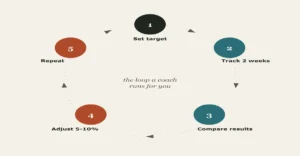
- You can run the same recalibration process yourself: set a target, track two weeks, compare, adjust 5–10%, repeat
- Vet any coaching service the same way: individualization, reassessment, real human feedback, reasonable deficits, verifiable results
What Does “Coach Calorie” Actually Mean?
CoachCalorie.com is a real site — a fitness and weight-loss blog run by a coach who writes from personal experience about training and fat loss. If that’s specifically what you were after, that’s the site to go check out directly.
But “coach calorie” also gets searched as a general concept, and honestly, that’s the more useful thing to actually understand.
A calorie coach, broadly speaking, is someone (or some service) that manages your calorie and macro targets and adjusts them based on how your body actually responds – not just a one-time number from a calculator that never gets touched again.
That’s the real gap most coach calorie searches are trying to close: a calculator gives you a number. Coaching gives you a moving target. Here’s why that distinction matters more than it sounds like it should.
How a Calorie Calculator Works (And Where It Breaks Down)
Every calorie calculator you’ve ever used runs on the same basic math. It first estimates your Basal Metabolic Rate (BMR) – the calories you’d burn lying in bed all day doing absolutely nothing.
Then it multiplies that by an “activity factor” based on how active you say you are, which gives you your Total Daily Energy Expenditure (TDEE). Subtract a deficit – this is usually where a calorie deficit calculator comes into play – and you’ve got your target.
It’s clean, it’s fast, and it feels scientific. Even big, well-established calculators like IIFYM’s macro calculator – one of the most widely used tools in this space – are built on the same estimated inputs, and results still vary from person to person depending on how accurately you report your stats and activity.
The problem isn’t the math. It’s that the two biggest inputs, your actual metabolic rate and your actual activity level, are both estimates, and both are frequently wrong by a wider margin than people expect.
Here’s a real pattern I’ve watched play out again and again with clients who look identical on paper. Take two women, both 32, both 165 lbs, both describing themselves as “moderately active.”
They run the same calculator and both land on a TDEE of 2,100 calories. One of them loses weight steadily at 1,700 calories a day. The other, eating that exact same 1,700, barely moves the scale after three weeks.
Same formula, same inputs, completely different real-world outcomes – because one of them has a genuinely higher metabolic rate, or is unconsciously more active day-to-day, or is logging her food just slightly less precisely than she thinks she is.
The calculator isn’t broken. It’s a starting guess, not a final answer. This is exactly where coaching earns its keep.
What a Real Calorie Coach Does Differently
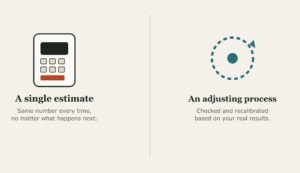
A calculator gives you a number once. A coach treats that number as a hypothesis and actually tests it against reality.
In practice, that looks like checking in every one to two weeks, comparing your actual weight trend to what the math predicted, and nudging the target up or down based on the gap.
It also means catching things a calculator simply can’t see. I’ve had clients who logged every single gym session as “high intensity” purely out of habit – which quietly inflated their calculated burn and made their real deficit smaller than they thought.
I’ve had others who were technically hitting their calorie target on paper but skipping the days they didn’t feel like logging, which erased the deficit entirely without them ever realizing it.
Here’s the part almost no calculator-focused content ever talks about: a plateau usually isn’t a sign that “calories in, calories out” stopped working. It’s a sign that one of your inputs – activity level, portion accuracy, even water retention masking real fat loss – has quietly drifted, and nobody’s been checking for it.
A good coach’s entire job is catching that drift before you get discouraged and give up. Harvard Health and other clinical sources describe this same phenomenon as a normal, expected part of weight loss, not a failure of willpower – your metabolism genuinely adapts as your weight changes, which is exactly why a static number stops matching reality over time.
Tired of guessing why the scale won’t move?
Get a free plan review → — I’ll look at your numbers and tell you what’s actually going on.
Is Coach Calorie (or Any Calorie-Coaching Service) Legit? How to Evaluate One
Whether you’re specifically looking at CoachCalorie or vetting any calorie-coaching service, the same checklist applies. I use some version of this myself whenever I’m evaluating whether a service is worth recommending to someone.
- Does it individualize, or does it hand everyone the same plan? If your “custom” macros look suspiciously like a generic 40/30/30 split regardless of your stats, goals, or training style, that’s not real individualization – that’s a template with your name on it.
- Does it reassess? A legitimate coach or service should revisit your targets every couple of weeks based on your actual results, not set a number once and leave it static for months.
- Is there a real human behind the feedback? Automated check-ins have their place, but if you ask a specific question about your plateau and get a copy-pasted generic response, that’s worth noticing.
- Are the deficits reasonable? Watch for plans that put anyone – regardless of size or activity level — on an extremely low calorie target. Aggressive, one-size-fits-all deficits are a common shortcut, and they usually cost you energy, muscle mass, and eventually your adherence.
- Can you find evidence of real results? Verifiable before-and-afters or client testimonials that read like actual people – not marketing copy – are a good sign you’re dealing with a genuine coaching relationship rather than an automated funnel.
To be clear, none of this is about whether one specific brand is good or bad. It’s just a due-diligence framework you can run against literally any coaching service you’re considering, including ones I haven’t mentioned here.
Recalibrate Your Calories Like a Coach Would
You don’t need to hire anyone to apply the core idea here. This is the same recalibration process I run with clients, simplified into steps you can do yourself.
- Set your starting target. Use our TDEE calculator or calorie calculator to get a baseline number – treat this as a hypothesis, not your final answer.
- Track for two full weeks. Log your food using a macro calculator or tracking app, and log your weight daily (or at minimum, weigh in 3–4 times a week and average it). Two weeks smooths out normal water-weight noise.
- Compare actual results to predicted results. A pound of fat is roughly 3,500 calories. If your deficit predicted a 2 lb loss over two weeks and you actually lost 0.5 lb, something’s off in your inputs.
- Adjust by 5–10%, not by guessing wildly. If you’re not losing as expected, drop your target by about 5–10% rather than slashing it dramatically. If you’re losing faster than expected, you can actually afford to eat a bit more.
- Repeat. Treat every two-week block as a fresh check-in, not a one-time fix.
Here’s a worked example so this isn’t abstract. Your calculator says 1,800 calories a day should produce a 1 lb/week loss. After two weeks at 1,800, you’ve actually lost 0.6 lb instead of 2 lb.
That’s a real, meaningful gap – probably your true maintenance is higher than estimated, or your logging is missing calories somewhere you haven’t noticed.
Drop to roughly 1,650–1,700, hold for two more weeks, and reassess again. That’s genuinely it. That’s the entire “coaching” process, minus the person doing it alongside you.
Calorie Coaching vs. Calorie Tracking Apps: What’s the Difference
It’s worth being clear-eyed about what each option actually gives you, because they’re not interchangeable.
- Static calculators (like our maintenance calorie calculator or the free TDEE tools all over the web) give you a single number based on formulas and your self-reported stats. Useful as a starting point, not much use as an ongoing strategy.
- Tracking-only apps (think MyFitnessPal-style tools) help you log food and hit a target consistently, but they won’t adjust that target for you – the thinking still has to come from you.
- Coached services add the layer both of the above are missing: a person (or a well-designed system) actively comparing your results to your targets and adjusting over time. You’re paying for judgment and course-correction, not just a number or a logging interface.
None of these is universally “better.” A disciplined, data-literate person can absolutely run their own recalibration loop with nothing but a tracking app.
Where coaching earns its cost is the accountability and the outside perspective — when you’re too close to your own data to see what’s actually going wrong, someone else usually can.
FAQs
Is Coach Calorie a real coaching service or an app?
CoachCalorie.com is a fitness and nutrition blog run by an individual coach, focused on training and fat-loss content rather than an app-based tracking product. If you specifically want automated tracking tools, pair it with a dedicated calorie calculator or tracking app.
How accurate are calorie coaching calculators?
They’re a reasonable starting estimate, but commonly off by a meaningful margin for any given individual, since both BMR formulas and self-reported activity levels are approximations. Even long-established tools like IIFYM.com and coaching apps like CalCoach note that results shift depending on how accurately you self-report your stats and activity. Treat any calculator’s output as a first guess to be tested, not a fixed truth.
How often should a calorie coach adjust my targets?
Every one to two weeks is the standard cadence – frequent enough to catch a real plateau, spaced out enough that you’re not overreacting to normal day-to-day weight fluctuation.
Can I do calorie coaching myself without hiring someone?
Yes. The recalibration framework above – set a target, track for two weeks, compare actual results to predicted results, adjust by a small percentage, repeat – is exactly the process a coach runs. What you give up doing it solo is an outside perspective and built-in accountability, not the method itself.
A quick note: this article is educational, not a substitute for individualized medical or nutritional advice. If you have a health condition, are pregnant, or have a history of disordered eating, talk to a doctor or registered dietitian before changing your calorie intake.
