
If you’ve ever tried to Google “how much should I weigh,” you’ve probably landed on a BMI calculator that only works one way – you type in your weight and height, and it spits out a number.
But what if you already know the BMI you’re aiming for, and you want to know what weight that actually translates to on the scale? That’s a completely different question, and weirdly, almost nobody online answers it properly.
This guide shows you how to calculate weight from BMI and height in three easy steps, whether you’re a man, woman, teenager, or fitness beginner anywhere in the world.
Instead of “what’s my BMI,” we’re solving for “what should my weight be, given my height and a target BMI.” Useful if you’re setting a weight goal, filling out an old medical form that only listed your BMI, prepping for a fitness program, or just curious what a “normal” BMI actually looks like on your frame.
Whether you’ve seen this number on a hospital chart, a gym intake form, or a fitness app, the math behind it is the same – we’re just working it backwards.
What Does “Calculating Weight from BMI” Actually Mean?
Normally, BMI works like this: you plug in your weight and height, and the formula gives you a BMI number. That’s the standard direction most people are used to – and if that’s actually what you meant, don’t worry, it’s the same formula, just not rearranged. We’ll show you both directions below.
But here, we’re doing it backwards. You already have two pieces – your height and a BMI number (either your own or a target you’re aiming for) – and you want the missing piece: weight. Think of it like knowing the area of a rectangle and one side length, then solving for the other side. Same formula, just rearranged to solve for a different variable.
Whether you call it calculating or working out weight from BMI and height, the process is identical – the math doesn’t change based on the phrasing, and it doesn’t change whether you’re male or female, since BMI itself doesn’t have separate formulas by sex (more on that in a dedicated section below).
A Quick Word on Where the BMI Formula Comes From
The formula behind BMI isn’t new or trendy — it dates back to the 1830s, developed by a Belgian mathematician named Adolphe Quetelet, which is why BMI was originally called the “Quetelet Index.” It wasn’t even designed as a personal health tool originally; Quetelet built it to study average body proportions across large populations, not to diagnose an individual’s health.
It only became the standard personal health screening tool decades later, once the WHO adopted it globally for its simplicity — all you need is a scale and a measuring tape, no lab work required.
That’s exactly why the “calculate weight from BMI and height” version of this formula is so useful too: it’s quick, requires no special equipment, and works anywhere in the world, which is part of why it remains so widely used across both developed and developing countries today.
The Formula to Calculate Weight from BMI and Height
The standard BMI formula looks like this:
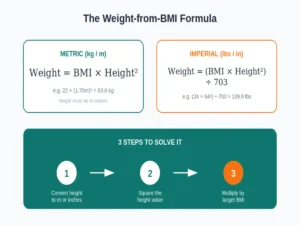
BMI = Weight (kg) ÷ Height² (m)
This is the same formula used when someone wants to calculate BMI with weight and height in kg — you’re just solving for the BMI variable instead of weight. To reverse it and solve for weight, you rearrange the algebra – multiply both sides by height squared:
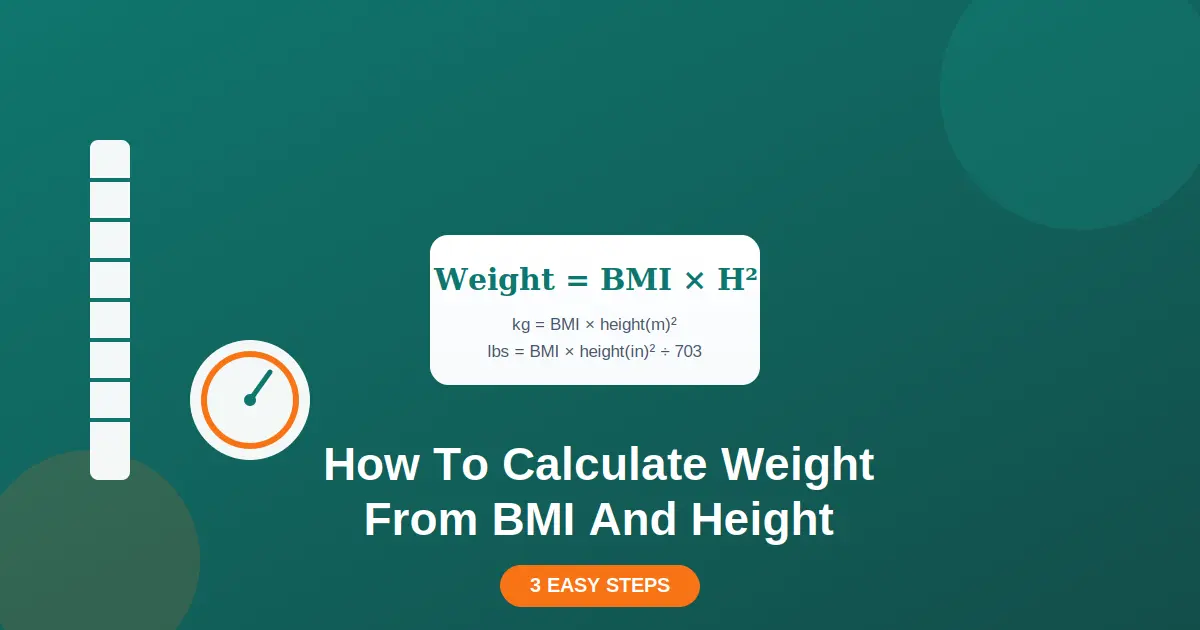
Weight (kg) = BMI × Height² (m²)
If you’re working in pounds and inches (common in the US and a few other countries), the formula adjusts slightly because of how the units convert:
Weight (lbs) = [BMI × Height² (inches)] ÷ 703
That 703 isn’t random – it’s a conversion constant that accounts for the fact that the original BMI formula was built around kilograms and meters, and 703 makes the math work out correctly in pounds and inches.
Why does height get squared instead of just multiplied? Because BMI isn’t measuring weight relative to height in a straight line – it’s measuring weight relative to body area, roughly speaking.
A person who’s twice as tall isn’t just twice as heavy at the same BMI; their body scales in two dimensions, not one. Squaring height accounts for that.
The 3 Steps, Simplified
Here’s how to calculate weight from BMI and height, broken down into the simplest possible version. However you phrase your search – “how to calculate weight from BMI and height” or “how to work out weight from BMI and height” – it always comes down to the same three steps:
- Convert your height into meters (metric) or inches (imperial)
- Square the height value
- Multiply by your target BMI (and divide by 703 if you’re using inches/lbs)
That’s the entire process. No app, spreadsheet, or advanced math needed — just three steps.
Step-by-Step Examples (Metric and Imperial)
Formulas are easy to skim past and hard to actually trust until you see them work. So here are three full examples, done by hand, covering different heights and genders so you can find one close to your own numbers.
Example 1 – Metric, Male: Someone who’s 170 cm tall, aiming for a BMI of 22
Step 1: Convert height to meters. 170 cm = 1.70 m
Step 2: Square the height. 1.70 × 1.70 = 2.89
Step 3: Multiply by the target BMI. 22 × 2.89 = 63.58
So a BMI of 22 at 170 cm works out to about 63.6 kg.
Example 2 – Imperial, Female: Someone who’s 5’4″ (64 inches), aiming for a BMI of 21
Step 1: Square the height in inches. 64 × 64 = 4,096
Step 2: Multiply by the target BMI. 21 × 4,096 = 86,016
Step 3: Divide by 703. 86,016 ÷ 703 ≈ 122.4
So a BMI of 21 at 5’4″ works out to about 122.4 lbs.
Example 3 – Metric, Taller Frame: Someone who’s 185 cm tall, aiming for a BMI of 24
Step 1: Convert height to meters. 185 cm = 1.85 m
Step 2: Square the height. 1.85 × 1.85 = 3.4225
Step 3: Multiply by the target BMI. 24 × 3.4225 = 82.14
So a BMI of 24 at 185 cm works out to about 82.1 kg.
A Mistake That Trips Up Almost Everyone: forgetting to convert units before squaring. If you square height in centimeters instead of converting to meters first, you’ll get a number that’s off by a factor of 10,000 – and it’s an easy error to miss because the result still looks like a real number, just a wildly wrong one. Same goes for imperial: if you accidentally use feet instead of inches, your weight estimate will be way too low. Always double-check your units before you multiply.
Does the Formula to Calculate Weight from BMI and Height Differ for Men and Women?
This is one of the most common follow-up questions, so it’s worth answering directly: no, the formula itself is identical for men and women. BMI was never designed with separate equations by sex – the same Weight = BMI × Height² formula applies whether you’re male, female, or anywhere on the spectrum.
What differs is interpretation, not calculation. Women, on average, tend to carry a higher percentage of body fat than men at the same BMI, due to normal physiological differences.
This doesn’t change the math – a BMI of 22 at 170 cm is still 63.6 kg regardless of gender – but it’s a reason many doctors pair BMI with a second measurement (like waist circumference or body fat %) when assessing a woman’s health more holistically. The calculation stays the same either way; only the clinical interpretation shifts slightly.
Free Weight-from-BMI Calculator
Doing this by hand is fine once or twice, but if you’re checking multiple BMI categories or comparing metric and imperial, a calculator saves the hassle. This tool handles the full calculation – weight from BMI and height – instantly, in kg or lbs:
- Enter your height (toggle between cm and feet/inches depending on what you’re used to)
- Enter the BMI value you’re targeting – or select a BMI category if you don’t have an exact number
- The calculator instantly gives you the corresponding weight in both kg and lbs
(👉 Try the free BMI calculator – swap this placeholder link for your actual calculator/tool page.)
BMI-to-Weight Reference Chart (by Height)
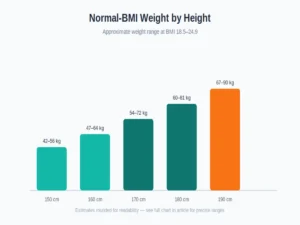
If you’d rather skip the math entirely, here’s a quick-reference table showing approximate weights across the four standard BMI categories, for a wide range of common heights – useful whether you’re on the shorter or taller end of average.
| Height | Underweight (BMI <18.5) | Normal (18.5–24.9) | Overweight (25–29.9) | Obese (30+) |
|---|---|---|---|---|
| 145 cm (4’9″) | Below 38.9 kg | 38.9 – 52.4 kg | 52.5 – 62.9 kg | 63.1+ kg |
| 150 cm (4’11”) | Below 41.6 kg | 41.6 – 56.0 kg | 56.0 – 67.3 kg | 67.5+ kg |
| 155 cm (5’1″) | Below 44.4 kg | 44.4 – 59.8 kg | 60.1 – 71.9 kg | 72.1+ kg |
| 160 cm (5’3″) | Below 47.4 kg | 47.4 – 63.7 kg | 64.0 – 76.5 kg | 76.8+ kg |
| 165 cm (5’5″) | Below 50.4 kg | 50.4 – 67.8 kg | 68.1 – 81.4 kg | 81.7+ kg |
| 170 cm (5’7″) | Below 53.5 kg | 53.5 – 71.9 kg | 72.3 – 86.4 kg | 86.7+ kg |
| 175 cm (5’9″) | Below 56.7 kg | 56.7 – 76.2 kg | 76.6 – 91.6 kg | 91.9+ kg |
| 180 cm (5’11”) | Below 60.0 kg | 60.0 – 80.6 kg | 81.0 – 96.8 kg | 97.2+ kg |
| 185 cm (6’1″) | Below 63.3 kg | 63.3 – 85.2 kg | 85.6 – 102.2 kg | 102.6+ kg |
| 190 cm (6’3″) | Below 66.8 kg | 66.8 – 89.8 kg | 90.2 – 108.0 kg | 108.3+ kg |
These are estimates rounded for readability – use the formula above if you need a precise figure for your exact height. For a deeper breakdown, see our guide on healthy weight ranges by height (internal link placeholder).
What Counts as a “Healthy” Weight for Your BMI?
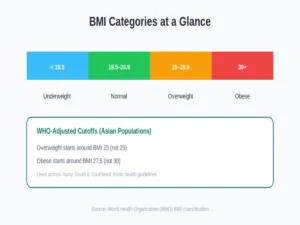
The standard BMI categories, used by the World Health Organization and most health organizations, break down like this:
- Below 18.5 – underweight
- 18.5–24.9 – normal weight
- 25–29.9 – overweight
- 30 and above – obese
Here’s something most articles on this topic skip entirely: these cutoffs aren’t universal. The WHO itself recommends lower BMI thresholds for people of Asian descent, because research has shown that health risks like type 2 diabetes and cardiovascular disease tend to show up at lower BMI levels in these populations. In that framework, “overweight” often starts around 23 instead of 25, and “obese” around 27.5 instead of 30.
This matters a lot if you’re reading this from South Asia, Southeast Asia, or other Tier 2 regions where these adjusted cutoffs are increasingly used by local health ministries and clinics, rather than the standard Western thresholds.
If you’re using this calculation for anything beyond curiosity – like tracking a health goal – it’s worth knowing which cutoff actually applies to your region.
For a full breakdown, check out our BMI categories explained guide (internal link placeholder).
There are also related metrics worth knowing about, even if we won’t dive deep into them here – BMI Prime (your BMI expressed as a ratio to the upper limit of “normal”) and BSA (body surface area, used more in clinical medication dosing than everyday health tracking). Neither replaces BMI, but they exist if you ever see them referenced.
Real-Life Situations Where People Calculate Weight from BMI and Height
Knowing how to calculate weight from BMI and height comes in handy more often than you’d think, across a range of everyday situations:
- Setting a weight-loss or weight-gain goal – instead of picking a random target number, you decide on a healthy BMI first, then calculate the exact weight that corresponds to it
- Filling out medical or insurance forms – some older records list only BMI and height, and you need to back-calculate an approximate weight
- Starting a gym or fitness program – many trainers ask for a target BMI range before building a nutrition or training plan
- Tracking progress over time – comparing your current weight against the weight that matches a “normal” BMI for your height gives a clearer sense of how far you are from that range
- Comparing international health guidelines – since BMI is used worldwide, travelers or expats sometimes need to recalculate their target weight against a different country’s BMI cutoff standards
Limitations of Using BMI to Estimate Weight
BMI is popular because it’s simple – all you need is height and weight. But that simplicity is also its biggest weakness, and it’s worth being honest about that.
This is a general screening formula, not a diagnostic tool, and even after you know how to calculate weight from BMI and height, remember the number doesn’t account for muscle mass, bone density, or overall body composition.
BMI doesn’t distinguish between muscle and fat. A muscular athlete and someone carrying excess body fat can land on the exact same BMI number despite having very different body compositions and very different health profiles. This is one of the most common criticisms of BMI, and it’s a fair one.
It also doesn’t account for age, sex, or bone density. Older adults naturally lose muscle mass over time, which can make BMI less reliable as a standalone health indicator later in life.
And this formula isn’t meant for children or teenagers at all – kids need BMI-for-age percentiles, which compare their BMI to others of the same age and sex, not a flat adult scale. See our BMI for children and teens guide if that applies to you (internal link placeholder).
Pregnant women and elite athletes are two more groups where BMI tends to mislead rather than inform, simply because their bodies don’t map neatly onto a formula built around a general adult population.
If you’re wondering how to calculate BMI without weight and height on hand – say, using just a waist-to-hip ratio or body fat percentage — those methods exist, but they measure something slightly different from BMI itself, and neither is a direct substitute.
BMI vs. Other Body Composition Metrics
| Metric | What It Measures | Best Used For |
|---|---|---|
| BMI | Weight relative to height | Quick, population-level screening |
| Waist-to-Hip Ratio | Fat distribution around the waist vs. hips | Estimating cardiovascular risk |
| Body Fat Percentage | Actual proportion of fat vs. lean mass | Athletes, detailed fitness tracking |
| BMI Prime | BMI as a ratio to the upper “normal” limit | Quick visual sense of how far from normal range |
None of this means BMI is useless — it’s a reasonable, fast screening tool. But if you want a fuller picture, pairing it with something like waist-to-hip ratio, body fat percentage, or an actual conversation with a doctor will give you a more accurate read than BMI alone ever could.
For general wellness habits alongside tracking your numbers, Fit4Rever has useful resources on fitness, nutrition, and disease prevention.
FAQs
How do I calculate my ideal weight using BMI?
This is essentially how to calculate weight from BMI and height for a target range: pick a target BMI within the “normal” range (18.5–24.9, or the adjusted range for your ethnicity if applicable), then use the formula Weight (kg) = BMI × Height² (m²) to find the corresponding weight for your height.
What is the formula to find weight from BMI and height in kg?
Weight (kg) = BMI × Height² (in meters). Square your height in meters first, then multiply by your target BMI.
How do I calculate BMI given weight and height?
Divide weight in kg by height in meters squared – that’s the original BMI formula, which this article’s calculation simply reverses.
Can I use BMI to calculate weight for kids?
No – this formula is built for adults. Children and teens need BMI-for-age percentile charts instead, since their healthy BMI range changes as they grow.
Is BMI accurate for calculating a healthy weight?
It’s a useful starting estimate, but it doesn’t account for muscle mass, bone density, or body composition, so it shouldn’t be treated as a complete picture of health on its own.
How much should I weigh for a BMI of 25 at my height?
Use the formula Weight (kg) = 25 × Height² (m²), or check the reference chart above for a quick estimate at common heights.
Is the formula different for men and women?
No. The formula to calculate weight from BMI and height is the same regardless of sex – only the clinical interpretation of the result can differ slightly.
Can I calculate BMI from height and weight in SPSS?
Yes – calculating BMI in SPSS or other statistical software follows the same formula, just applied across a dataset instead of one person. That’s a separate workflow from the manual, single-person calculation covered in this article.
Key Takeaways
- The short version of how to calculate weight from BMI and height: use Weight (kg) = BMI × Height² (m²), or Weight (lbs) = [BMI × Height² (inches)] ÷ 703
- It’s a simple 3-step process: convert height → square it → multiply by your target BMI
- Unit conversion is where most people make mistakes – always convert height to meters or inches before squaring it
- The formula is identical for men and women; only clinical interpretation of the result can differ
- Standard BMI categories are 18.5–24.9 (normal), but WHO recommends lower thresholds for people of Asian descent
- BMI is a helpful screening tool, not a complete health assessment — it doesn’t account for muscle mass, age, or body composition
Now that you know how to calculate weight from BMI and height, try the free calculator above to get your exact number in seconds – or check out our full BMI categories guide to see where you land.
This article is for informational purposes only and does not replace professional medical advice.
