
Your doctor tells you to cut back on fiber, and the fruit bowl on your counter suddenly looks like a minefield.
A ripe banana is usually fine. A soft, creamy avocado sounds even gentler, but half of one has about 4.6 g of fiber, compared with 2.7 g in a banana.
That kind of mix-up is why picking fruits in low fiber diet plans trips so many people up. Below you’ll find 7 safe fruits, 6 to skip, the fiber in each one, and a few ways to prepare fruit so it doesn’t irritate your gut.
Fiber is everywhere right now. “Fibermaxxing” is all over social media, and most Americans really do eat too little of it. But if you’re recovering from bowel surgery, in the middle of a Crohn’s or colitis flare, or prepping for a scan, your doctor may want you on less for a while. Fruit is where most people get stuck.
One thing before we start: this is a short-term diet that your care team sets up, so follow their instructions first. This guide just fills in the details on fruits in low fiber diet plans, so you know what to buy and how to prepare them.
Which Fruits In Low Fiber Diet Plans Are Safe?
Most lists of fruits in low fiber diet plans agree on the same handful: ripe bananas, melons, applesauce, canned peaches or pears without the skins, and juice without pulp. Mayo Clinic’s low-fiber diet guide names bananas, melons, applesauce, and skinless canned peaches. The National Cancer Institute’s low-fiber foods list includes canned pears as well.
A simple test works for almost any fruit: is it soft, peeled, seedless, and cooked or canned? If it has skin you’d normally eat, seeds, or stringy bits, leave it for now.
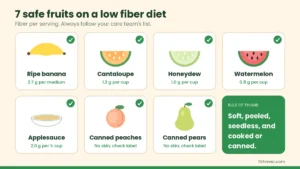
7 Safe Fruits In Low Fiber Diet Plans
Here are seven fruits that work in most low fiber plans, with the fiber you can expect from each.
- Ripe banana. About 2.7 g in a medium one. Choose fruit with brown freckles, which is softer and easier to digest. It’s the highest on the safe list, so count it.
- Cantaloupe. About 1.3 g per cup, plus potassium and vitamin C, which helps when your food list is short.
- Honeydew. About 1.0 g per cup. Soft and mild.
- Watermelon. Roughly 0.6 to 0.8 g per cup, depending on the database. It’s the lowest of the group and very hydrating.
- Applesauce. About 2.0 g per half cup. Go for smooth and unsweetened, one serving at a time.
- Canned Peaches, No Skin. Mayo Clinic names these. Fiber varies by brand, so check the label.
- Canned Pears, No Skin. NCI lists them. Pick fruit packed in juice or water over heavy syrup.
Fruit Fiber Chart: How Much Is In Each?
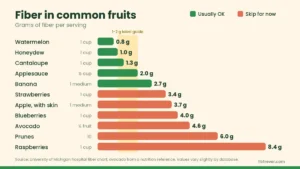
These figures come from a University of Michigan hospital fiber chart, except avocado, which is from a nutrition reference.
Other databases can differ by a few tenths of a gram, depending on fruit size and how it was measured. Use the chart to compare fruits in low fiber diet lists at a glance, including the tempting ones that don’t belong.
| Fruit | Serving | Fiber (g) | Verdict |
|---|---|---|---|
| Watermelon | 1 cup | 0.8 | Easy yes |
| Honeydew | 1 cup | 1.0 | Easy yes |
| Cantaloupe | 1 cup | 1.3 | Easy yes |
| Applesauce | ½ cup | 2.0 | Yes, one serving at a time |
| Apple, no skin | 1 medium | 2.4 | Only if cooked soft |
| Banana | 1 medium | 2.7 | Yes if ripe; count it |
| Orange | 1 medium | 3.0 | Usually skip |
| Strawberries | 1 cup | 3.4 | Skip |
| Apple, with skin | 1 medium | 3.7 | Skip |
| Pear, fresh | 1 medium | 4.0 | Skip (choose canned, peeled) |
| Blueberries | 1 cup | 4.0 | Skip |
| Avocado | ½ fruit | about 4.6 | Skip |
| Prunes | 10 | 6.0 | Skip |
| Raspberries | 1 cup | 8.4 | Skip |
Peeling helps a lot: an apple with skin has about 3.7 g, and a peeled one about 2.4 g. For any fruit that isn’t listed, look it up in USDA FoodData Central.
How to Fit Fruit Into Your Daily Fiber Limit
Mayo Clinic suggests choosing packaged foods with no more than 1 to 2 g of fiber per serving. A banana and a serving of applesauce sit right at that line or just over it, and they’re still standard picks. The label rule is only a guide. What really matters is your daily total.
Your care team may give you a number. One clinical reference Mayo cites is a 13-gram plan, so budgets can be small. Ask what yours is.
See how quickly it adds up: a banana (2.7 g), half a cup of applesauce (2.0 g), and a cup of cantaloupe (1.3 g) make 6 g, and you haven’t eaten a slice of bread yet.
On a 13 g budget, that’s almost half. So when you plan fruits in low fiber diet menus, spread them across the day and think twice before that second banana.
6 Fruits In Low Fiber Diet Plans To Skip
These are the fruits in low fiber diet plans that cause the most trouble, mostly because of seeds, skins, or a high fiber count.
- Raspberries. 8.4 g per cup, and the seeds don’t help.
- Blueberries and strawberries. About 4.0 and 3.4 g per cup, with seeds and skins.
- Avocado. It’s soft and creamy, and a few “easy to digest” lists include it, but half has about 4.6 g. That’s more than a banana.
- Prunes and other dried fruit. Mayo Clinic says to avoid dried fruit. Ten prunes come to about 6 g.
- Apples and pears with skin. About 3.7 and 4.0 g. Peel and cook them, or use applesauce and canned pears.
- Oranges. About 3.0 g each, plus tough membranes. Pulp-free juice is easier.
Watch labels, too. Yogurt, ice cream, cereal, and drinks sometimes have fiber added, and a “fruit and seed” yogurt or a fiber-boosted fruit bar can undo a careful day.
How to Prepare Fruits In Low Fiber Diet Meals
Preparation changes how fruits in low-fiber diet plans behave in your body. Cooking and canning break down some of the fiber, and peeling or removing seeds cuts more. Cooking doesn’t wipe the fiber out, though, so keep counting the grams.
- Poach A Peeled Pear. Simmer halves in water with a cinnamon stick until a fork slides in with no resistance.
- Bake Peeled Apple Slices, covered, until they collapse. Mayo Clinic recommends tender cooking such as simmering, poaching, stewing, steaming, braising, or baking and microwaving in a covered dish.
- Let Bananas Get Spotty. A freckled banana is softer than a green-tipped one.
- Blend Melon With A Little Ice for a smooth, hydrating drink.
- Choose Eans packed in Juice or Water, and check for skins or seeds.
Fruit By Situation: Flare-Ups, Surgery, Ostomy, And Colonoscopy Prep
Your reason for the diet changes how strict you need to be with fruits in low fiber diet plans.
Flare-Ups and Recovery. Doctors may recommend a low fiber diet during an inflammatory bowel disease flare, while you recover from diverticulitis or bowel surgery, or during radiation that affects the gut. Start with the softest options, like applesauce and blended melon, in small portions.
After Bowel Surgery. Less fiber means less bulky stool, which lets your gut heal with less strain. Follow your surgeon’s list closely.
With an ostomy. Stringy, fibrous, or skin-on fruit can block a stoma, so check new foods with your ostomy nurse first.
Before a Colonoscopy. Prep instructions vary, and some are stricter than a standard low fiber diet, sometimes cutting fruit out completely for the last day or two. Your prep sheet wins over any article, including this one.
Juice and Applesauce: The Sugar Catch
Mayo Clinic and NCI both list juice among the fruits in low fiber diet options, and pulp-free juice has almost no fiber. But pear and apple juice contain sorbitol, which can cause diarrhea and dehydration in large amounts. If your stool is already loose, keep servings small.
After diarrhea, applesauce is often the better pick. It has more pectin than apple juice, and pectin helps firm up stool.
Have diabetes? Juice and fruit canned in syrup can spike blood sugar. Choose no-added-sugar versions and ask your dietitian how they fit.
Nutrients And Energy When Fruit is Limited
Many low fiber foods aren’t very nutritious, so make your fruit work harder. Melons are the standout among fruits in low fiber diet plans: a cup of cantaloupe has over 400 mg of potassium and about 57 mg of vitamin C, and honeydew is similar. They’re mostly water, too, which helps with hydration.
Keep drinking fluids. Smaller, less frequent stools make constipation easy to slip into.
If you’re active and your doctor has cleared you to train, a ripe banana or a pouch of smooth applesauce gives quick carbs without bulk, and melon replaces fluids after a light session.
Pair fruit with a little protein, like plain yogurt without seeds or a couple of eggs, so you’re not hungry an hour later.
How To Bring Fruit Back After a Low-Fiber Diet
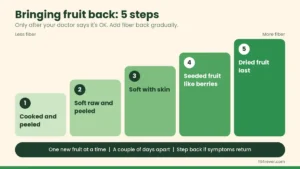
This diet is usually temporary, and the limits on fruits in low-fiber diet plans can typically be lifted slowly after a short time. Your doctor decides when. A gradual approach looks like this:
- Stay on the safe list until your symptoms settle, and your team says go.
- Add one new fruit at a time, a couple of days apart, so you can tell which one caused a problem.
- Move up in steps: cooked and peeled, then soft raw and peeled, then soft with skin, then seeded fruit like berries, with dried fruit last.
- Keep a quick food note on your phone: what you ate and how you felt.
- Step back if symptoms return. Pain, bloating, or loose stools mean returning to the last fruit that worked.
If you need to stay on the diet longer, Mayo Clinic suggests working with a registered dietitian so you still get the nutrition you need.
A Sample Day With Fruit
Here’s one way fruits in low fiber diet meals can fit into a day. It’s an example, not a prescription.
- Breakfast: Cream of Rice with half a cup of applesauce stirred in
- Snack: Cantaloupe cubes with plain yogurt (no seeds)
- Lunch: Turkey sandwich on white bread with skinless canned peaches
- Snack: A ripe, freckled banana
- Dinner: Baked fish, mashed potatoes, cooked carrots, and skinless canned pears for dessert
The applesauce, banana, and cantaloupe alone add up to about 6 g, before the canned fruit. Check labels and compare the total with your own limit. If you’re close, skip the banana or swap the pears for more melon. Want more everyday meal ideas? Try these healthy eating ideas on Fit4Rever.
When to Call Your Doctor
Diet can ease symptoms, but it can’t fix everything. Call your care team promptly if you have severe or worsening belly pain, repeated vomiting, a swollen belly, blood in your stool, or a fever, or if you stop passing stool or gas. These can signal problems that need medical attention.
FAQ: Fruits In Low Fiber Diet
Are bananas OK on a low fiber diet?
Yes, when they’re ripe, and you’re not eating several a day. One medium banana has about 2.7 g.
Is watermelon low in fiber?
Yes. It’s one of the lowest, at roughly 0.6 to 0.8 g per cup depending on the source.
Can I eat apples?
Only peeled and cooked soft, or as applesauce. A raw apple with skin has close to 4 g.
Is avocado low in fiber?
No. Half an avocado has about 4.6 g.
Are canned fruits in low fiber diet plans okay?
Usually, if they’re skinless and packed in juice or water. Canning breaks down some of the fiber, but check the label for the grams.
Can I eat fruit skins or seeds?
Generally not until your doctor says so.
Which fruits in low fiber diet plans are best after surgery?
The gentlest options are applesauce, a ripe banana, and soft or blended melon, in small portions. Your surgeon’s list overrides any general advice.
What’s the lowest fiber fruit?
Watermelon, at roughly 0.6 to 0.8 g per cup.
How long do I stay on a low fiber diet?
It depends on your situation, so follow your care team’s timeline instead of a general rule.
The Bottom Line On Fruits In Low Fiber Diet Plans
The safest fruits in low fiber diet plans are ripe bananas, melons, applesauce, and peeled or canned peaches and pears. Hold off on berries, dried fruit, avocado, and anything with skin or seeds until your doctor says otherwise. Watch your grams, cook fruit until it’s soft, and add foods back one at a time.
How This Guide Was Researched
Food lists for fruits in low fiber diet plans come from Mayo Clinic and the National Cancer Institute. Fiber values come from a University of Michigan hospital fiber chart and standard nutrition references, and they vary slightly between sources.
The numbers were last checked on September 20, 2026. This is general information, not medical advice, so follow your own doctor’s or dietitian’s instructions. For more nutrition and wellness guides, visit Fit4Rever.
