
There’s a number floating around the internet that claims to convert calories to grams. It’s technically correct, technically pointless, and it has confused a lot more people than it’s actually helped.
Search “calories to grams,” and you’ll probably see something like this: 1 calorie equals 0.13 grams. No context, no explanation. Just a decimal sitting there, daring you to figure out what it means. Spoiler: it doesn’t mean much for anything you’re actually trying to do.
Here’s why. A calorie is a measurement of energy. A gram is a measurement of weight. They’re not the same kind of thing, so they don’t just convert into each other automatically. You need to know what you’re measuring first. Calories in what? Grams of what?
That’s really the whole problem with this search term. People type “calories to grams” expecting one clean answer, but there isn’t one. There are five, depending on what you’re trying to figure out, and each one solves a different real problem: hitting a macro target, weighing out an actual food, or working out how a deficit turns into fat loss. This guide covers all five, in plain language, with the exact math worked out so you’re not left guessing.
Jump to:
- Way 1: Learn the 4-4-9-7 rule
- Way 2: Reverse the formula for exact grams
- Way 3: Convert calories to grams for real foods
- Way 4: Convert a calorie deficit into grams of fat
- Way 5: Use a calculator and read labels correctly
- FAQ
Where that weird “conversion” number comes from
Quick tangent, then we’ll get into what actually matters.
That 0.13 grams-per-calorie figure comes from mass-energy equivalence. Yes, the E = mc² kind of physics. It’s the math a physicist might use to describe how much mass a burst of energy theoretically contains. Real science. Completely irrelevant to your dinner plate.
If a calculator ever hands you a tiny decimal with no explanation attached, that’s what happened behind the scenes. Ignore it and move on. It won’t help you hit a protein target, read a label, or figure out how much fat you’re losing. Which, honestly, is what people actually want when they search “calories to grams” in the first place.
So let’s actually answer it. Five ways, starting with the one that underpins almost everything else on this page.
Way 1: Learn the 4-4-9-7 rule
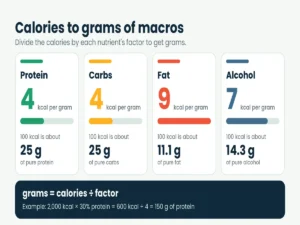
Back in the 1800s, a chemist named Wilbur Atwater, working for the USDA, figured out roughly how much usable energy the body actually gets from a gram of protein, carbs, and fat. Those numbers stuck. They’re called Atwater factors, and they’re still what every Nutrition Facts label on every product in your pantry is built on, more than a century later.
| Macronutrient | Calories per gram |
|---|---|
| Protein | 4 |
| Carbohydrates | 4 |
| Fat | 9 |
| Alcohol | 7 |
Multiply grams by these numbers and add them up, and you get total calories:
Calories = (protein × 4) + (carbs × 4) + (fat × 9) + (alcohol × 7)
Fat sits at more than double protein and carbs. That’s just chemistry, not a reason to panic about fat in your diet. A tablespoon of olive oil is about 14 grams, all fat, and lands around 126 calories. Hitting that same number with pure protein would take over 30 grams. More than double the weight for the same energy.
This is also why two meals can look wildly different on a plate but land at the same calorie count. A small serving of something fatty, like cheese or nuts, can carry as many calories as a huge plate of something lean and watery, like grilled chicken and vegetables.
Once you understand the calories-to-grams relationship for each macronutrient, that stops being confusing and starts being useful for actual meal planning.
Way 2: Reverse the formula for exact grams
Flip the formula around, and you get grams instead of calories. This is the actual calories to grams conversion most people are searching for.
grams = calories ÷ (4, 4, 9, or 7, depending on the macro)
For a flat 100 calories:
| Source | Calculation | Grams for ~100 calories |
|---|---|---|
| Protein | 100 ÷ 4 | 25 g |
| Carbohydrates | 100 ÷ 4 | 25 g |
| Fat | 100 ÷ 9 | 11.1 g |
| Alcohol | 100 ÷ 7 | 14.3 g |
Say a label tells you 180 calories come from fat. Divide by 9. Twenty grams of fat. The same idea works for converting calories to grams of protein; just divide by 4 instead.
Let’s run a real number. Say you’re eating 2,000 calories a day, split 40% protein, 30% carbs, 30% fat.
Protein: 800 ÷ 4 = 200 grams. Carbs: 600 ÷ 4 = 150 grams. Fat: 600 ÷ 9 = 67 grams.
That’s the entire engine behind most macro-tracking apps. They’re just doing this calories-to-grams math faster than you can, and displaying it as a neat little progress bar.
One catch, though. This only works if you already know which macronutrient the calories came from. Total calories alone, with no breakdown, won’t get you there. You’ll need an actual label or food database for that. Which is exactly what the next section covers.
Way 3: Convert calories to grams for real foods
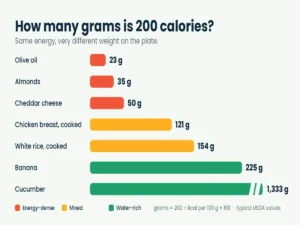
A gram of food is not a gram of nutrient. This is where most calories to grams confusion actually comes from, so it’s worth sitting with for a second.
Whole foods aren’t pure anything. Chicken isn’t pure protein. Rice isn’t pure carbs. They’re mixtures of water, fiber, minerals, and macronutrients all mixed in together.
That mixture is what decides how many grams of a food you actually get for a given calorie count, and it’s why a simple calories to grams calculator built for macros can’t answer a question about an actual meal.
Quick test. Protein has 4 calories per gram. So why doesn’t 100 grams of chicken breast hit 400 calories? Water. Chicken is mostly water by weight. The protein is just part of what’s there. The same logic applies to almost every whole food you eat.
Here’s what 100 calories actually looks like across different foods:
| Food | Approx. grams for 100 calories |
|---|---|
| Olive oil (nearly pure fat) | ~11 g |
| Sugar (pure carbohydrate) | ~25 g |
| Cooked chicken breast | ~60 g |
| Cooked rice | ~75 g |
| Cucumber (mostly water) | ~650 g |
Eleven grams of olive oil. Six hundred and fifty grams of cucumber. Same 100 calories. That gap tells you everything about why calories to grams isn’t a fixed ratio once real food is involved.
Fat packs a lot of energy into very little weight. Water does the opposite. It’s why a small handful of nuts and a huge bowl of cucumber can land at roughly the same calorie count, even though one fits in your palm and the other barely fits in a bowl.
It’s also worth remembering that cooking method changes this further. Grilling, boiling, and frying all change a food’s water content, which shifts its weight without changing its calorie count much at all.
So the calories-to-grams ratio for raw chicken and pan-fried chicken in oil won’t be identical, even though it’s “the same food.”
Trying to hit a protein target without blowing your calories? Fit4rever’s protein intake calculator helps you figure out exactly how many grams you need, so you’re not guessing at the table.
Way 4: Convert a calorie deficit into grams of fat
[Image: calorie-deficit-grams-of-fat.png — alt: “Converting a calorie deficit into grams of body fat lost”]
This is probably the real reason a lot of people land on the search term “calories to grams” in the first place. Not a label question. A weight loss one. If I cut 500 calories a day, how much fat am I actually losing, in grams, on the scale?
You’ve probably heard that 3,500 calories equals a pound of fat. That rule assumes pure fat sits at 9 calories per gram and works backward from there.
Not a bad starting point, but it slightly oversells the number. Body fat isn’t pure fat in a lab-sample sense. It holds water and cell structure too.
A more realistic figure lands closer to 7,700 calories per kilogram, which, funny enough, ends up pretty close to the old 3,500-calorie rule anyway once you do the unit conversion.
So. A 500-calorie daily deficit adds up to 3,500 over a week. Run that through 7,700 calories per kilogram, and you get roughly 450 grams of fat lost per week. That’s the calories to grams conversion nobody explains clearly, and it’s arguably more useful than any macro calculator for someone focused purely on weight loss.
Some honest caveats before you build your whole plan around that number:
It’s an estimate. Metabolism, sleep, stress, hormones- all of it nudges the real figure up or down from one person to the next.
Water weight swings by hundreds of grams day to day. It can hide fat loss or make it look faster than it really is, especially in the first couple of weeks of a new routine.
None of this replaces a doctor or a dietitian, especially if you’re managing a health condition or have a more complicated relationship with weight and food.
Haven’t figured out your deficit yet? Fit4rever’s calorie deficit calculator walks you through setting one up in a way you can actually stick with, and the body fat calculator tracks real progress better than the scale alone, since it accounts for water weight fluctuations the scale can’t.
Way 5: Use a calculator and read labels correctly
[Interactive tool placement: embed your calories → grams calculator here, defaulting to the calories-to-grams direction with a toggle for the reverse. Include protein/carbs/fat/alcohol inputs. Also link fit4rever’s TDEE calculator here.]
Doing this math by hand every day gets old fast. A good calories to grams calculator handles it instantly. But it helps to know why your own numbers might not match the label exactly, so you’re not left thinking you messed something up when you didn’t.
A few reasons things drift apart.
Rounding happens at more than one step. Manufacturers start with precise numbers, then round the grams and the calorie total separately, under FDA labeling regulations. By the time you’re multiplying the rounded label numbers back together, you’re not working with the original figures anymore, so a small gap is expected rather than a sign of a mistake.
Fiber doesn’t always follow the 4-calorie rule. That same FDA regulation allows lower values for certain fibers. Some soluble types land around 2 calories per gram. Some insoluble ones count as essentially zero. Multiply a high-fiber food’s total carbs by 4 across the board, and you’ll overshoot the real number.
Sugar alcohols play by their own rules too. Erythritol, xylitol, maltitol- none of them count the same as regular sugar. FDA figures range from 0 calories per gram up to around 3, depending on which one. This is exactly why “keto-friendly” labels sometimes look like the calories to grams math doesn’t add up, even when it’s printed correctly.
And some ingredients get even more specific treatment than the general 4-4-9-7 system allows for, based on the National Academies’ Dietary Reference Intakes for Energy, which define energy contribution more precisely for certain nutrients.
A gap of a few calories between your math and the label is normal. Don’t stress over it. A bigger gap is worth double-checking against serving size, or whether you’re comparing the food raw versus cooked. Cooking changes weight through water loss, and that alone throws off any calories-to-grams comparison if you’re not accounting for it.
One more thing while we’re here. “Calorie” with a capital C, the kind on food labels, is the same thing as a kilocalorie. A 200-calorie snack and a 200 kcal snack are identical.
Different notation, same amount. This has nothing to do with that mass-energy thing from earlier. Different topic entirely, and not something you need to factor into any calories-to-grams calculation you do at home.
Frequently asked questions
How many grams is 100 calories?
Depends on the source. Pure protein, about 25 grams. Carbs: also 25 grams. Fat: closer to 11.1 grams. Alcohol, around 14.3 grams. For whole foods, it swings a lot more, anywhere from 11 grams (olive oil) to over 600 grams (cucumber), depending on water and fat content.
How do I convert calories to grams of protein?
Divide by 4. 100 calories from protein comes out to 25 grams.
How do I convert calories to grams of fat?
Divide by 9. 180 calories from fat comes out to 20 grams.
Is there one calories to grams converter that works for everything?
No, and that’s really the point of this whole guide. A macronutrient calculator built on 4-4-9-7 won’t tell you a food’s total weight. A food-weight tool won’t tell you your macro split. Different jobs, same search term.
How many grams of fat is a 500-calorie deficit?
Roughly 450 grams a week, using the ~7,700 calories per kilogram figure. Still an estimate. Results vary person to person.
Are kcal and Calories the same thing?
Yes. One capital-C Calorie equals one kilocalorie.
Why doesn’t my calculated total match the nutrition label?
Usually rounding, fiber’s variable value, sugar alcohols, or a more specific energy factor the manufacturer used. A small mismatch is expected, not a mistake.
The bottom line
Five ways, one idea underneath all of them. Calories to grams only makes sense once you know what you’re actually converting.
Macros: use 4-4-9-7 and its reverse. Whole foods: think about water and fat content, not just label math. Fat loss: lean on the 7,700-calorie-per-kilogram figure instead of the oversimplified 9. And when in doubt, a calculator plus a bit of label literacy covers the rest.
Next time a nutrition label, or some confusing online converter, has you second-guessing your own calories-to-grams math, come back here and find the section that actually matches your question.
This article is for educational purposes and isn’t a substitute for personalized advice from a doctor or registered dietitian.
