
![Reverse BMI Calculator to Find Weight [Free Tool]](https://fit4rever.com/wp-content/uploads/2026/09/reverse_bmi_calculator_featured_image.webp)
I’ll be honest – most BMI tools annoyed me for years before I actually understood why. You type in your weight and height, get a number back, and… that’s it. Great, now what?
If your BMI comes out at 27 and you want to be at 23, good luck figuring out how many pounds that actually is without doing the math yourself.
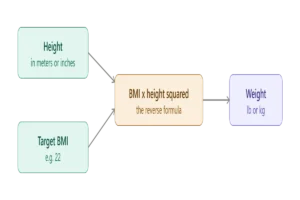
That’s the gap a reverse BMI calculator fills. Instead of weight and height going in and a BMI coming out, you flip it: put in your height and the BMI you’re aiming for, and it tells you the weight that gets you there.
Simple idea, but weirdly hard to find a version of it that also explains the math and doesn’t just spit out a number and move on.
So that’s what this page does. A working reverse BMI calculator to find weight for any height, the formula laid out so you can double-check it yourself, and – because I think this part gets skipped way too often – an honest look at when that target weight is actually worth trusting.
What Is a Reverse BMI Calculator?
Think of it as the standard BMI calculator running backward. A normal one asks, “given my weight and height, what’s my BMI?” This one asks the opposite question: “given my height and a BMI I want to hit, what should I weigh?”
| Standard BMI Calculator | Reverse BMI Calculator | |
|---|---|---|
| You enter | Weight + Height | Target BMI + Height |
| It gives you | Your current BMI | The weight matching that BMI |
| Good for | Checking where you stand now | Setting an actual number to aim for |
If you haven’t checked your current BMI yet, do that first with our BMI Calculator – then come back here once you’ve got a target in mind and want to know what it means in pounds or kilos.
Reverse BMI Calculator to Find Weight
Height: [enter in feet/inches or cm] Target BMI: [enter an exact number, or pick a category – Underweight, Healthy, Overweight, Obese]
You’ll get back:
- Your target weight in pounds and kilograms
- Which BMI category that number falls into
- A quick reminder that this is a general estimate, not a personal prescription
(Interactive calculator widget goes here.)
The Formula, in Case You Want to Check It Yourself
You genuinely don’t need a reverse BMI calculator for this – it’s simple enough for your phone’s calculator app, and it takes about ten seconds.
Metric: Weight (kg) = BMI × Height (m)²
Imperial: Weight (lb) = BMI × Height (in)² ÷ 703
Both formulas trace back to the same idea – weight divided by height squared – that Adolphe Quetelet worked out in the 1800s and Ancel Keys later standardized into what we now call BMI. We’re just solving it for weight instead of BMI.
Let’s actually do one. Say you’re 5’6″ and want a BMI of 22.
- Height in inches: 5’6″ = 66 inches
- Square that: 66 × 66 = 4,356
- Multiply by your target BMI: 4,356 × 22 = 95,832
- Divide by 703: 95,832 ÷ 703 ≈ 136.3 lb
So at 5’6″, BMI 22 lands you around 136 pounds. Not bad for napkin math.
And in metric, because plenty of readers here aren’t using pounds. Say you’re 170cm and want a BMI of 23.
- Height in meters: 170cm = 1.70m
- Squared: 1.70 × 1.70 = 2.89
- Times 23: 2.89 × 23 = 66.5 kg
That’s it. Two steps, no app required.
Target Weight by Height – the Full Chart
If math isn’t your thing today, fair enough – think of this as a reverse BMI calculator to find weight that you can scan instead of typing in. It covers common heights against several BMI targets, rounded to the nearest whole number.
| Height | BMI 18.5 | BMI 20 | BMI 22 | BMI 24 | BMI 25 | BMI 30 |
|---|---|---|---|---|---|---|
| 4’10” (147 cm) | 88 lb / 40 kg | 96 lb / 43 kg | 105 lb / 48 kg | 115 lb / 52 kg | 120 lb / 54 kg | 144 lb / 65 kg |
| 5’0″ (152 cm) | 95 lb / 43 kg | 102 lb / 46 kg | 113 lb / 51 kg | 123 lb / 56 kg | 128 lb / 58 kg | 154 lb / 70 kg |
| 5’2″ (157 cm) | 101 lb / 46 kg | 109 lb / 50 kg | 120 lb / 55 kg | 131 lb / 60 kg | 137 lb / 62 kg | 164 lb / 75 kg |
| 5’4″ (163 cm) | 108 lb / 49 kg | 117 lb / 53 kg | 128 lb / 58 kg | 140 lb / 63 kg | 146 lb / 66 kg | 175 lb / 79 kg |
| 5’6″ (168 cm) | 115 lb / 52 kg | 124 lb / 56 kg | 136 lb / 62 kg | 149 lb / 68 kg | 155 lb / 70 kg | 186 lb / 84 kg |
| 5’8″ (173 cm) | 122 lb / 55 kg | 131 lb / 60 kg | 145 lb / 66 kg | 158 lb / 72 kg | 164 lb / 74 kg | 197 lb / 89 kg |
| 5’10” (178 cm) | 129 lb / 58 kg | 139 lb / 63 kg | 153 lb / 70 kg | 167 lb / 76 kg | 174 lb / 79 kg | 209 lb / 95 kg |
| 6’0″ (183 cm) | 136 lb / 62 kg | 147 lb / 67 kg | 162 lb / 73 kg | 177 lb / 80 kg | 184 lb / 84 kg | 221 lb / 100 kg |
| 6’2″ (188 cm) | 144 lb / 65 kg | 156 lb / 71 kg | 171 lb / 78 kg | 187 lb / 85 kg | 195 lb / 88 kg | 234 lb / 106 kg |
| 6’4″ (193 cm) | 152 lb / 69 kg | 164 lb / 75 kg | 181 lb / 82 kg | 197 lb / 89 kg | 205 lb / 93 kg | 247 lb / 112 kg |
| 6’6″ (198 cm) | 160 lb / 73 kg | 173 lb / 78 kg | 190 lb / 86 kg | 207 lb / 94 kg | 216 lb / 98 kg | 260 lb / 118 kg |
Find your row, read across to your target BMI, and that’s the number a reverse BMI calculator would hand you anyway – just without the typing.
So What’s Actually “Healthy” Here?
For most adults, the range doctors and researchers point to is 18.5 to 24.9. That comes from the CDC, and it’s the range you’ll see repeated almost everywhere.
| BMI Range | Category | Good goal? |
|---|---|---|
| Below 18.5 | Underweight | Not really — talk to a doctor first |
| 18.5–24.9 | Healthy | Yes, this is the general target range |
| 25.0–29.9 | Overweight | Fine as a short-term milestone |
| 30.0 and up | Obese | Better approached gradually than all at once |
Quick note if you’re reading this from outside the US or Europe: the WHO actually recommends a lower cutoff for Asian populations – BMI 23 instead of 25 for “overweight.” Several countries in South and Southeast Asia have adopted this because the research shows real health risk shows up at lower BMI numbers in these populations.
If your national health guidelines use a different cutoff than what’s above, trust those over this general chart – they’re built specifically for your context.
Why the Number You Get Might Not Be the Right One For You
Here’s what almost nobody mentions on these calculator pages, and it bugs me a little. You punch a BMI into a reverse BMI calculator, get a weight back, and it’s presented like gospel. It isn’t. A few things can throw the whole thing off.
Muscle. BMI has no way to tell fat from muscle – it’s just weight over height, period. If you lift weights regularly, that “healthy” target might actually sit below where you’d need to be to keep your muscle.
A 5’10” guy who lifts and weighs 200 lb could have a BMI over 28, which reads as “overweight” on paper while he’s walking around with a fairly low body fat percentage.
Age. As people get older, muscle tends to drop off even when the number on the scale barely moves. Because of this, some researchers argue for a slightly higher healthy range in older adults – something like 21 to 27 – since a bit of extra weight seems to help with strength and resilience later in life.
Where you’re from. Already touched on this above, but worth repeating: the standard 18.5–24.9 range came largely from research done on European populations. It doesn’t map perfectly onto everyone, which is exactly why the WHO has a separate guideline for Asian populations.
Your frame. Bigger bone structure, broader shoulders, naturally stockier build – none of that shows up in a BMI number, but it absolutely affects what a “normal” weight looks like on you specifically.
Pregnancy, growing teens, certain medical conditions. This whole approach just doesn’t apply here. If any of these describe you, treat the number as background information only and loop in a doctor.
None of that makes the number useless, to be clear. It just means treating it as a starting point rather than a verdict. NIH’s guidance on weight management backs this up too – the actual research points toward gradual, sustainable change mattering more than hitting an exact figure.
Okay, But How Long Will This Actually Take?
Fair question, and one most reverse BMI calculator pages never answer. Once you know your target weight, the obvious next thing you want to know is a timeframe.
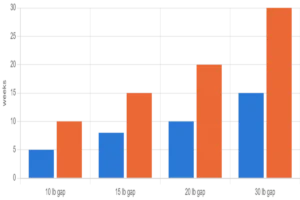
A pace that’s generally considered safe is around 1–2 lb (0.5–1 kg) a week for losing weight. Gaining weight in a way that’s mostly muscle rather than fat tends to move slower – closer to 0.5–1 lb (0.25–0.5 kg) a week.
Let’s put a number on it. If your reverse BMI target sits 15 lb below where you are now, you’re looking at roughly 8 to 15 weeks – two to four months, give or take. A 30 lb gap stretches that out to four to seven months.
If you want to work out the actual calories behind that, our Calorie Deficit Calculator turns your target weight into a daily number, and the TDEE Calculator is the starting point for figuring out your baseline energy needs.
A Few Other Ways to Sanity-Check Your Goal Weight
BMI is popular because it’s so simple – just height and weight, nothing else required. That’s also the tradeoff with any reverse BMI calculator: simple math, incomplete picture.
If you want a fuller picture of whether your target weight actually makes sense for your body, a couple of other measurements are worth pairing it with.
Body fat percentage tells you what portion of your weight is actually fat, which BMI can’t do at all. Our Body Fat Calculator is a decent starting point.
Waist-to-height ratio is another one worth knowing – it’s a pretty strong signal for abdominal fat specifically, and abdominal fat correlates more closely with cardiovascular risk than total body weight does.
Lean body mass separates muscle, bone, and organ weight from fat entirely, which matters a lot if you’re strength training and the scale isn’t telling the whole story.
And if BMI just isn’t clicking for you as a framework, the Ideal Weight Calculator uses four different clinical formulas (Devine, Robinson, Miller, Hamwi) instead – worth trying if you want a second opinion on the number.
Questions People Actually Ask
Should I aim for the low end of the range, like 18.5?
Probably not, unless there’s a specific reason to. The bottom of the healthy range is still healthy for a lot of people, but if you’re already close to it, going lower doesn’t buy you anything and can tip into underweight territory.
What’s a healthy BMI once you’re past 50?
Somewhere around 21 to 27 tends to come up in the research as more appropriate for older adults – the logic being that a little extra weight helps preserve strength as you age. Still varies a lot by individual health, so this is a good one to actually ask a doctor about rather than assume.
Does this work for teenagers?
No, and this is important – BMI for anyone under 20 gets measured against age and sex percentiles, not these fixed adult categories. Running a teenager’s numbers through a reverse BMI calculator built for adults will give you a misleading answer.
How reliable is a reverse BMI calculator for me?
The math itself holds up regardless of height. Where it gets shakier is that BMI as a concept was validated mostly on people closer to average height, so at the extremes the resulting weight can feel a bit off intuitively. Treat it as a rough estimate rather than something precise.
What if my target weight seems way off – too high, too low?
Trust that feeling, honestly. Especially if you’re very muscular, very lean, older, or dealing with a health condition. That’s exactly the situation where a quick conversation with a doctor or dietitian beats guessing.
Is BMI calculated differently for men vs. women?
Same formula, same categories for both. The difference is in how you should read it – women naturally carry more body fat than men at an identical BMI, which is one more reason to pair this number with something like body fat percentage rather than relying on BMI alone.
The Short Version
- A reverse BMI calculator to find weight just runs the normal formula backward – height and a target BMI go in, and an actual weight comes out.
- You can do the math yourself: Weight (kg) = BMI × Height (m)², or Weight (lb) = BMI × Height (in)² ÷ 703.
- The number is a general estimate, not a diagnosis. Muscle, age, ethnicity, and body frame can all shift what’s genuinely healthy for you.
- Pair your target with a realistic timeline and, ideally, a second measurement like body fat percentage before treating it as a fixed goal.
This article is for educational purposes and isn’t a substitute for personalized medical advice. If you’re using a reverse BMI calculator to find weight for yourself, treat the number as a starting point – talk to a doctor or registered dietitian about your specific situation.
Sources: CDC – Adult BMI Categories · WHO Expert Consultation – Appropriate BMI for Asian Populations · Keys et al., 1972 – Indices of Relative Weight and Obesity · NIDDK – Choosing a Safe and Successful Weight-Loss Program
